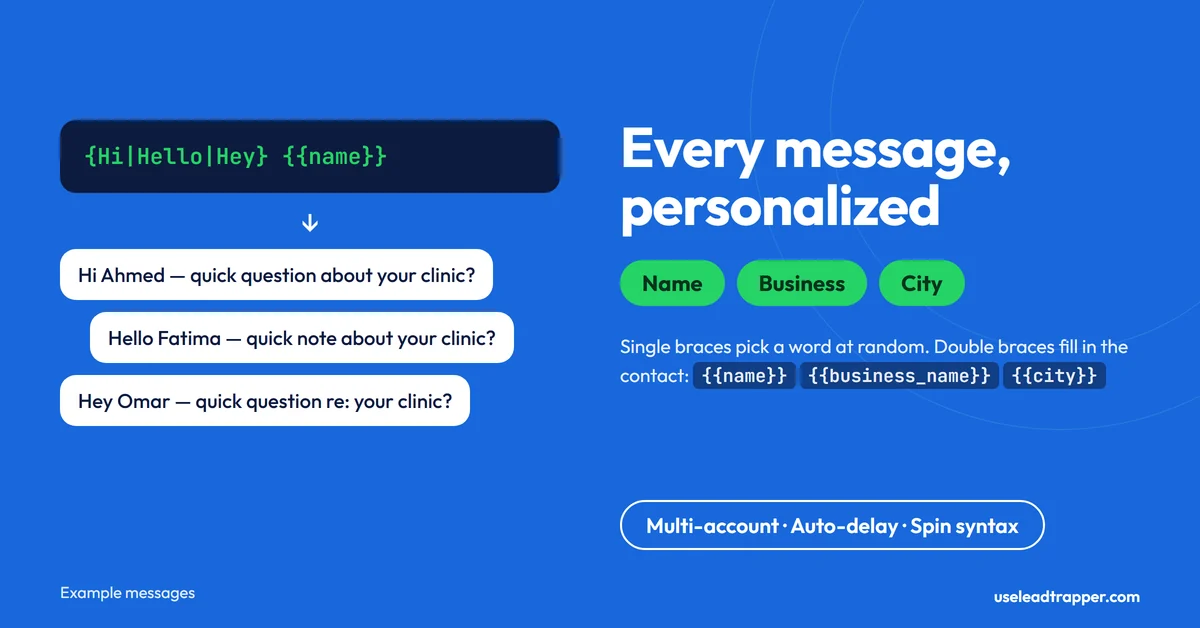
Write a short message with a first line specific to the recipient, personalise it with tokens such as name and city, and send it when the business is open. WhatsApp marketing fits offers people recognise quickly, not long, slow sales.
- A WhatsApp message that reads like a form letter is easy to ignore even when it is seen. The template structure matters as much as delivery.
- Personalization tokens (name, business, city, category) turn one template into a message that reads as written specifically for that contact.
- The first line decides whether the rest gets read — lead with something specific to the recipient, not a greeting.
- Campaign timing changes reply rates more than most people expect: a message sent when a business is open gets answered by a person, not ignored until later.
- This channel is not for every business — it fits outreach to people who will recognize the value fast, not a slow-consideration sale.
Why the Template Matters as Much as the Send
People often quote a 98% open rate for WhatsApp, but that figure has no clear public source, and it answers the wrong question anyway. Open rate would tell you a message was seen. It says nothing about whether it was read past the first line or answered at all.
Being read is not the same as getting a reply, and the gap is mostly decided by what the message says. A message that says nothing about the recipient, such as “Hi, we have great listings, contact us!”, is easy to ignore. A message written for that specific business, such as “Hi {{name}}, I saw {{business_name}} is listed in {{city}}. Are you looking for buyer leads this month?”, shows it was written with them in mind before they decide whether to keep reading. No figure here is a measured result; it is the reasoning behind personalizing.
Personalization Tokens That Actually Work
LeadTrapper’s template editor accepts tokens like {{name}}, {{business_name}}, and {{city}}, pulled directly from the lead record your Google Maps, Instagram, or Facebook scrape produced. Write the template once and every contact receives a version filled in with their own details.
Two or three tokens is the practical limit. A template stacking five or six variables starts to read exactly like what it is — a mail-merge — because natural sentences do not usually pack that much specific detail into one line. The tokens worth using, in order of impact:
The contact’s name. The single highest-impact token. A message addressed to a person by name is processed differently than one addressed to nobody.
The business name. Proves the message is about them specifically, not a template blasted at a category.
One detail visible on their listing. Category, rating, or area. This is the token most templates skip, and it is the one that does the most work — it signals the sender actually looked at the business before writing, rather than pulling a name from a list.
The First Line Decides Everything
WhatsApp shows the first line of a message in the notification preview, before the recipient opens the conversation. That line is doing the job a subject line does in email — except here, the entire decision to read further happens in the time it takes to glance at a lock screen.
| ❌ Generic opener | ✅ Specific opener |
| "Hello! Hope you're doing well. We wanted to reach out..." | "Hi {{name}}, I came across {{business_name}} on Google Maps — saw you've got a 4.6 rating with 200+ reviews." |
| "We offer great services for businesses like yours." | "Most {{category}} businesses in {{city}} lose 2-3 hours a week on [specific task] — here's how we cut that." |
| Reads as sent to a list | Reads as written after looking at this one business |
The second column is not longer or more clever — it is more specific. Specificity is the entire mechanism. A generic compliment (“great business!”) is worthless because it could be sent to anyone. A specific, checkable detail (a rating, a review count, a category) is worth something because it could only have come from actually looking.
Timing a Campaign for Replies
The same message sent at different times produces different reply rates, and the difference is large enough to matter.
A campaign to business contacts released at 11pm sits unread — or worse, read and forgotten — until the recipient checks their phone the next morning, by which point the message has lost whatever urgency it had. The same campaign released at 10am, mid-morning after most businesses have opened and settled into the day, reaches someone actively working and checking WhatsApp between tasks.
For consumer-facing campaigns — a restaurant promotion, a retail offer — timing shifts toward when people are deciding what to do next: late morning before lunch, or late afternoon before evening plans.
Who This Channel Actually Fits
WhatsApp marketing is not the right channel for everything, and pretending otherwise wastes a campaign on the wrong audience.
It fits well: offers with obvious, fast-to-grasp value — a lower price than what the recipient currently pays, a service that solves a problem they clearly have (visible from their business category or listing), a local or time-limited offer. A property agent reaching landlords about buyer demand, a supplier undercutting a recipient’s current vendor, a clinic reminding patients about an appointment — all understood in one message, no explanation required.
It fits poorly: anything needing a long, considered decision — enterprise software with a multi-stakeholder buying process, a high-value service that genuinely needs a call to explain properly. A cold WhatsApp message trying to open that kind of sale reads as pushy rather than helpful, because the format itself signals “quick and simple,” and a complex pitch fighting that format loses either way.
Know which one your offer is before writing the campaign. The template techniques above make a good-fit message convert better. They do not make a poor-fit message work.
Template and Personalization Tools Compared
Sending capability is table stakes at this point — most tools can deliver a message. What differs is whether the template system supports doing this well.
| Feature | WATI | AiSensy | Brevo | LeadTrapper |
|---|---|---|---|---|
| Personalization tokens | Yes | Yes | Yes | Yes |
| Multiple templates rotating per campaign | Template library, manual selection | Limited | No | Yes, automatic rotation |
| Pulls contact data directly from a lead source | No — import only | No — import only | No — import only | Yes — from Maps, Instagram, Facebook scrapes |
| Requires WhatsApp Business API | Yes | Yes | Yes | No |
| Cost | $39–$229/mo | Free tier, then $45–$99/mo | $65/mo | $50/year |
The meaningful difference is the third row. On the API platforms, personalization tokens are only as good as the CSV you import — someone still has to go find the business name, category, and rating and put them in a spreadsheet first. LeadTrapper’s tokens are populated directly from the scraper’s own output, so the same search that finds the lead also fills in the template.
The “Requires WhatsApp Business API” row matters more than it looks. Meta’s own template documentation requires every template on those platforms to go through approval before it can be sent outside an active customer conversation — a real review step, on top of building the personalization logic itself. LeadTrapper sends from a connected personal or business WhatsApp account instead, so a new template is ready the moment it’s written.
For the mechanics of sending at volume without triggering a block, see the WhatsApp bulk sender guide. For the platform rules that decide who can be messaged at all, see what Meta actually allows.
Frequently Asked Questions
Specificity in the first line. A message that opens with the recipient's business name and something concrete about them (their category, their rating, their location) reads as researched. A generic greeting followed by a pitch reads as a mass message, even if it technically was personalized, because nothing in the first sentence proves it.
Two or three is usually enough: the contact's name, their business name, and one detail specific to them — city, category, or something visible on their listing. Beyond that, templates get long and start reading like a mail-merge rather than a message.
During the recipient's normal business hours, not evenings or early morning. A message to a business contact sent at 11pm sits unread until the owner checks their phone the next morning, by which point urgency is gone. Messages sent between 9am and 6pm local time reach someone actively working and checking WhatsApp.
No. It fits products and services where the value is obvious within a short message — a lower price, a faster service, a specific local offer. It fits poorly for anything requiring a long, considered sales process, where a cold WhatsApp message reads as pushy rather than helpful. Know which one you are before building a campaign.
Yes. You can create several distinct templates — different tone, different opening, different call to action — and rotate them across your contact list, so the campaign is not one message repeated at scale but several genuinely different approaches running in parallel.
About LeadTrapper
LeadTrapper is a Windows app for finding business leads and contacting them on WhatsApp. It collects business contacts from Google Maps, Instagram, Facebook, TikTok and LinkedIn, checks which numbers are on WhatsApp with its Number Filter, and sends personalised campaigns with automatic delays from one or more WhatsApp accounts. It also has a chatbot, a shared inbox for every account, and Store Orders for online shops. The full app is free for 14 days, then $50 a year. Free web tools, browser extensions and a Wix app are listed on the Free Tools page.
Write Campaigns That Get Replies, Not Ignored
LeadTrapper's template editor supports personalization tokens and multiple rotating templates per campaign. $50/year — all features included.
Related Articles
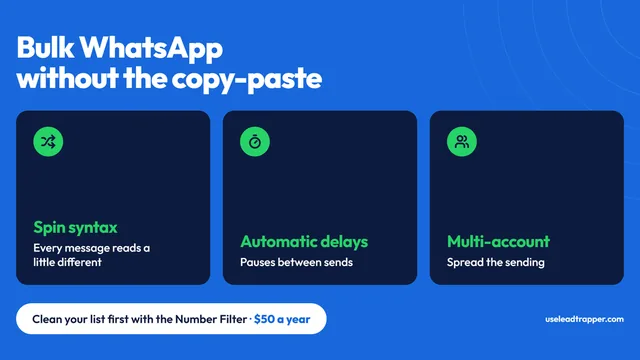
WhatsApp Bulk Sender: 1,000+ Messages Without Ban
WhatsApp bulk sender software sends personalized messages to a contact list without the API or month…
Read article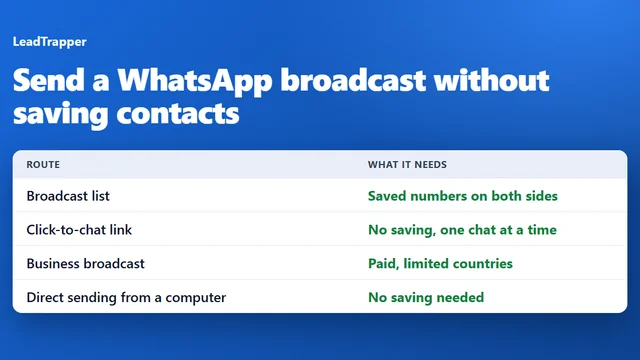
Send a WhatsApp Broadcast Without Saving Contacts
Can you send a WhatsApp broadcast without saving contacts? Not with a broadcast list. Four routes th…
Read article