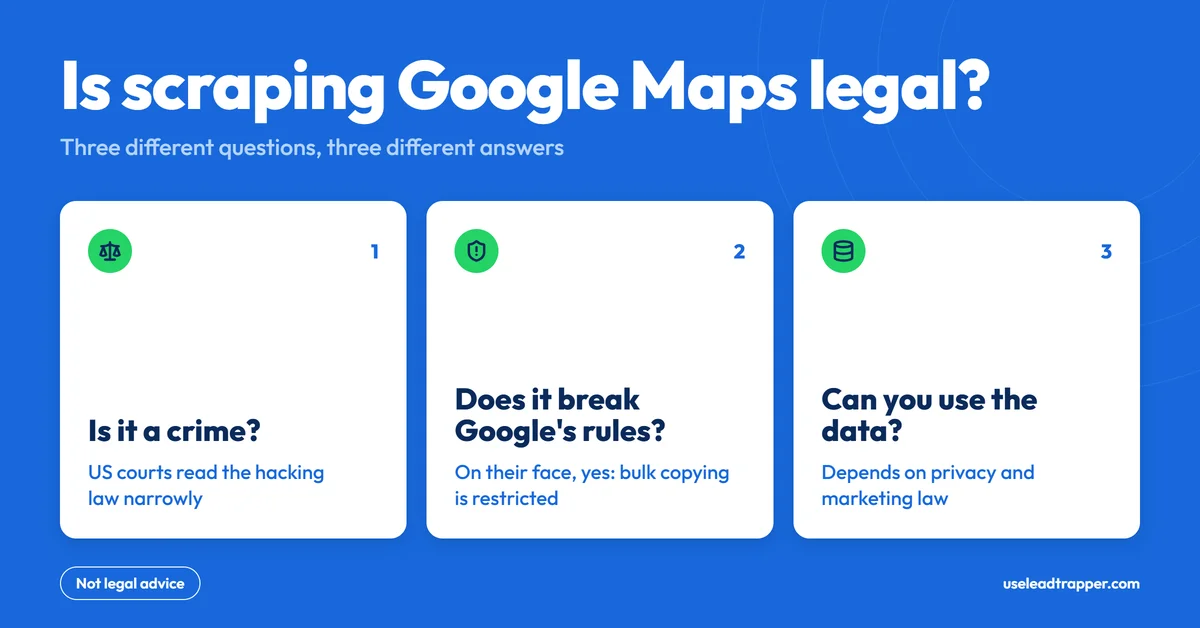
- There are three separate questions: whether it's a crime, whether it breaks Google's rules, and whether you can lawfully use the data. They don't have the same answer.
- In the US, the leading appeals court ruling (hiQ v. LinkedIn, 2022) found that automated collection from public pages that need no account is unlikely to breach the main anti-hacking law.
- Google's own Maps terms restrict copying and mass downloading of Maps content, so a scraper breaks Google's rules on their face, whatever the law says.
- Privacy and marketing law can still apply to the list you build, especially where a listing is a sole trader's name and number.
- LeadTrapper's Maps scraper runs on your computer without signing in to Google. That doesn't put it inside Google's terms, so the risk is yours. This isn't legal advice.
Whether scraping Google Maps is legal has no single answer, because it’s three questions with three different answers. In the US, leading court rulings say reading public web pages isn’t hacking. Google’s own terms still restrict copying and mass downloading Maps content. And privacy law can apply to the list you end up with. This guide sets out what each says, with sources, and what it means for a lead-generation tool like LeadTrapper’s Google Maps scraper. It isn’t legal advice, and if a lot depends on the answer, ask a lawyer in your country.
Three Different Questions
| Question | What decides it | Where it stands |
|---|---|---|
| Is it a crime? | Anti-hacking law, mainly the US Computer Fraud and Abuse Act (CFAA) | US courts have read it narrowly for public pages that need no account |
| Does it break Google’s rules? | Google’s terms | On their face, yes: they restrict copying and mass downloading of Maps content |
| Can you lawfully use the data? | Privacy, data protection and marketing law in your country | Depends on who the data is about and how you use it |
Most articles on this topic answer one of the three and let you assume it covers the others. It doesn’t.
What Courts Have Said
The leading US case is hiQ Labs v. LinkedIn. In April 2022 the Ninth Circuit, applying the Supreme Court’s narrow reading of the CFAA in Van Buren v. United States, held that automated collection from public pages that need no account was unlikely to be access “without authorization” under the CFAA.
That wasn’t the end of it. In November 2022 the district court ruled that LinkedIn’s user-agreement ban on scraping was enforceable as a matter of contract, and in December 2022 hiQ agreed to a permanent injunction, deletion of the scraped data and $500,000 in damages. Winning on hacking law didn’t stop the contract claim.
In January 2024 a federal court ruled in Meta v. Bright Data that Meta’s terms didn’t stop a company scraping public data while logged out, and Meta dropped the case a month later. The key fact was being logged out: the court reasoned that a logged-out scraper wasn’t a user bound by the terms.
These are US rulings, at particular stages of particular cases, and other countries approach the question differently. They tell you the hacking-law risk is lower for public pages than many assume. They don’t tell you the contract, copyright or privacy risk is zero.
What Google's Terms Say
Google’s Maps and Earth Additional Terms say that compliance with their “Prohibited Conduct” section “is a condition of your license to use Google Maps.” Among other things, you may not “mass download or create bulk feeds of the content (or let anyone else do so)”, and you may not use Google Maps to create or augment a dataset, including a “business listings database, mailing list, or telemarketing list”, for use in a service that is a substitute for Google Maps. The second clause is aimed at competing services, and a private prospect list isn’t obviously one. The first isn’t qualified: a scraper that walks through hundreds of listings is bulk collection by design.
Two other Google documents come up. Google’s general Terms of Service prohibit using automated means to access content in violation of the machine-readable instructions on its pages, such as robots.txt. And the Google Maps Platform Terms, which bind API customers, include a “No Scraping” clause.
Google has also gone to court. In December 2025 it sued SerpApi, a search-scraping service, under the DMCA’s anti-circumvention provisions, alleging that SerpApi got around Google’s technical protections. That’s a different legal route from hacking law or contract, it concerns bypassing protections rather than merely reading public pages, and its outcome is unsettled, so check where it stands before relying on any of this.
Privacy and Marketing Law
A business listing is usually company information. But for a sole trader, a freelancer or a small clinic named after its owner, a name and phone number are personal data. In the EU and UK, the GDPR then requires a lawful basis to collect and use it, and marketing rules can require consent or an easy opt-out before you contact people. Other countries have their own anti-spam and data protection laws.
Contacting people on WhatsApp adds a platform layer. Messaging numbers that don’t want your messages is what gets accounts reported and restricted, which is why checking numbers before you send matters. Whatever the law says about collecting the data, this part is about how you use it.
What LeadTrapper's Maps Scraper Does
LeadTrapper’s scraper runs in a headless browser on your own computer and is not signed in to a Google account. You give it a keyword and a location, or paste a Google Maps link. It searches a grid of zones so it can go beyond the first screen of results, scrolls each result list until it ends, and opens each place to read the business name, phone number, website, address, rating and review count. The review count is a number, not the reviews’ text. Where a business publishes them on its own website, it also reads email addresses, social links and WhatsApp numbers. Services and prices are collected where the listing shows them.
Two things follow. Reading a listing without signing in is the situation the Bright Data ruling turned on, though that ruling was about Meta’s terms and not Google’s. And none of this makes automated collection permitted by Google’s Maps terms, which restrict mass downloading whether or not you’re signed in. LeadTrapper can’t grant Google’s permission, so the risk of using any Maps scraper is yours.
Ways to Lower the Risk
| Approach | Google’s terms | Trade-off |
|---|---|---|
| Google Places API | Official and permitted under the Maps Platform terms, which restrict how you store and reuse the data | Paid, priced by Google per request, so large lists cost more |
| OpenStreetMap data | Open licence under ODbL, with attribution required | Free, but business phone numbers and coverage vary widely by area |
| A scraper such as LeadTrapper | Restricted on their face | Fast, broad coverage; the terms risk is yours |
If you scrape, a few habits reduce the exposure. Keep to business information and leave out personal data you don’t need. Don’t resell or republish Maps data, because Google’s terms restrict redistribution. Contact only numbers you’ve checked are on WhatsApp, offer an easy way to opt out, and keep modest volumes. For a comparison of scraping tools on cost, see the Outscraper alternative breakdown, and LeadTrapper is $50 a year with all features included. Other platforms have their own rules: LinkedIn bans scraping outright, as does LinkedIn allow scraping sets out.
Frequently Asked Questions
It depends which law you mean. US courts have held that collecting data from public web pages isn't 'hacking' under the Computer Fraud and Abuse Act, but Google's Maps terms still restrict mass downloading and copying, and privacy law can apply to the data you collect. It isn't a simple yes or no, and this isn't legal advice.
Technically, yes. Tools open Google Maps in a browser, run a search and read each business listing. Whether you should is a separate question: Google's terms restrict it, Google can block automated access, and the page layout can change and break a scraper.
On their face, yes. Google's Maps terms say you may not mass download or create bulk feeds of the content, and that compliance is a condition of your licence to use Google Maps. Google's own Maps Platform terms, which apply to API customers, separately forbid scraping Maps content.
Not automatically. US courts have distinguished hacking law, contract law and copyright, and websites' own terms can still be enforced as contracts, as LinkedIn showed against hiQ. Rules differ by country, and personal data is covered by privacy law wherever it's collected.
Yes. Google's Places API is the official route. It's paid, priced by Google, and its terms restrict how you can store and reuse the data. For a large lead list it can cost more, which is why some people scrape instead.
Build a Google Maps Lead List, With Your Eyes Open
LeadTrapper's Google Maps scraper, Number Filter and WhatsApp sender all come with it. $50/year — all features included.
Related Articles
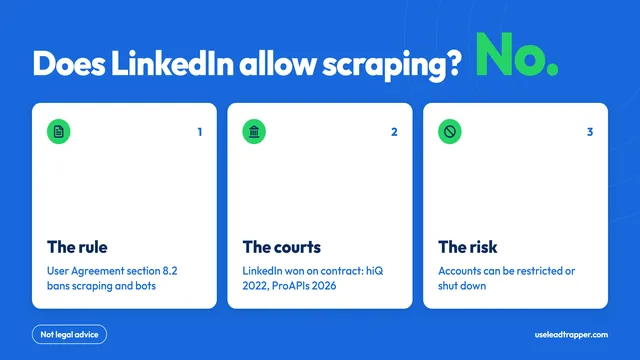
Does LinkedIn Allow Scraping? What Its Rules Say
No: LinkedIn's User Agreement bans scraping and bots. The rules, the court cases, what can happen to…
Read article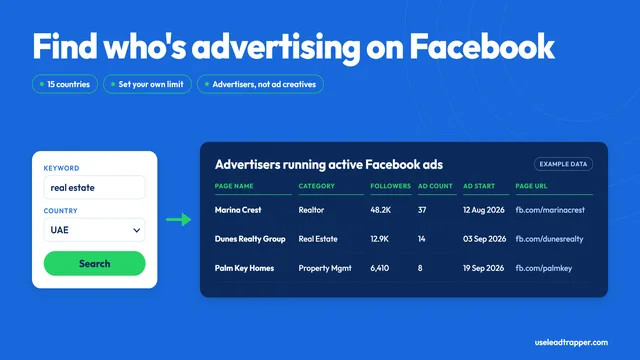
Facebook Ad Library Scraper: Find Advertisers by Keyword
LeadTrapper's Facebook Ad Library scraper lists businesses running active ads for a keyword and coun…
Read articleBrowse All Articles
Lead generation, WhatsApp marketing, Google Maps, Instagram, and Facebook scraping guides.
See all