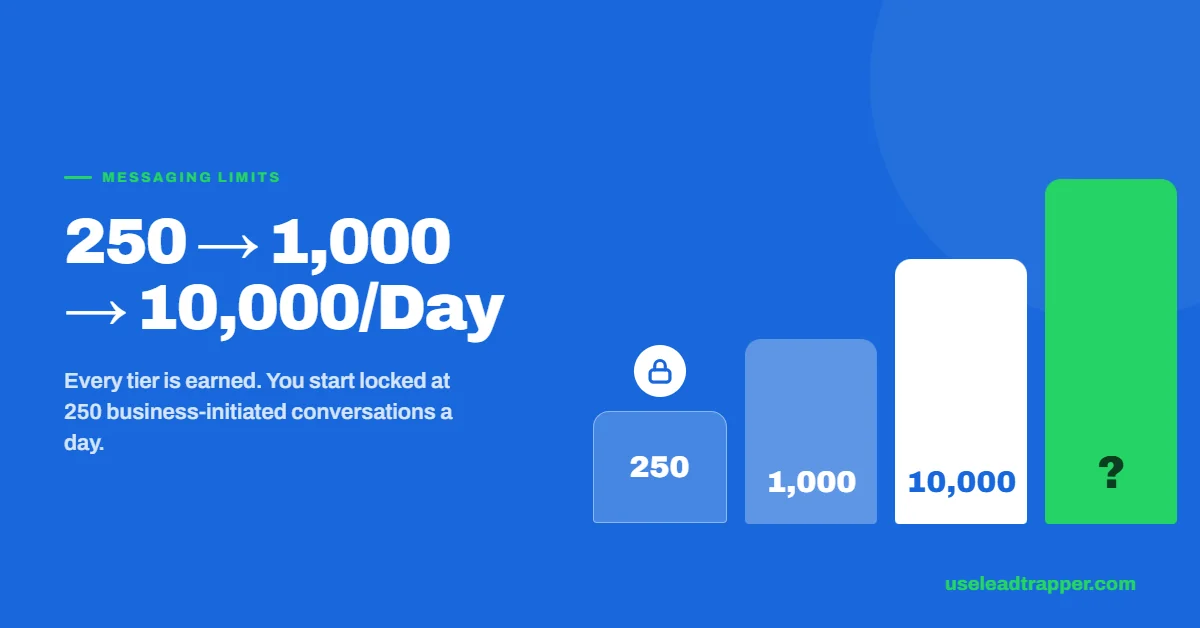
- New, unverified WhatsApp Business Accounts are capped at 250 messages to unique contacts per 24 hours. Business verification unlocks Tier 1 at 1,000/day.
- Advancing beyond Tier 1 requires using at least 50% of the current limit within a rolling 7-day window while holding a Green quality rating.
- Quality rating (Green, Yellow, Red) is driven by blocks, spam reports, and low engagement — a Red rating no longer demotes the account, it just freezes advancement.
- Meta re-evaluates tier eligibility every 6 hours, faster than the 24-48 hour cycle it used previously.
- LeadTrapper has no Meta-imposed tier to climb, but that isn't the same as an unlimited ceiling — the same block/report-rate risk still sets a practical safe volume per account.
A brand-new WhatsApp Business API account cannot send more than 250 messages to unique contacts a day — and that number only grows through weeks of Meta watching how recipients react. Here’s exactly how that system works.
This matters most at the planning stage, before a campaign is built rather than after it hits a wall. A business scoping out the API assuming it can reach a 5,000-contact list on day one discovers the actual constraint only once the integration is live and the daily cap turns out to be a fraction of that — by which point the business verification and template approval work is already done, and the tier ceiling is the one remaining variable nobody accounted for.
The Tier Ladder: 250 to 10,000+
Meta’s messaging limits apply to unique contacts reached outside a customer service window, within a rolling 24-hour period:
- Unverified account: 250 unique contacts/24h
- Tier 1 (after business verification): 1,000/24h
- Tier 2: 10,000/24h
- Tier 3: 100,000/24h
- Higher tiers exist beyond this, reached the same way — sustained volume and quality over time
Business verification is what unlocks the jump from 250 to 1,000. Every tier after that is earned, not granted.
It Caps Unique Contacts, Not Total Messages
The number that matters here is how many different people a business starts a conversation with in a rolling 24-hour window — not the total count of messages sent. A business at Tier 1 can message the same 1,000 people multiple times in a day without exceeding the limit, but can’t start a fresh conversation with a 1,001st person until the window rolls forward. This also means the limit only applies to business-initiated conversations: replying to a customer who messaged first, inside the free 24-hour service window, doesn’t count against the tier at all, regardless of how many of those replies go out.
This distinction changes how a campaign should actually be planned. A list of 1,000 leads at Tier 1 can each receive a full message sequence — an opener and one or two follow-ups — without touching the daily ceiling, since the limit was already spent on the first contact with each person, not on every message sent to them afterward. The bottleneck is reaching new people, not messaging the ones already reached.
Quality Rating: Green, Yellow, Red
Separately from the tier itself, every account carries a quality rating: Green (healthy), Yellow (warning), or Red (at risk) — driven by block rate, spam reports, and how recipients engage with messages. This is the mechanism that decides whether an account is trusted to handle more volume, independent of how long it’s been active.
The two signals measure different things and can move independently. A brand-new, low-tier account can hold a Green rating simply by sending carefully to a small, receptive list — tier and quality aren’t the same axis. Conversely, a high-tier account with a long track record can slip to Yellow or Red if a single campaign lands badly, regardless of how much volume it successfully handled before. Engagement is evaluated on an ongoing basis, not banked as a permanent credit from past good behavior.
How Tier Advancement Actually Works
Two conditions have to be true at once for an account to move up: it must use at least 50% of its current daily limit within a rolling 7-day window, and it must hold a Green rating during that time. Meta re-checks eligibility every 6 hours — a faster cycle than the 24–48 hour evaluation it used previously. In practice, an account sending consistently and maintaining a healthy rating typically progresses from Tier 1 to Tier 2 within one to four weeks.
Sitting well under the limit doesn’t help — advancement is tied to actually using a meaningful share of the current tier, not just avoiding problems. This creates a real, practical tension: an account trying to prove it deserves more volume has to actually send more volume first, which is also the exact behavior most likely to trigger complaints if the underlying list quality isn’t strong enough to support it.
What Happens at the Ceiling
A Red rating no longer demotes an account to a lower tier the way it once did — it simply freezes advancement. The account keeps its current limit but can’t move higher until the rating recovers. This is a real, documented change in how Meta enforces quality: falling behind holds you in place rather than pushing you backward, but it still caps how much volume the account can ever reach while the underlying engagement problem persists.
Recovering from Yellow or Red isn’t instant, and there’s no published fixed timeline — the rating reflects a rolling read of recent recipient behavior, so it improves as more recent messages land well, gradually diluting the effect of whatever caused the drop. The practical fix is the same regardless of tier: pause on the specific list or content that triggered the decline, since continuing to send at the same pattern only adds more negative signal into the same rolling window rather than letting it clear.
LeadTrapper Doesn't Have Tiers — But Volume Still Has a Real Limit
LeadTrapper doesn’t route through Meta’s Business Platform, so there’s no 250-to-10,000 ladder to climb and no weeks-long wait to reach higher volume. That’s a genuine, practical difference for a business that wants to send meaningfully on day one rather than earning its way there.
It isn’t the same as an unlimited ceiling, though. The channel LeadTrapper automates still enforces its own block-and-report-based limits — a safe practical volume is typically 300 to 500 messages a day per account, scaling with multiple connected accounts rather than a Meta-assigned tier. Different mechanism for arriving at a daily limit, not the absence of one.
For the cost side of climbing those tiers, see the real WhatsApp Business API pricing, or for why the API restricts who you can message in the first place, see why it blocks cold outreach. Not sure which tool fits your volume? Start here.
Frequently Asked Questions
It depends on your tier. Unverified accounts are capped at 250 unique contacts per 24 hours. Verified accounts start at 1,000/day (Tier 1) and can advance to 10,000+/day (Tier 2 and beyond) by maintaining consistent volume and a healthy quality rating over time.
A three-level status — Green (healthy), Yellow (warning), Red (at risk) — driven by how often recipients block or report messages and how they engage. It's tracked separately from the messaging tier but directly controls whether an account can advance to a higher tier.
Not automatically. A Red rating currently holds an account at its existing tier rather than demoting it or shutting it down outright — but it blocks any further advancement until the rating improves, and sustained poor quality is exactly the pattern that leads to account restrictions.
Meta evaluates tier advancement every 6 hours. To actually move up, an account needs to use at least 50% of its current daily limit within a rolling 7-day window while holding a Green rating — in practice, businesses with steady, well-received volume often progress from Tier 1 to Tier 2 within one to four weeks.
Not a Meta-imposed one, since it doesn't route through the Business Platform. That doesn't mean unlimited sending is safe — the same underlying WhatsApp block-and-report-rate enforcement still applies to the channel it automates, which is why a practical daily ceiling (typically 300 to 500 per account) still matters, just measured differently than a formal tier.
No Tier to Climb, No Waiting to Scale
LeadTrapper doesn't gate your sending volume behind a weeks-long tier progression. $50/year, all features included.
Related Articles
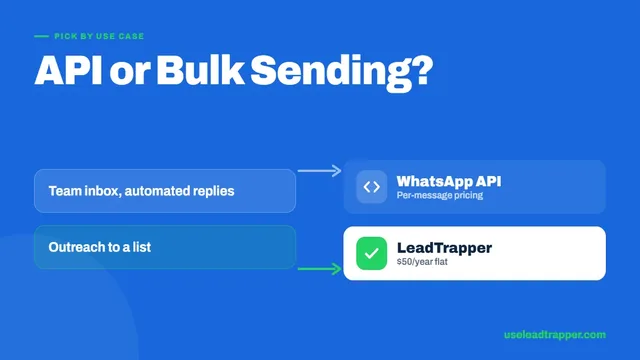
Do You Need the WhatsApp Business API, or Bulk Sending?
A real decision framework for the WhatsApp Business API versus bulk sending — by use case, team size…
Read article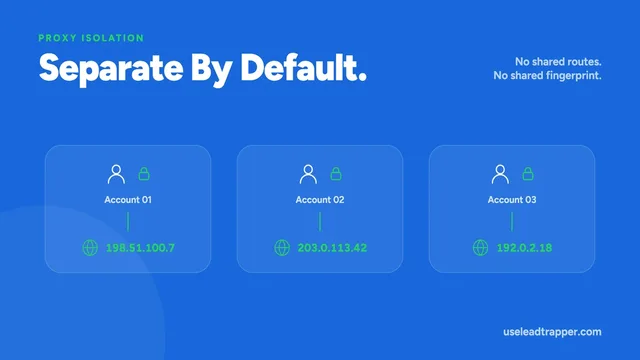
Running Multiple WhatsApp Numbers Without Overlap
Each WhatsApp account in LeadTrapper gets its own isolated browser session and proxy, so multiple nu…
Read articleBrowse All Articles
Lead generation, WhatsApp marketing, Google Maps, Instagram, and Facebook scraping guides.
See all