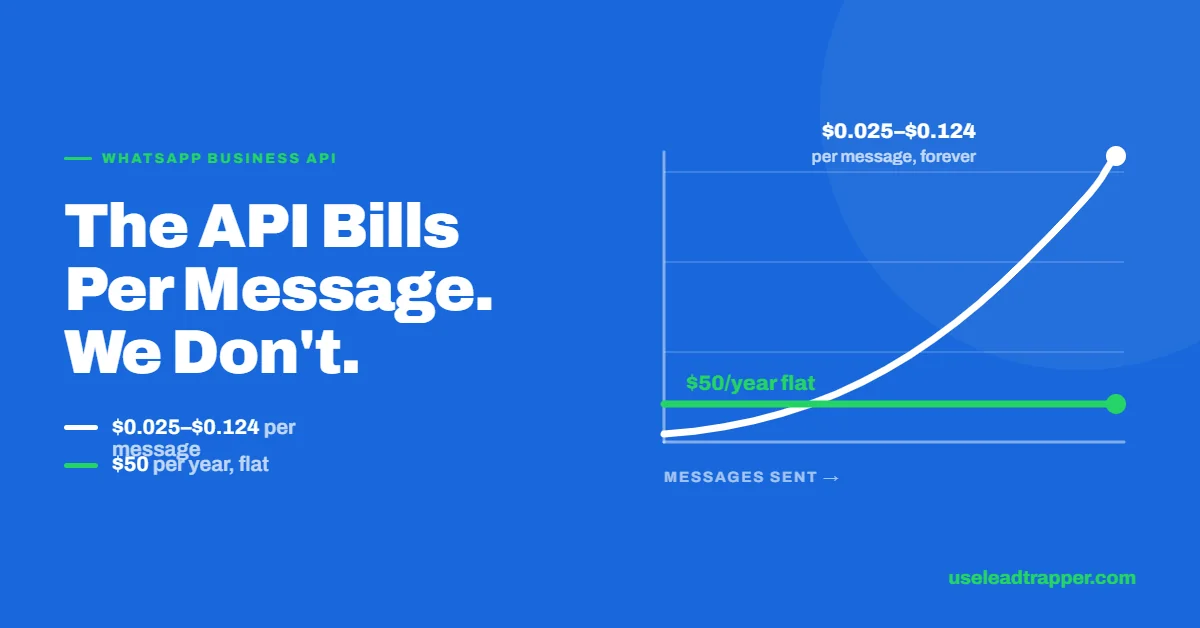
- Meta moved WhatsApp Business API billing to a per-message model on July 1, 2025 — the old per-24-hour-conversation fee no longer applies to business-initiated templates.
- Marketing message rates vary sharply by country: roughly $0.0094 in India versus over $0.124 in Germany, with the US around $0.025.
- A Business Solution Provider (BSP) subscription sits on top of Meta's own per-message fee — $39 to $229 a month depending on the provider, before a single message goes out.
- From October 1, 2026, Meta starts charging for service replies and utility messages inside the previously-free 24-hour customer service window too.
- LeadTrapper doesn't meter messages at all — the channel it automates was never billed per message, and its own fee is a flat $50/year regardless of volume.
$125 a month in per-message fees, before any subscription cost — that’s what 5,000 WhatsApp Business API messages actually costs at the U.S. marketing rate today, in September 2026. Most comparisons still quote the old flat monthly-plan framing. The real bill runs differently now, and it’s worth knowing exactly how before choosing a channel.
Meta Charges Per Message Now, Not Per Conversation
Until mid-2025, the WhatsApp Business API billed businesses per 24-hour conversation window — one fee covered every message exchanged with a contact during that window, however many were sent. Meta retired that model on July 1, 2025. Business-initiated template messages are now billed individually, per message delivered, priced by category (marketing, utility, or authentication) and the recipient’s country.
The practical effect: a business messaging the same contacts repeatedly, which is exactly what a bulk campaign does, now pays per send rather than once per window. Volume and cost scale together in a way the old model didn’t.
What This Actually Costs, By Country
Marketing message rates vary sharply by market:
| Country | Approx. rate per marketing message |
| India | ~$0.0094 |
| United States | ~$0.025 |
| Mexico | ~$0.0305 |
| United Kingdom | ~$0.048 |
| UAE | ~$0.0499 |
| Brazil | ~$0.0625 |
| Germany | ~$0.124+ |
A campaign reaching contacts across several of these markets pays a different rate for each one — there’s no single number that describes “the cost,” only a range that depends entirely on where the recipients are.
The category of message matters as much as the country. Meta’s per-template fees range from roughly $0.0014 to $0.0499 depending on both country and category — authentication messages (one-time codes, login verification) sit at the low end almost everywhere, utility messages (order updates, appointment reminders tied to an existing transaction) sit in the middle, and marketing messages consistently cost the most, since they carry the highest scrutiny under Meta’s opt-in policy. A business sending the same volume of messages can pay meaningfully different totals purely based on which category those messages fall into.
The BSP Subscription Sits on Top
Meta’s own per-message rate isn’t the whole bill. Businesses access the API through a Business Solution Provider — WATI, AiSensy, Freshchat, or Twilio are common choices — and that provider charges its own separate subscription:
- WATI: $39–$229/month depending on plan
- AiSensy: free tier available, then $45–$99/month
- Freshchat: $15–$69/month (the $39/month Pro tier is where WhatsApp integration becomes available)
- Twilio: no monthly base fee, pay-as-you-go — but adds its own $0.005 per-message fee on top of Meta’s rate, plus optional add-ons like link tracking at $0.015/message after the first 1,000 free each month
Two separate bills, from two separate companies, for every message sent — Meta’s per-message rate, and the BSP’s subscription or usage fee.
The subscription isn’t purely a gatekeeping cost, to be fair to what it buys. A BSP typically provides the actual interface for building and managing templates, a shared team inbox if multiple agents need one, delivery and read-receipt reporting, and support when something in the integration breaks — none of which Meta’s raw Cloud API hands a business on its own without development work. The fee is for that layer, not just for permission to use the API at all.
A Worked Example: 5,000 Messages a Month
Take a mid-volume campaign — 5,000 messages a month, sent from the US, through a mid-tier BSP:
- Meta’s fee: 5,000 × $0.025 = $125/month in per-message charges
- BSP subscription: $39–$229/month, depending on provider
- Total: $164–$354/month, or roughly $1,968–$4,248/year
That’s before accounting for higher rates in markets like Brazil or Germany, which push the per-message portion higher still. And it scales up, not down — send more as the campaign grows, and the bill grows with it.
Scale that same campaign to 20,000 messages a month — a realistic size for a growing outreach operation, not an enterprise one — and Meta’s US-rate fee alone reaches $500/month, or $6,000/year, before the BSP subscription is even added. At Brazil’s higher rate, the same 20,000 messages costs $1,250/month in Meta’s fees alone. The per-message model means there’s no volume where the bill flattens out — it keeps climbing in a straight line with however many contacts get reached.
There’s no equivalent volume discount that changes this shape for marketing messages specifically, either. Some utility and authentication template fees do get reduced at high volume in certain countries, but Meta explicitly excludes marketing templates from that discount — which matters, because marketing is the category most outbound campaigns fall into.
Why This Changed
The conversation-based model it replaced had an odd incentive built in: a business paid the same fee whether it sent one message or fifty inside a 24-hour window with a contact, which made heavy, repeated messaging effectively free once the window was already open. Per-message billing removes that incentive entirely — every message costs something, regardless of how many others were sent to the same person that day. For a business genuinely limiting itself to a handful of meaningful messages per contact, the practical cost difference is often smaller than the framing suggests. For a bulk campaign built around repeated touches, it’s a materially different bill than the old model would have produced.
The Free Window Is Shrinking
One thing that’s kept the API’s real cost lower than the headline rate for many businesses: messages sent within 24 hours of a customer initiating contact have historically been free, regardless of category. That’s changing. From October 1, 2026, Meta begins charging for service replies and utility messages sent inside that same 24-hour window — a cost that used to be zero. Any cost model built around “just stay inside the free window” needs updating before that date.
LeadTrapper: Flat $50/Year, No Meter
LeadTrapper doesn’t have a per-message fee because the channel it automates — the regular WhatsApp Web/app session — was never metered per message in the first place. Only Meta’s official Business Platform bills this way. LeadTrapper’s own price is a flat $50 per year, the same whether 500 messages go out or 50,000.
That’s not a workaround to the API’s pricing — it’s a genuinely different channel with a different cost structure from the start. For the mechanics of sending at volume without triggering a block on that channel, see the WhatsApp bulk sender guide.
Cost is one side of the comparison. For why the API also formally restricts who you can message, see why the API won’t let you cold-message leads, or for the actual daily sending caps, see how messaging tiers work. If you’re not sure which tool your business actually needs, start with the API vs. bulk sending decision guide.
Frequently Asked Questions
No, not for business-initiated messages. Meta charges per delivered template message based on category, country, and volume tier. There is a free 24-hour customer service window for replying to a customer who messaged first, but even part of that free window starts being billed from October 1, 2026.
At the US marketing rate of roughly $0.025 per message, 5,000 messages costs about $125 a month in Meta's fees alone — before adding a BSP subscription, which typically runs $39 to $229 a month on top. A year of that volume lands between roughly $1,968 and $4,248, depending on the provider and country mix.
Meta retired conversation-based billing on July 1, 2025, replacing the old flat per-24-hour-window fee with per-message billing. A business sending frequently to the same contacts now pays for every template message individually, rather than one fee covering a whole conversation window.
No. LeadTrapper is a flat $50 per year regardless of how many messages are sent. It automates the regular WhatsApp Web/app session rather than Meta's billed Business Platform, so there's no per-message meter on either side.
A Business Solution Provider (BSP) — companies like WATI, AiSensy, Freshchat, or Twilio — gives businesses a usable interface and support layer on top of Meta's raw Cloud API, which isn't practical to run directly without development resources. The BSP's own subscription fee is separate from, and on top of, Meta's per-message charges.
Send Without Watching a Meter
LeadTrapper is $50/year, flat, no matter how many messages you send. No per-message billing, no BSP subscription on top.
Related Articles
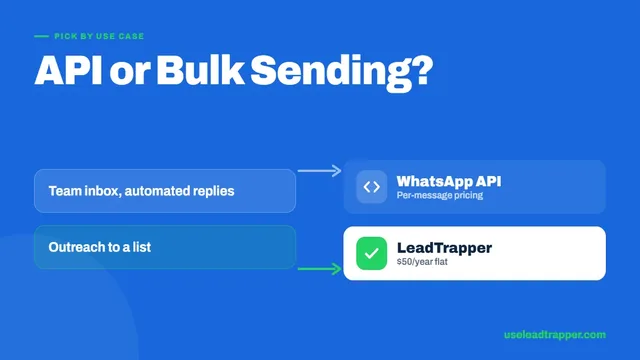
Do You Need the WhatsApp Business API, or Bulk Sending?
A real decision framework for the WhatsApp Business API versus bulk sending — by use case, team size…
Read article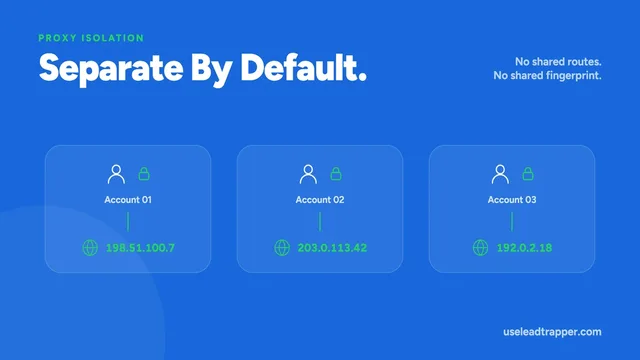
Running Multiple WhatsApp Numbers Without Overlap
Each WhatsApp account in LeadTrapper gets its own isolated browser session and proxy, so multiple nu…
Read articleBrowse All Articles
Lead generation, WhatsApp marketing, Google Maps, Instagram, and Facebook scraping guides.
See all