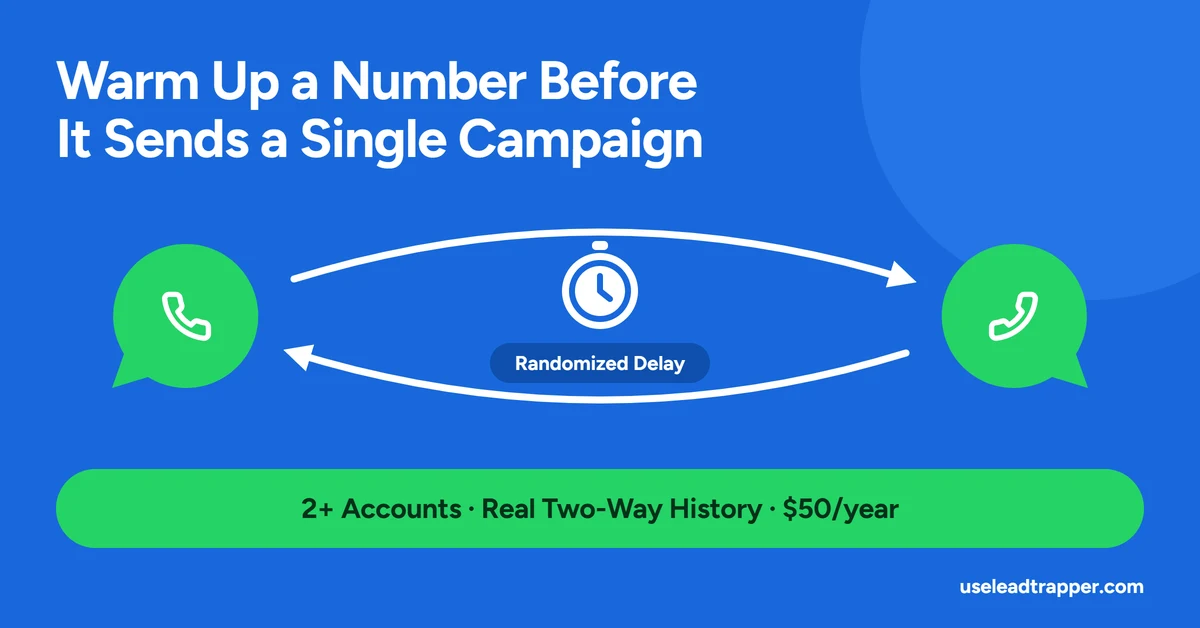
- Warming up a WhatsApp number means building real send-and-reply history before pointing it at a bulk campaign — a brand-new number's first activity being 500 identical outbound messages is the pattern that gets flagged.
- LeadTrapper's Account Warmer needs at least two of your own connected accounts and runs a genuine two-way conversation between them, not one-sided outbound pings.
- Every warming message runs through spin-tax so the same handful of lines never repeat verbatim for hours — repetition is exactly the fingerprint warming exists to avoid.
- The delay between each warming message is randomized within a range you set, not fixed — and the warmer stops itself automatically after 10 failed sends in a row instead of failing silently overnight.
- Warming reduces one specific risk (a number with zero history suddenly sending in bulk) — it doesn't replace the other safety mechanisms LeadTrapper runs, like the [account safety telemetry panel](/articles/whatsapp-account-safety-telemetry/).
A brand-new WhatsApp number’s first real activity, if you skip straight to a campaign, is a burst of one-way outbound messages to people who’ve never messaged it back. That’s not what normal WhatsApp use looks like on day one for anyone. Warming up a number means giving it real conversation history — actual sent and received messages — before it ever touches a bulk send. Here’s exactly what LeadTrapper’s Account Warmer does to produce that, verified against the code that runs it, not the feature’s marketing description.
Why a Brand-New Number Needs This
Every WhatsApp number starts with zero history. A number that goes from zero messages to five hundred outbound sends in its first hour looks nothing like a real person’s phone — and a number that’s sat dormant for months and then suddenly resumes with a bulk burst isn’t much different. Neither pattern is something WhatsApp has published exact rules about, but both are the kind of first-activity spike that draws more scrutiny than a number with an existing, ordinary back-and-forth history behind it.
Warming closes that gap deliberately: instead of a campaign being the first thing a number ever does, it becomes just another day for a number that already has real conversation history sitting behind it.
What LeadTrapper's Warmer Actually Sends
The Warmer needs at least two of your own connected WhatsApp accounts — it can’t warm one number in isolation, because warming means real two-way exchange, not one-sided pings. You supply a list of conversational lines (LeadTrapper defaults to something as simple as “Hi, how are you?” if you don’t), and the Warmer cycles through them as the conversation runs.
Every line is run through LeadTrapper’s spin-tax parser before it’s sent — the same mechanism used in bulk campaigns — so a warmer left running for hours doesn’t just repeat the same handful of identical strings back and forth between the same two numbers. Sending the exact same text over and over is precisely the mechanical fingerprint warming is meant to avoid, so the code resolves fresh variation on every single message, not just the first few.
How to Warm Up a Number in LeadTrapper
The Warmer is a three-step wizard, and each step maps directly to what was covered above:
Step 1 — Select Accounts. A checkbox table lists every connected WhatsApp account. Pick two or more — the number you’re warming, plus at least one partner account it can exchange messages with.
Step 2 — Conversation. A text box where you write the lines the Warmer will cycle through, one message per line. There’s no minimum — even a handful of everyday small-talk lines is enough, since spin-tax varies each one before it’s sent. If you already keep a longer script somewhere, there’s a “Select Text File” button that loads a .txt file directly instead of retyping it.
Step 3 — Delay Settings. Set the minimum and maximum seconds between each warming message, and pick the Warming Type — One to One or One to Many, covered next. Hit Finish, and the accounts you selected start exchanging the conversation you wrote, on the randomized timer you set.
One to One vs. One to Many
There are two warming modes, and they build different conversation shapes:
One to One builds every unique pair among your connected accounts and has each pair exchange both an initial message and a reply — with three accounts, that’s every possible pairing talking to each other, not just one central number doing all the work.
One to Many picks a single base account and has it exchange messages with each of the other connected accounts in turn — base sends to target, target replies to base, then the same pattern repeats with the next target. This shape makes sense when you’re specifically warming one central sending number and only need the others as conversation partners, rather than building history across all of them equally.
The Randomized Delay, and What Stops It Automatically
Between each warming message, LeadTrapper waits a random interval drawn from a min/max range you set — not a fixed gap repeated identically every time, for the same reason spin-tax exists on the message content: a perfectly even interval is itself a mechanical pattern.
The Warmer also doesn’t fail silently. If ten sends in a row fail — an account got disconnected, a session dropped — it stops itself and logs exactly why, rather than continuing to quietly fail every few seconds for the rest of the night while you assume it’s working. That’s a deliberate fix: a warmer that fails without telling you is worse than not running one at all, since you’d walk into a campaign believing a number was warmed when it never actually sent anything.
What Warming Reduces, and What It Doesn't
Warming addresses one specific, named pattern: a number with no history suddenly sending in bulk. It doesn’t touch the other risk patterns LeadTrapper’s Account Safety Telemetry is built to reduce — an imbalanced send-to-reply ratio during a live campaign, or a mechanically uniform activity fingerprint while it’s running. Those are separate mechanisms addressing separate risks, and warming a number well doesn’t make the others unnecessary once a real campaign starts.
It also doesn’t override WhatsApp’s own block-and-report-based enforcement, which responds to how real recipients react regardless of how much conversation history a number has behind it. A well-warmed number sending to a list that doesn’t want to hear from it can still get reported. Warming reduces the specific risk of looking brand-new — it doesn’t replace sending to people who actually want the message, the same limit that applies to any WhatsApp sending pattern, official API or not.
Frequently Asked Questions
It runs a real, two-way conversation between two or more of your own connected WhatsApp accounts on a schedule, so the number accumulates genuine sent-and-received message history before you point it at a real campaign, instead of its first real activity being a burst of one-way outbound messages.
At least two. LeadTrapper's Account Warmer needs two or more of your own connected accounts to exchange messages with each other — it can't warm a single number in isolation, since warming means building real two-way conversation history.
No. It reduces one specific, named risk pattern — a number with no history suddenly sending in bulk. It doesn't override WhatsApp's own block-and-report-based enforcement, and it doesn't replace sending to contacts who actually want to hear from you.
There's no official number published by WhatsApp — this is a risk-reduction practice, not a documented threshold. Most users run it for at least a few days of genuine back-and-forth activity before starting a real campaign on a brand-new or long-dormant number.
Warm Up Every New Number Before It Sends a Single Campaign
LeadTrapper's Account Warmer runs on any connected account. $50/year — all features included.
Related Articles
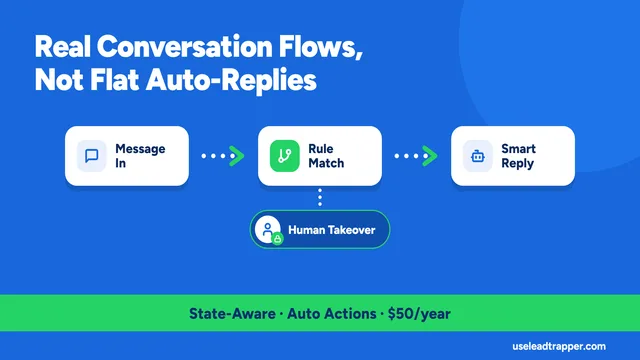
WhatsApp Chatbot for Business: How the Rule Engine Works
LeadTrapper's chatbot runs real multi-step conversation flows, not flat auto-replies, and steps asid…
Read article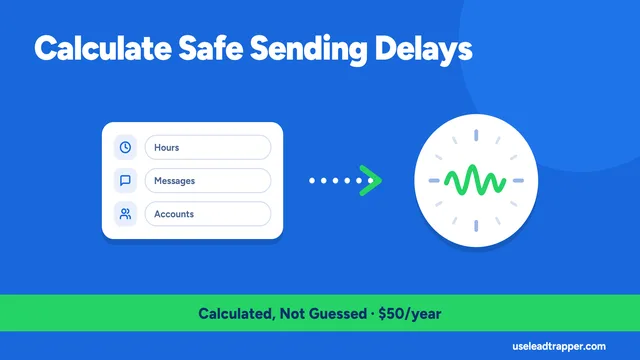
WhatsApp Delay Calculator: How Safe Sending Delays Work
LeadTrapper calculates safe message and batch delays from your campaign size, then requires it befor…
Read articleBrowse All Articles
Lead generation, WhatsApp marketing, Google Maps, Instagram, and Facebook scraping guides.
See all