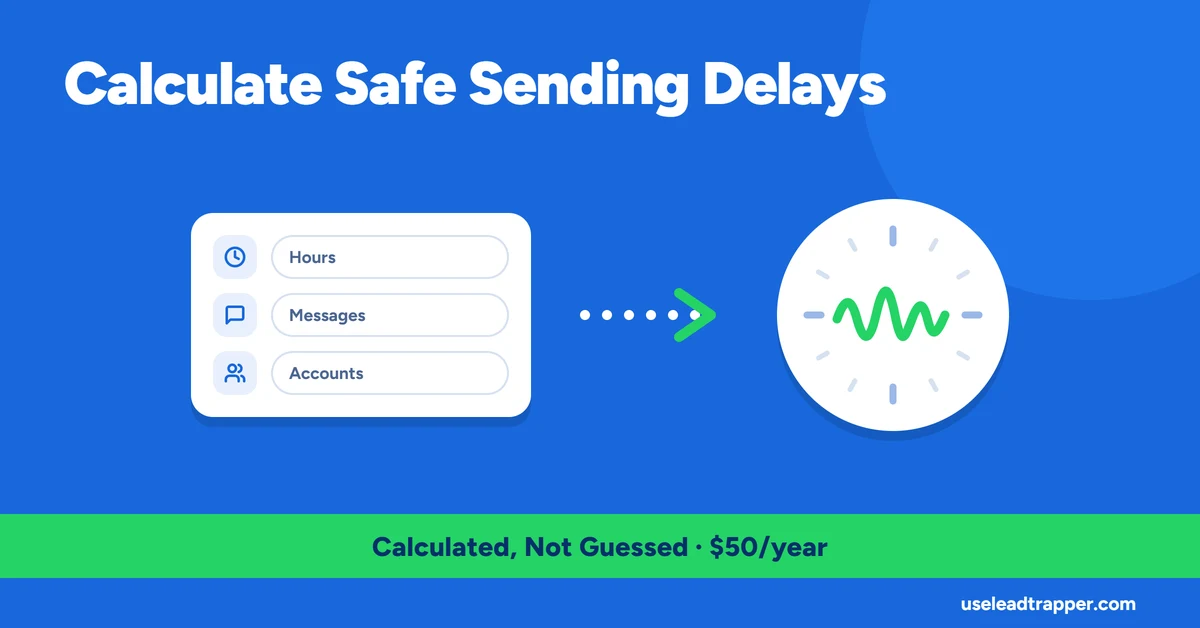
- LeadTrapper's Delay Calculator computes a delay range from your actual campaign numbers — target hours, message count, account count, and batch size — not a fixed guess like 'wait 5 to 10 seconds.'
- Campaign Builder requires running the calculator at least once before a campaign can send, and the resulting delay fields are read-only afterward — they can't be hand-edited back to something unsafe.
- The math targets finishing at or slightly after your target time, never under it, using randomized min/max ranges rather than one fixed interval.
- A free standalone version of the same calculator is available as a browser extension on Chrome and Microsoft Edge, for planning a campaign's timing before you've even opened LeadTrapper.
- Delay alone isn't a complete safety strategy — it works alongside message variation and multi-account rotation, not instead of them.
“Wait 5 to 10 seconds between messages” is the kind of advice that sounds like a safety rule but isn’t actually calculated from anything. Whether that gap is safe depends entirely on how many messages you’re sending and over what timeframe — 500 messages at a flat 8-second gap takes over an hour, but 5,000 messages at the same gap takes half a day, and neither number tells you whether that’s a reasonable pace for the accounts involved. LeadTrapper’s Delay Calculator computes the actual answer from your real numbers instead of reusing a generic rule of thumb. Here’s exactly how, verified against the calculation itself.
Why a Fixed Delay Isn't the Same as a Safe One
A flat, unchanging interval is itself a pattern — sending exactly every 7 seconds for hours looks as mechanical as sending with no gap at all, just slower. Real pacing needs two things a single fixed number can’t provide: a randomized range instead of one constant value, and a pace that’s actually derived from the size of the campaign rather than picked arbitrarily. A calculator that only knows “seconds between messages” and nothing about how many messages or how long the campaign should take can’t tell you whether that number is remotely reasonable for what you’re about to run.
What Actually Goes Into the Calculation
Five inputs feed the calculation: how many hours you want the campaign to take, the total number of messages, how many WhatsApp accounts are sending, how delays are applied — one shared queue on a single device, or each account sending in parallel — and how often to insert a longer pause after a batch of messages. From those, it works out two separate randomized ranges: a short delay before each individual message, and a longer delay after every batch, sized so the campaign lands at or slightly after your target time rather than finishing early by cutting delays short. A “Low” style keeps per-message delays small and leans on the batch pause to absorb most of the timing; a “High” style does the opposite, spreading more of the wait into every single message. If your numbers don’t leave room for a sensible batch pause — very few messages over a long timeframe, for instance — the calculator folds everything into the per-message delay instead of producing a nonsensical batch value, and flags the resulting pace with a warning if it ends up unusually slow.
A Worked Example
Take a real, ordinary campaign: 500 messages, 10 connected accounts, an 8-hour target, batching every 10 messages, on the “Low” style. Run through the calculator, and it comes back with roughly 3 to 5 seconds before every message, and 7 to 11 minutes after every batch of 10 — spreading 50 messages per account across the full 8 hours instead of front-loading them. Change only the message count down to 5, keeping everything else the same, and the same calculator returns a completely different shape: with so few messages spread across the same 8 hours, there’s no sensible batch pause left to lean on, so it folds the entire wait into the per-message delay instead — several thousand seconds between each of the 5 messages — and flags that the resulting pace is unusually slow. Same inputs structure, same formula, genuinely different output, because the right pacing for 500 messages and for 5 aren’t the same number scaled down.
Why Campaign Builder Won't Let You Skip It
The calculated delay fields in Campaign Builder are read-only — they can only be set by running the calculator and applying its result, not typed in directly. Campaign Builder also won’t let a campaign start at all until the calculator has been run at least once; trying to send without it opens the calculator automatically instead of proceeding. That’s a deliberate design choice, not an oversight: a safety calculation that can be typed over with any number a person feels like entering isn’t really a safety mechanism, it’s a suggestion. Making the field read-only closes that gap specifically.
The Same Calculator as a Free Browser Extension
The exact same math is also available as a free, standalone browser extension — on the Chrome Web Store and Microsoft Edge Add-ons — for anyone who wants to plan a campaign’s timing before deciding on a sending tool, or without installing anything at all. It runs the identical calculation entirely in the browser, with nothing sent anywhere; the only difference from the in-app version is that Campaign Builder applies its result directly to a real campaign, while the extension just shows you the numbers.
What Delay Alone Doesn't Solve
Pacing addresses one specific pattern — a fixed, predictable sending rate — and it’s meant to work alongside other mechanisms, not replace them. Sending identical text to hundreds of contacts is still a distinct risk even at a perfectly calculated pace, which is what spin syntax and message variation exist for. A brand-new number with no history is a different risk again, addressed by warming it up before a campaign ever starts, not by timing alone. And none of these mechanisms override how WhatsApp’s own enforcement actually responds to real recipients — a well-paced campaign sent to a list that doesn’t want to hear from it can still get reported, the same limit that applies regardless of how the message was sent, official WhatsApp Business Platform API included.
Frequently Asked Questions
Given your target campaign duration, total message count, number of connected WhatsApp accounts, and batch size, it computes a randomized safe delay range for both individual messages and pauses after each batch — sized so the campaign finishes on schedule without sending at a fixed, predictable interval.
No, not in LeadTrapper's Campaign Builder. The delay fields are read-only and only get set by running the calculator and applying its result — they can't be hand-edited afterward, so a campaign can't accidentally run on unsafe values someone typed in without thinking about it.
Yes — the same calculation is available as a free standalone browser extension on the Chrome Web Store and Microsoft Edge Add-ons, useful for planning a campaign's timing even before deciding on a sending tool.
No. It reduces one specific risk — sending at a fixed, predictable rate — but it isn't a complete safety strategy by itself. It's meant to work alongside message variation and multi-account rotation, not replace them.
Calculate Your Campaign's Safe Delay Before You Send
LeadTrapper's Delay Calculator runs before every campaign automatically. $50/year — all features included.
Related Articles
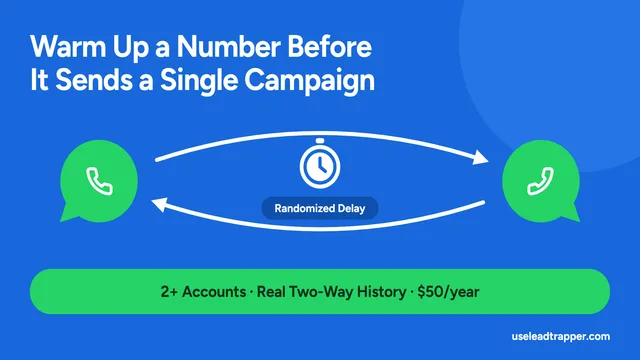
WhatsApp Account Warmer: How to Warm Up a Number
LeadTrapper's Account Warmer runs a real two-way conversation between your own WhatsApp accounts bef…
Read article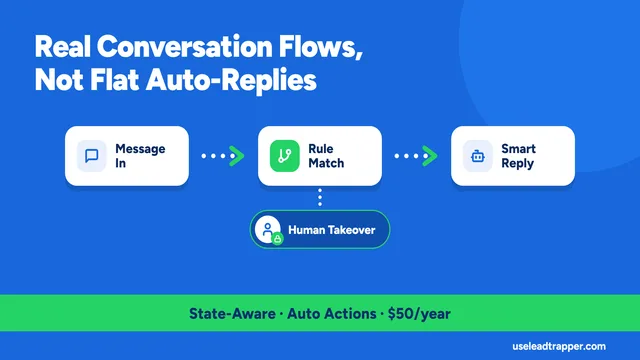
WhatsApp Chatbot for Business: How the Rule Engine Works
LeadTrapper's chatbot runs real multi-step conversation flows, not flat auto-replies, and steps asid…
Read articleBrowse All Articles
Lead generation, WhatsApp marketing, Google Maps, Instagram, and Facebook scraping guides.
See all