In this article 8 sections
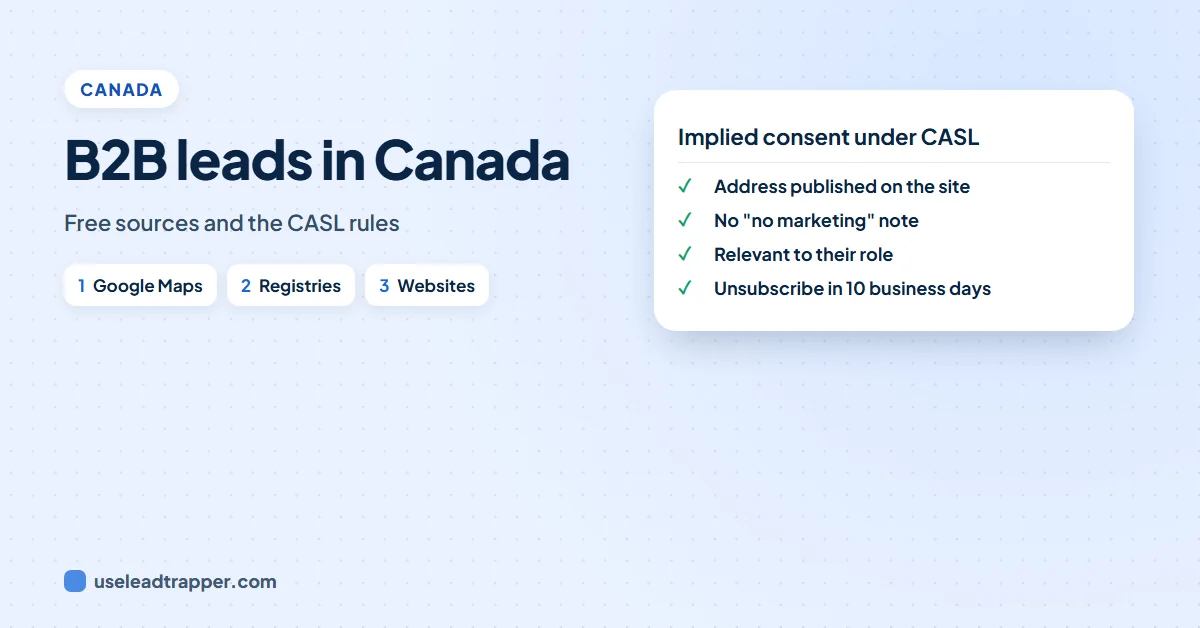
Free Canadian B2B leads come from Google Maps, Corporations Canada and the provincial registries, and each company's website. CASL requires consent for commercial emails and texts, even to businesses, but consent can be implied when a business publishes its address with no 'no marketing' note and your message is relevant to its role.
- Google Maps lists Canadian local businesses with phone, website and reviews; Corporations Canada and the provincial registries confirm the legal name and status.
- CASL requires consent, express or implied, for commercial electronic messages: email, texts and instant messages. It has no general business-to-business exception.
- Consent is implied when a business has conspicuously published its address, with no statement that it doesn't want marketing, and your message is relevant to its business or role.
- Every message must name you, give a mailing address plus a phone, email or website, and carry an unsubscribe that you action within 10 business days.
- CASL penalties reach $10 million per violation for a business. The National Do Not Call List rules don't apply to telemarketing calls made to businesses.
Canada looks like the US from a sales point of view, with the same +1 phone numbers and many of the same business types. The rules are very different. Canada’s Anti-Spam Legislation (CASL) is one of the strictest email laws in the world, and it applies to business-to-business messages too. The good news is that CASL itself allows emailing a business address the business has published, as long as you follow three conditions. This guide covers where to find Canadian leads for free and how to stay inside those conditions. We make LeadTrapper, which appears in some steps, and we say so where it does.
Free Source 1: Google Maps
For local businesses such as clinics, contractors, restaurants, dealerships and agencies, Google Maps is the most up-to-date free directory in Canada. Search a business type and city, such as “accounting firm Calgary” or “dentist Mississauga”, and each listing shows phone, website, address, rating and reviews. In Quebec, search in French too: “comptable Montréal” returns firms that “accountant Montreal” misses.
LeadTrapper’s Google Maps scraper collects a whole city for you on Windows, splitting it into districts to get past the roughly 120 results one search shows, with one row per business.
Free Source 2: Corporations Canada and the Provinces
Canadian companies are registered either federally or in a province, so there is no single register:
- Corporations Canada has an online search for corporations created under federal law, by name, corporation number or business number, with status and filters by province.
- Provincial and territorial registries hold companies incorporated in a province and most sole proprietorships and partnerships. Corporations Canada points to Canada's Business Registries for those.
- What they're good for: confirming a business is active and finding the legal name. They don't give you emails.
Free Source 3: Company Websites
The company’s own website is where it chooses to publish its contacts, and under CASL that matters: a published address is the basis for implied consent.
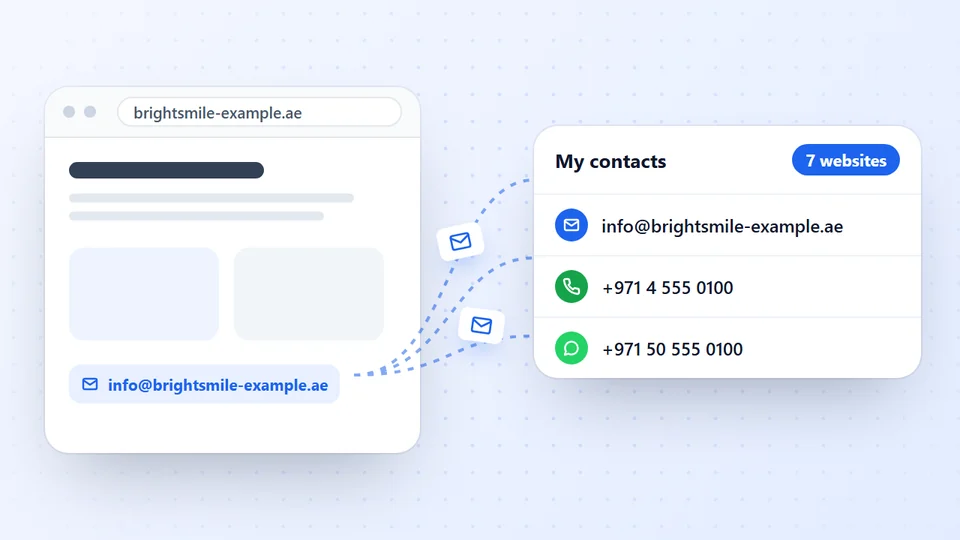
LeadTrapper’s Email Finder reads the contact, about, team and branch pages of each website in your list and collects the emails, phone and WhatsApp numbers it publishes. Each email is labelled as a general inbox, a department, a named person or a branch, and owners, presidents and managing directors named on the site are marked as decision makers. Canadian numbers have the same 10-digit format as US ones, so the app labels them “mobile or landline”.
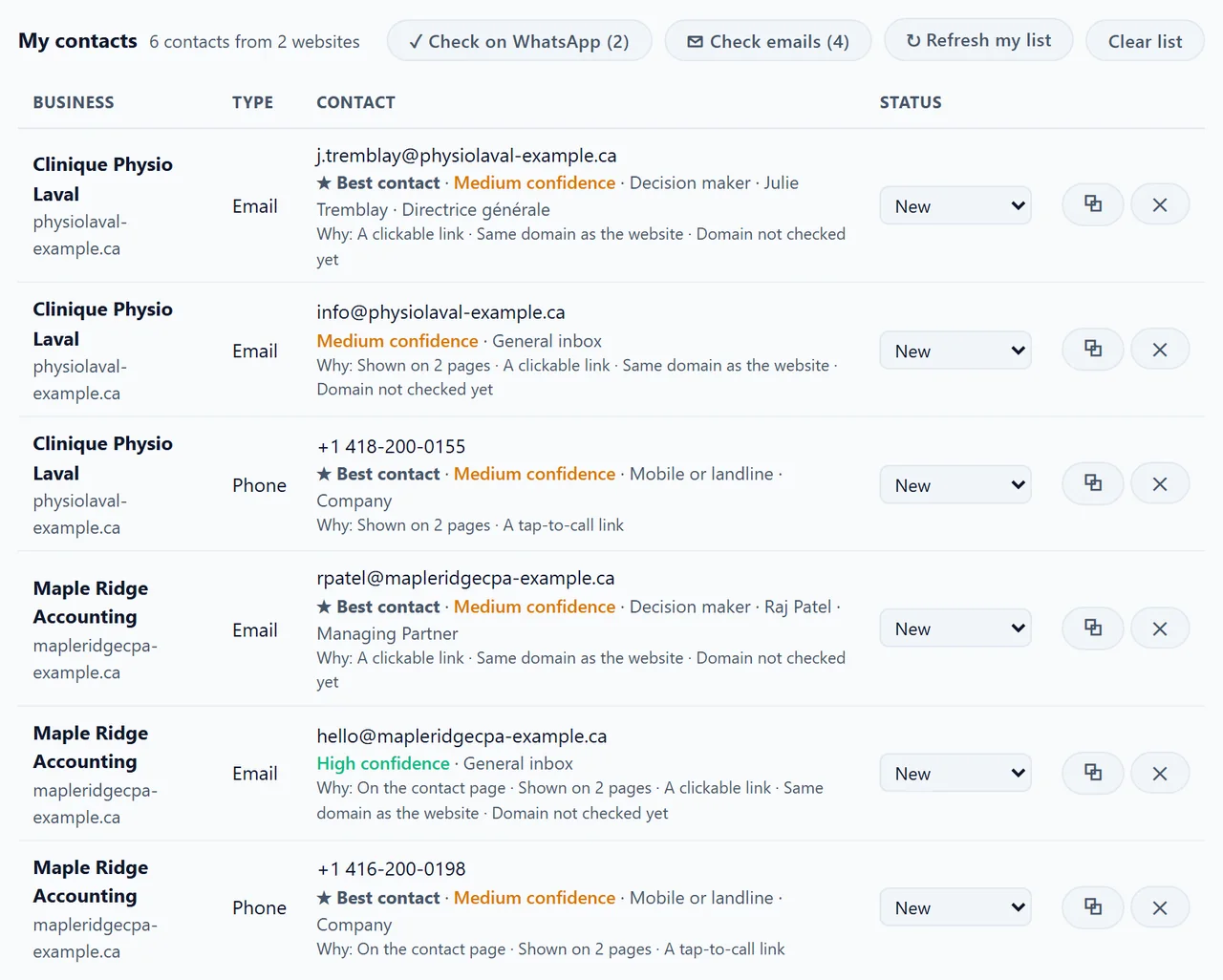
The businesses in this screenshot are samples, shown in the real app screen.
Collect Canadian business contacts free for 14 days
CASL: Consent Before You Email
CASL covers every commercial electronic message: email, text messages, instant messages and similar platforms. The sender needs the recipient’s consent, express or implied, and the Act has no general exception for business recipients.
Implied consent from a published address. Section 10(9)(b) of the Act implies consent when all three of these are true:
- The business or person conspicuously published the address, or had it published, for example on its website’s contact page.
- The publication isn’t accompanied by a statement that they don’t want unsolicited commercial messages. Check the contact page for notes such as “no solicitations”.
- Your message is relevant to their business, role, functions or duties. A cleaning offer to an office manager is relevant; a personal loan offer is not.
What every message must include:
- Your business name, and the name of anyone you're sending on behalf of.
- A mailing address, plus a phone number, email or website, valid for at least 60 days after you send.
- An unsubscribe that works, actioned within 10 business days at no cost to the recipient.
Keep proof. Under section 13, whoever claims consent has to prove it. Record where you found each address and when. The Email Finder’s export has a “Found on page” column with the page each contact came from, which is a start; add the date you collected it.
Other routes to consent are an existing business relationship, such as a purchase in the last two years, and an inquiry, which lasts six months. A narrow exemption covers messages between employees of two organizations that already have a relationship, about the receiving organization’s activities.
What about privacy law? Canada’s federal privacy law, PIPEDA, says in section 4.01 that it doesn’t apply to business contact information collected and used only to contact someone about their job, business or profession. That covers a work email or phone number used for a relevant sales approach. It doesn’t replace CASL, which still decides whether you may send the message.
CASL Consent Types: Quick Table
Every commercial email to a Canadian business needs one of these bases, and you must be able to prove which one. For cold outreach, the realistic options are a published address or an address the person gave you.
| Situation | Basis under CASL | How long it lasts | Proof to keep |
|---|---|---|---|
| The person said or wrote "yes, send me information" | Express consent | Until they withdraw it | Who agreed, when, how, and what you asked |
| info@ or a named manager's email on the company's own contact or team page, no "no solicitations" note | Implied: conspicuous publication, s. 10(9)(b) | No fixed limit, while it stays published and your message stays relevant to the role | The page, the date you saw it, and why your offer fits the role |
| Someone handed you a business card at a trade show without saying "don't email me" | Implied: address disclosed to you, s. 10(9)(c) | No fixed limit in the Act; messages must stay relevant to their role | Where and when you got it |
| The business bought, leased or signed a contract with you | Implied: existing business relationship | 2 years from the purchase or contract | Invoice or contract date |
| The business asked you a question or requested a quote | Implied: inquiry | 6 months from the inquiry | The inquiry and its date |
| The contact page says "no solicitations" or "no marketing" | None | Not applicable | Skip the address, or call and ask for express consent |
| An address from a bought list | Only what the seller can prove for each address | Depends on that basis | The seller's consent records; without them you can't meet section 13 |
Worked example. A Laval physiotherapy clinic lists info@ on its “Nous joindre” page with no note about solicitations. You sell bookkeeping for health clinics. That’s implied consent under section 10(9)(b), because the address is published, there’s no refusal, and bookkeeping is relevant to running the clinic. Your record reads: “info@ from the contact page, collected 21 Nov 2026”. Your email, written in French, names your company, gives a mailing address and a phone number valid for at least 60 days, and has an unsubscribe link. If the clinic unsubscribes on Monday 23 November, you must stop by Monday 7 December, 10 business days later. The same email offering a personal loan to the clinic’s owner would fail the relevance test.
Calls and the Do Not Call List
The National Do Not Call List site says its rules don’t apply to telemarketing calls made to businesses. Its exemptions page was last updated in 2018, and it still said so when we checked it on 20 November 2026. That makes a phone call the simplest first contact in Canada:
- Call the business line from the Maps listing or the website, and ask the right person whether they'd like information by email. A yes is express consent; note it.
- A sole trader's number may also be a personal line. If it looks like a home or personal mobile, treat it as covered by the consumer rules.
- Say who you're calling for at the start of the call. The DNCL site requires this even on exempt calls.
- Keep your own do-not-call list. Even telemarketers making exempt calls must add a person who asks within 14 days and keep them on it for three years.
- Calls with prerecorded messages and automatic dialers have their own rules. Live calls are safer.
A CASL-Safe Lead Workflow
Collect businesses from Maps, take only the addresses they published themselves, record where and when you found each one, and send messages that identify you and can be unsubscribed from.
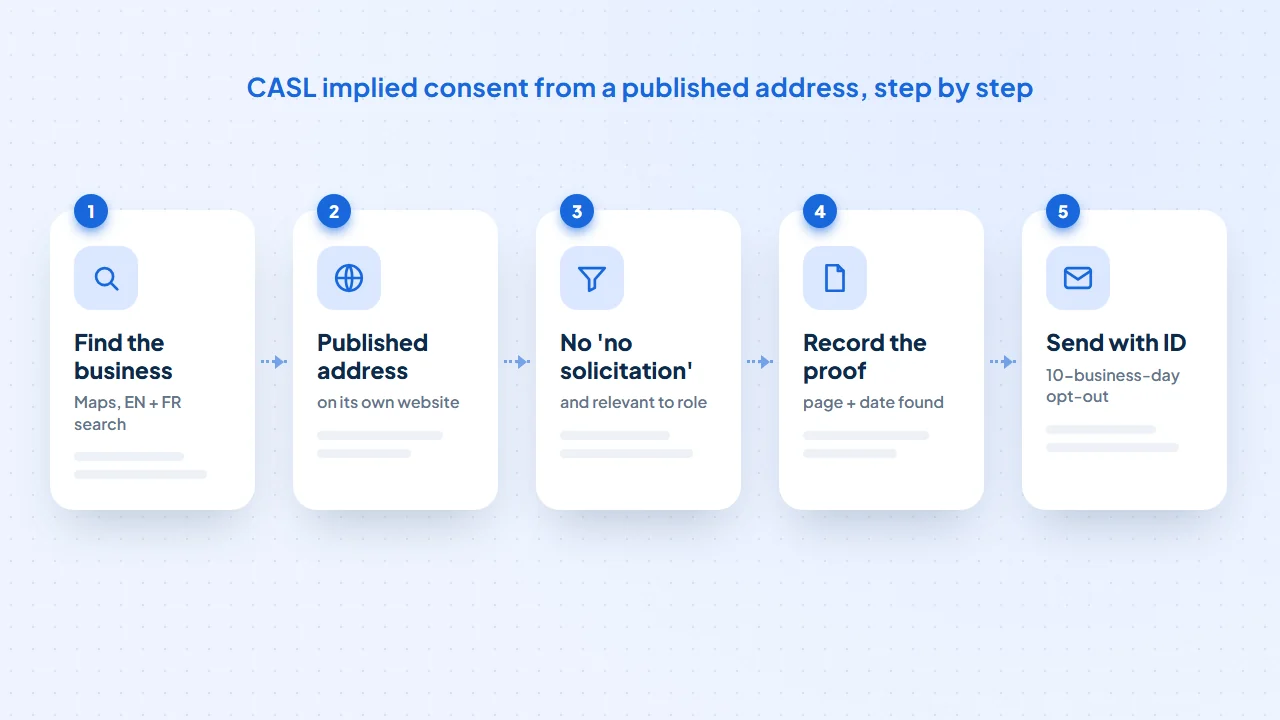
- Pick one business type and one city, such as "physiotherapy clinics in Ottawa", plus the French search in Quebec.
- Run the Google Maps scraper, then the Email Finder on the websites.
- Keep only emails that are published on the business's own site, and skip any site that says it doesn't want solicitations.
- Add the date collected next to the source page for each contact.
- Send short messages that are clearly relevant to the role, with your name, mailing address, contact details and an unsubscribe in each one. Or call first and ask permission.
Check before you send:
- Every address has a consent basis from the table above, with the page or document and a date.
- No contact page in your list says "no solicitations", "no marketing" or similar.
- The offer is relevant to the role behind each address, not just to the company.
- The message names your business, gives a mailing address and a phone, email or website that will work for 60 days.
- The unsubscribe is free, works, and you can action it within 10 business days.
- Businesses whose website is in French, as most in Quebec are, get a French message.
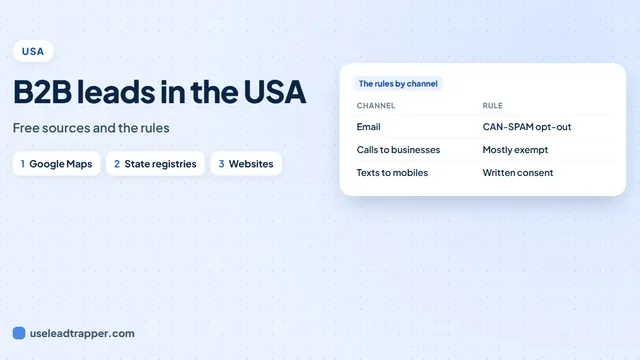
Selling across the border too? Our guide to B2B leads in the USA covers CAN-SPAM, which is looser on email but stricter on texts, and our guide to B2B leads in Australia covers a consent law built on the same idea of published addresses, and the guide to B2B leads in the UK covers PECR’s softer rules for corporate addresses. For the general method, see the B2B lead generation how-to.
This is a summary of the law and official guidance, not legal advice.
Sources
- Justice Laws Website. An Act to promote the efficiency and adaptability of the Canadian economy (CASL), S.C. 2010, c. 23, sections 6, 10, 11, 13 and 20.
- Innovation, Science and Economic Development Canada. Getting consent to send email.
- Justice Laws Website. Electronic Commerce Protection Regulations, SOR/2013-221.
- Justice Laws Website. Personal Information Protection and Electronic Documents Act (PIPEDA), section 4.01.
- National Do Not Call List. Exemptions.
- Corporations Canada. Search for a federal corporation.
The Google Maps scraper and Email Finder are part of LeadTrapper for Windows, which costs $50 a year with a 14-day free trial. LeadTrapper is not affiliated with or endorsed by Google.
Frequently Asked Questions
Google Maps for local businesses with phone numbers and websites, the Corporations Canada search for federally incorporated companies, the provincial business registries for the rest, and each company's own website for emails and the people in charge.
Only with consent, but CASL allows implied consent when the business conspicuously published the address, didn't say it doesn't want marketing, and your message is relevant to its business or role. You must be able to prove the consent, so record where and when you found each address. This is not legal advice.
Yes. CASL has no general B2B exception. A narrow exemption covers messages between employees of organizations that already have a relationship, about the receiving organization's activities. Cold outreach to a new business relies on express or implied consent.
The National DNCL site says its rules do not apply to telemarketing calls made to businesses. Calls to a sole trader's personal or home number are a grey area, so check the number is a business line first.
Up to $1 million per violation for an individual and $10 million for a business, under section 20 of the Act. The person claiming consent also has to prove it.
It depends on the basis. A purchase, lease or contract gives implied consent for two years from the transaction, and an inquiry or application gives six months, under section 10(10). Consent from a conspicuously published address has no fixed end date in the Act, but it lasts only while the address is published without a no-marketing note and your message stays relevant to the role. Express consent lasts until withdrawn.
Section 4.01 of PIPEDA says its privacy rules don't apply to an individual's business contact information that an organization collects, uses or discloses only to communicate with them about their employment, business or profession. That doesn't remove CASL: you still need express or implied consent before sending a commercial email, and you must be able to prove it. This is not legal advice.
About LeadTrapper
LeadTrapper is a Windows app for finding business leads and contacting them on WhatsApp. It collects business contacts from Google Maps, Instagram, Facebook, TikTok, LinkedIn and business websites, checks which numbers are on WhatsApp with its Number Filter, and sends personalised campaigns with automatic delays from one or more WhatsApp accounts. It also has a chatbot, a shared inbox for every account, and Store Orders for online shops. It installs from the Microsoft Store, and the full app is free for 14 days, then $50 a year. Free web tools, browser extensions and a Wix app are listed on the Free Tools page.
Build a Canadian Lead List With the Source Recorded
LeadTrapper's Google Maps scraper and Email Finder collect the contacts Canadian businesses publish, with the page each was found on. $50/year, 14-day free trial.