In this article 9 sections
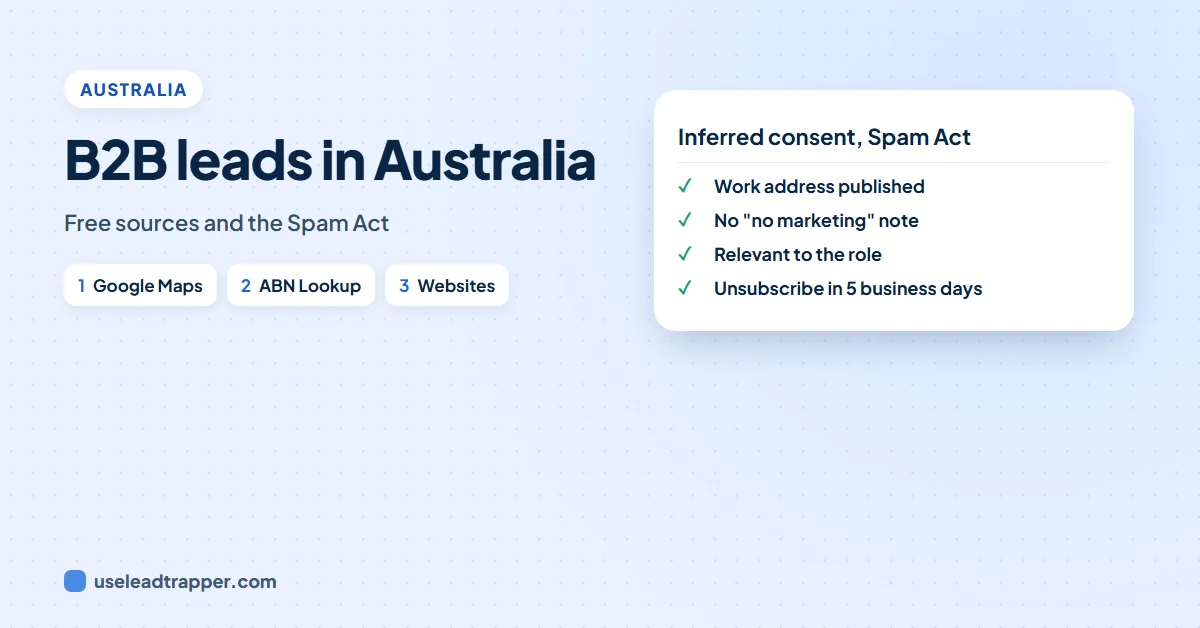
Free Australian B2B leads come from Google Maps, ABN Lookup and ASIC's free company search, and each company's website. The Spam Act needs consent for marketing emails and texts, also to businesses, but consent is inferred when a work address is conspicuously published, has no 'no marketing' note, and your message fits the role.
- ABN Lookup is free with no login: ABN status, business type, GST status and trading names. ASIC's basic company search is free too, with name, type, registration date and the registered office suburb.
- Google Maps adds what the registers don't: phone numbers, websites and reviews for local businesses.
- The Spam Act needs consent for commercial emails, texts and instant messages, and it applies to business account holders too.
- Consent is inferred when a work address is conspicuously published, isn't marked 'no marketing', and your message is relevant to that person's or role's work.
- Unsubscribes take effect within 5 business days. Business numbers can't be put on the Do Not Call Register, which is for private and domestic numbers.
Australia has excellent free business registers and a clear anti-spam law. The registers tell you a business exists and what it’s called; Google Maps and the business’s own website tell you how to reach it. The Spam Act 2003 decides whether you may email or text it. Unlike US law, it needs consent even for business addresses, but it also says when consent is inferred from an address the business published itself. This guide covers both. We make LeadTrapper, which appears in some steps, and we say so where it does.
Free Source 1: Google Maps
For local businesses such as clinics, tradies, cafes, real estate agencies, gyms and accountants, Google Maps is the most current free directory in Australia. Search a business type and a suburb or city, such as “plumber Parramatta” or “physio Brisbane”, and each listing shows phone, website, address, rating and reviews. Use Australian words too: “tradie”, “chemist” and “real estate agent” return different businesses than the US terms.
One search shows about 120 places, and Sydney or Melbourne have far more, so search by suburb or region. LeadTrapper’s Google Maps scraper splits a city into districts for you on Windows and keeps going until Google Maps shows nothing new, one row per business.
Collect Australian business leads free for 14 days
Free Source 2: ABN Lookup and ASIC
Australia has two free official registers that help you check a business:
- ABN Lookup (Australian Business Register) is free with no login. It shows whether an ABN is active or cancelled, the business type, GST status, historical trading names and other public details.
- ASIC's company search gives basic information for free: name, type, ABN or ACN, registration date, and the suburb, state and postcode of the registered office. More detailed paid extracts start at $10.
- What they're good for: confirming a business is active, telling a company from a sole trader, and finding the legal name behind a trading name. Neither gives you an email.
Free Source 3: Company Websites
The business website is where it publishes the contacts it wants used, and under the Spam Act that publication is what inferred consent rests on.
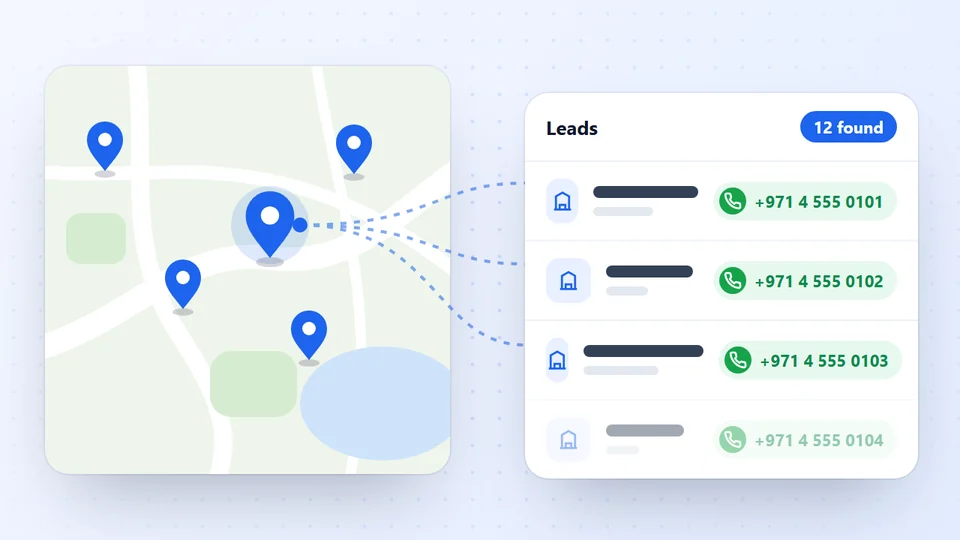
LeadTrapper’s Email Finder reads the contact, about, team and branch pages of each website in your list and collects the emails, phone and WhatsApp numbers it publishes. It labels each email as a general inbox, a department, a named person or a branch, and marks owners, directors and managing directors named on the site as decision makers. Its export has a “Found on page” column, so you can see exactly where each contact was published.
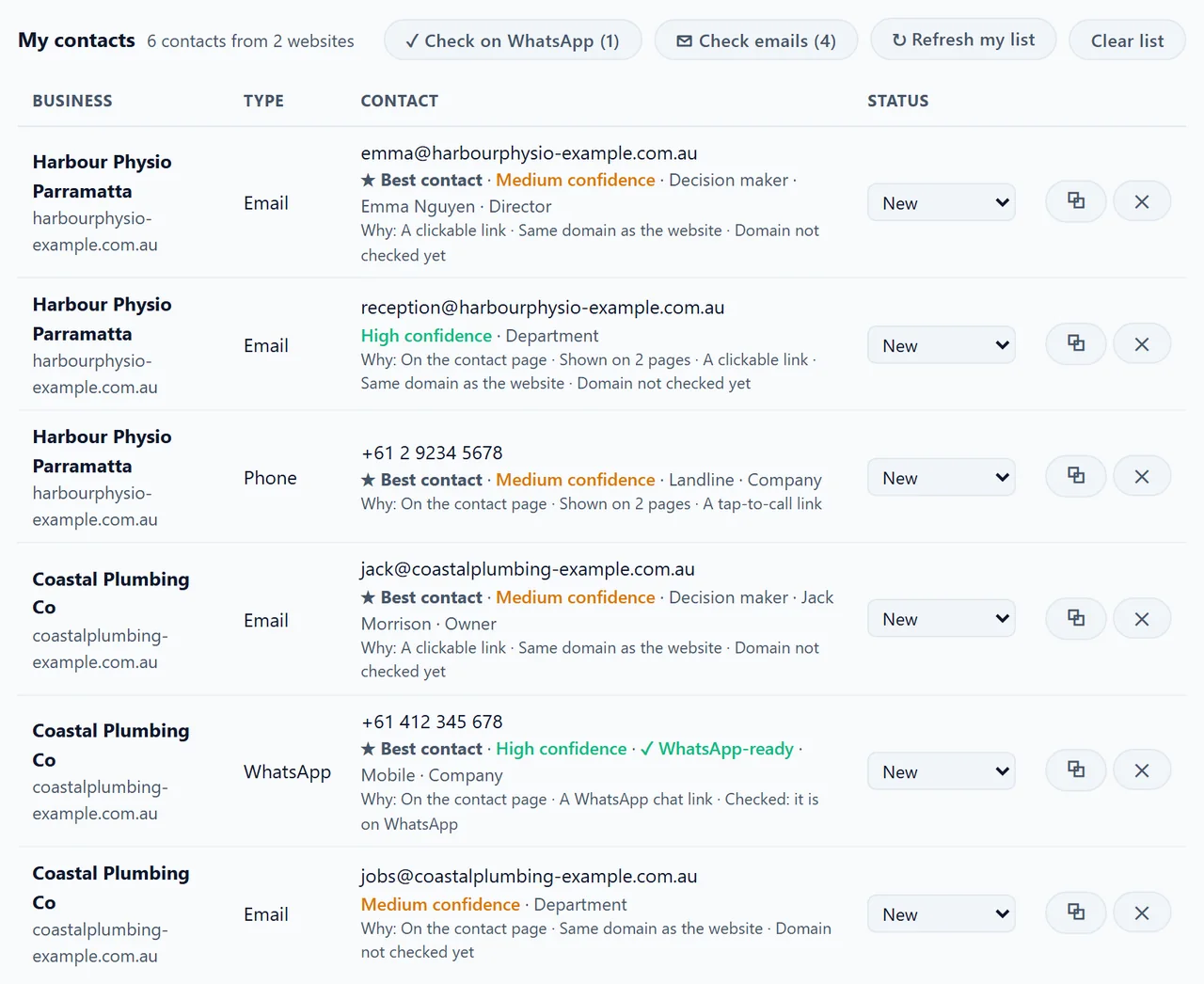
The businesses in this screenshot are samples, shown in the real app screen.
Australian mobile numbers start with 04, or +61 4 in international format, so you can tell them from landlines. The WhatsApp Number Filter shows which numbers are on WhatsApp.
The Spam Act: Consent for Emails and Texts
The Spam Act 2003 covers commercial electronic messages sent to email, instant messaging and telephone accounts, which includes texts. Voice calls are not covered. Messages may only be sent with the consent of the account holder, and that holder can be an organisation. There is no general business exception.
Inferred consent from conspicuous publication. Schedule 2, clause 4 of the Act says the mere fact that an address is published is not consent. But consent is inferred when:
- The address is conspicuously published and lets the public contact a particular employee, director, officer, partner or self-employed person, or a role or function within an organisation, such as sales@ or accounts@.
- The publication isn’t accompanied by a statement that the holder doesn’t want unsolicited commercial messages.
- Your message is relevant to the work of that person, office, role or function.
Every message must:
- Clearly and accurately identify the person or organisation that authorised it, with contact details that stay valid for at least 30 days.
- Include a clear, functional unsubscribe that works for at least 30 days after sending.
- Stop after an unsubscribe: under the Act, withdrawal of consent takes effect within 5 business days.
The ACMA enforces the Act, and breaches carry civil penalties for each day of contravention. This is a summary of the Act, not legal advice.
Texts sent under a business name. Since 1 July 2026, a text whose sender ID is a business name rather than a number shows as “Unverified” if that name isn’t on the ACMA’s SMS Sender ID Register. Register it through your telco or message provider before you text prospects that way.
Which Addresses You Can Email: Quick Table
A work address the business published itself is usually fine for a relevant offer. An address you can’t trace back to the business’s own publication usually isn’t. The table applies Schedule 2, clause 4 of the Act to the kinds of addresses a lead list typically holds.
| Address in your list | Where it came from | Inferred consent? |
|---|---|---|
| info@ or reception@ | Contact page of the business's own website | Yes, if the page has no "no marketing" note and your offer fits the business |
| accounts@, sales@, bookings@ | Website footer or contact page | Yes, for offers relevant to that role: an invoicing tool to accounts@, not a gym membership |
| A named person, such as sarah@ | The business's team or about page | Yes, for offers relevant to her job as the page describes it |
| Any address | A page that says "no unsolicited marketing" or similar | No. You need express consent |
| A personal Gmail or Outlook address | A forum post, review or social comment | Doubtful. It wasn't published so the public could contact someone at work |
| A bought list | A data seller | Only if you can show consent for each address. You are still responsible for every message you send |
| A former customer | Your own records | Not automatically. In the SpinTel case the ACMA found that inferred consent didn't continue after the customer relationship ended |
| An 04 mobile | The business's Maps listing or website | Yes for relevant texts, if published as a work contact. The same rules apply as for email |
Worked example. A Parramatta physio clinic lists reception@ on its contact page with no “no marketing” note. You sell online booking software for clinics. That is inferred consent: the address is published, there’s no refusal statement, and the offer is relevant to the clinic’s work. Your email names your business, gives contact details and has an unsubscribe link. If the practice manager unsubscribes on a Monday, you have until the following Monday (5 business days) to stop. A personal Gmail the owner posted in a local Facebook group gives you nothing to rely on.
What about email scrapers? Sections 20 to 22 of the Spam Act deal with “address-harvesting software” and “harvested-address lists”. Subsection 22(2) says the ban on using them doesn’t apply when the use isn’t connected with sending messages that break section 16, the consent rule. So the test is the one in the table: does each message have consent? A tool that records the page each address came from, as LeadTrapper’s Email Finder does, helps you show the address was published by the business.
Recent ACMA Penalties
ACMA spam penalties run from hundreds of thousands to millions of dollars, and recent cases turn on consent and unsubscribe failures. Examples from ACMA media releases and the courts:
- Telstra, March 2025: $626,000 after sending close to 10.5 million texts that broke the rules.
- Latitude Finance, April 2026: $3.96 million after the ACMA found more than 2.7 million breaches. It was the company's second spam penalty.
- SpinTel, November 2026: $653,000 for marketing to former customers, plus a 3-year court-enforceable undertaking.
These were consumer-facing cases, but the Act has no exception for business recipients, so the same rules govern B2B outreach.
Calls and the Do Not Call Register
The Spam Act doesn’t cover voice calls, which fall under the Do Not Call Register rules. The register is for numbers used mainly for private or domestic purposes, and its site says business numbers are not eligible, except those used mainly for faxes. In practice:
- Calling a business line from its Maps listing or website is the simplest first contact.
- A sole trader may list a personal mobile that is on the register. If a number looks personal, wash it against the register before calling; washing needs an account and a subscription.
- On the call, ask whether you can send details by email. A yes is express consent; note the date.
- Keep to the calling hours in the telemarketing industry standard: weekdays 9am to 8pm, Saturdays 9am to 5pm, and no calls on Sundays or national public holidays. The Do Not Call Register's industry standards page says the standard covers calls to Australian numbers, even those not on the register.
- Show your caller ID, and keep that number working for at least 30 days so the person can find out who called and why.
A Simple Australian Lead Workflow
Pick a narrow target, collect it from Maps, add the emails each business publishes, check the business, then send relevant messages that identify you.
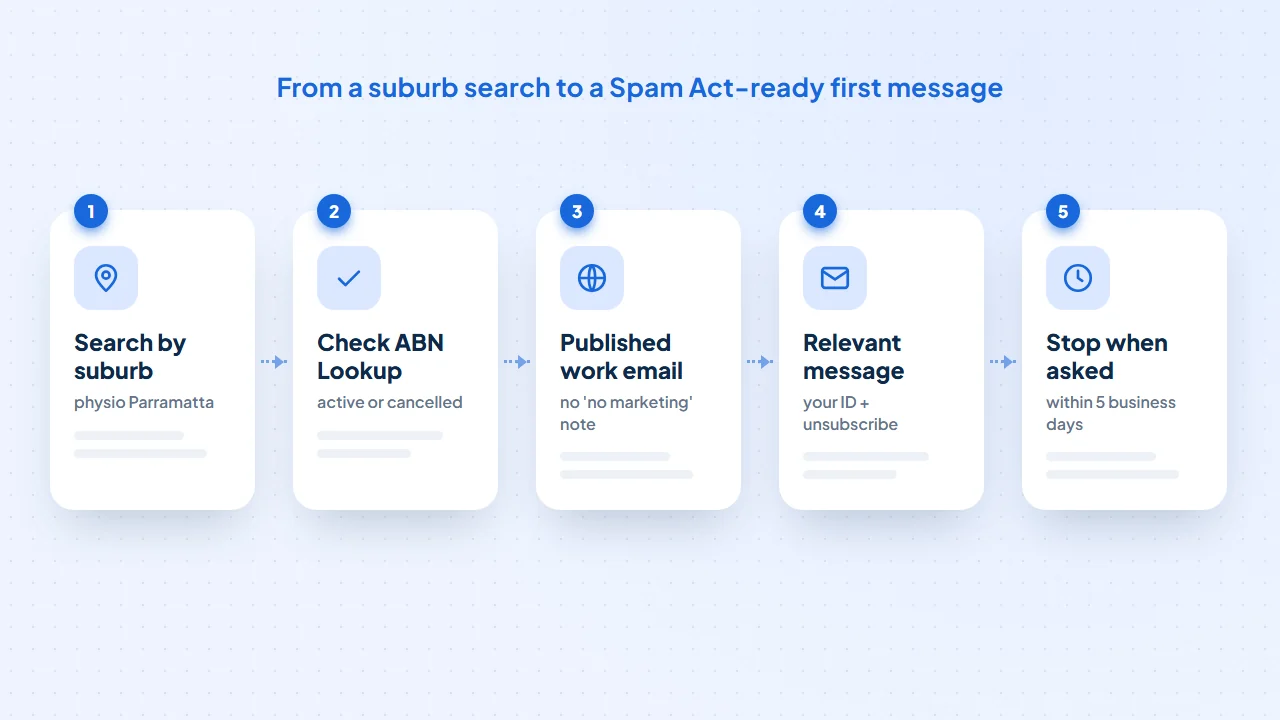
- Pick one business type and one region, such as "dental clinics in Perth's northern suburbs".
- Run the Google Maps scraper suburb by suburb and export the list.
- Run the websites through the Email Finder. Keep emails the business published, and skip sites that say they don't want marketing.
- Check your top prospects on ABN Lookup: active, and a company or a sole trader?
- Send short, relevant messages that say who you are and include an unsubscribe, or call first and ask permission. Keep a do-not-contact list.
Check before you send:
- Each address came from the business's own website or listing, and you know which page.
- That page has no "no marketing" or "no solicitations" note.
- Your offer matches the role behind the address.
- Your business name and contact details are in the message and stay valid for 30 days.
- The unsubscribe works without a login, and you can act on it within 5 business days.
- Texts sent under a business name use a sender ID on the SMS Sender ID Register.
Phone numbers from listings go out of date too. Our guide to how reliable B2B lead phone numbers are shows how to check them before you call.
Selling to other countries as well? Our guides to B2B leads in Canada and B2B leads in the UK cover two laws with similar ideas, and B2B leads in the USA covers the looser CAN-SPAM rules. For the general method, see the B2B lead generation how-to.
Sources
- Federal Register of Legislation. Spam Act 2003, sections 5, 16, 17 and 18, and Schedule 2 clauses 4 and 6.
- Australian Business Register. ABN Lookup.
- ASIC. Company and organisation registers.
- ACMA. Sending text messages with your business or organisation name, and media releases on Telstra, Latitude Finance and SpinTel.
- Do Not Call Register. Industry standards (calling hours and caller ID).
- Do Not Call Register. Registering numbers and Washing process overview.
The Google Maps scraper is part of LeadTrapper for Windows, which costs $50 a year with a 14-day free trial. LeadTrapper is not affiliated with or endorsed by Google.
Frequently Asked Questions
Google Maps for local businesses with phone numbers and websites, ABN Lookup and ASIC's free company search to confirm the business and its type, and each company's own website for emails and the people in charge.
Only with consent, but the Spam Act infers consent when a work email address is conspicuously published, for example on the company website, isn't accompanied by a statement refusing marketing, and your message is relevant to that person's or role's work. Each message must identify you and offer a working unsubscribe. This is not legal advice.
Texts count as commercial electronic messages under the Spam Act, so the same consent rules apply. A mobile number the business publishes for its work can be messaged about relevant offers; a number it doesn't publish needs express consent.
The Do Not Call Register is for numbers used mainly for private or domestic purposes. Its site says business numbers are not eligible, except those used mainly for faxes. A sole trader's home number may be registered, so check before calling a personal line.
Whether an ABN is active or cancelled, the business type, GST status, current and historical trading names and other public details provided to the Australian Business Register. It's free with no login, but it doesn't give email addresses.
Sections 20 to 22 of the Spam Act deal with address-harvesting software and harvested lists, but subsection 22(2) says the ban on using them doesn't apply when the use isn't connected with sending messages that breach section 16, the consent rule. So collected addresses can only go into messages that have consent, such as inferred consent from a conspicuously published work address. This is not legal advice.
Recent ACMA media releases include Telstra paying $626,000 in March 2025 for close to 10.5 million non-compliant texts, Latitude Finance paying $3.96 million in April 2026, and SpinTel paying $653,000 in November 2026 for marketing to former customers. The ACMA lists every penalty in its media releases, so check them before a campaign to see which practices it is chasing now.
About LeadTrapper
LeadTrapper is a Windows app for finding business leads and contacting them on WhatsApp. It collects business contacts from Google Maps, Instagram, Facebook, TikTok, LinkedIn and business websites, checks which numbers are on WhatsApp with its Number Filter, and sends personalised campaigns with automatic delays from one or more WhatsApp accounts. It also has a chatbot, a shared inbox for every account, and Store Orders for online shops. It installs from the Microsoft Store, and the full app is free for 14 days, then $50 a year. Free web tools, browser extensions and a Wix app are listed on the Free Tools page.
Build an Australian Lead List in an Afternoon
LeadTrapper's Google Maps scraper collects Australian businesses suburb by suburb with phone, website and rating, and its Email Finder reads the emails each website publishes. $50/year, 14-day free trial.