In this article 6 sections
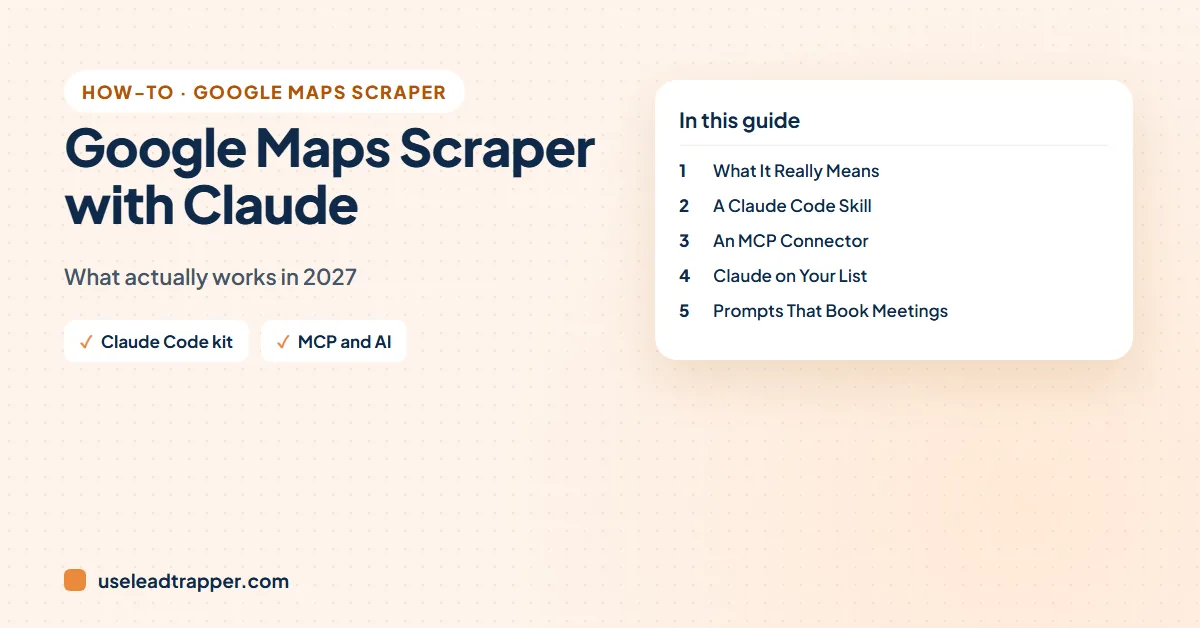
Claude can't scrape Google Maps by itself. A Google Maps scraper with Claude means one of three setups: a Claude Code skill that drives an open-source scraper running in Docker, an MCP connector that calls Google's Places API, or Claude enriching a list you already scraped, such as reading each business website for contacts.
- Claude doesn't browse Google Maps at scale on its own; every working setup connects it to a scraper or an API.
- The popular 'Google Maps scraper kit' is a Claude Code skill wrapped around the open-source gosom/google-maps-scraper, run locally in Docker.
- MCP connectors that use Google's Places API inherit its limits: an API key, billing per request and 60 results per text search.
- Where AI shines is after scraping: qualifying businesses, reading their websites, and writing a personal first line for each.
- You still need a lead source that covers a whole city; AI makes the list smarter, not bigger.
“This free kit lets Claude scrape Google Maps” has become one of the most shared lead generation posts of 2026. The idea is real, but the headline hides how it works. This guide explains the three setups people actually use, what each one needs, and where AI genuinely makes a Google Maps lead list better.
What 'Scrape Google Maps with Claude' Really Means
Claude is a language model. It can browse a page you give it, but it doesn’t open hundreds of Google Maps listings, scroll results panels and export a city on its own. Every working “Claude scrapes Google Maps” setup connects Claude to something that does: a scraper running on your computer, or Google’s Places API. Claude is the friendly front end, plus a very good assistant for what comes after.
Setup 1: A Claude Code Skill on an Open-Source Scraper
The viral “Google Maps scraper kit” works like this, according to its GitHub page and the posts promoting it:
- It wraps gosom/google-maps-scraper, an open-source scraper written by Georgios Komninos.
- It runs locally in Docker, with no Google API key.
- A Claude Code skill teaches Claude the scraper’s commands, so you type requests such as a scrape of dentists in a city, and Claude runs the job.
- Options crawl each business’s website for emails and social profiles and export everything to CSV.
According to the kit’s README (checked 20 November 2026), setup is three commands: clone the repository, run docker compose up -d (a download of roughly 600 MB the first time), then start a job from Claude with slash commands such as /scrape, /scrape-batch and /scrape-jobs. Options include a grid that splits a city into tiles, filters such as no-website-only or a minimum number of reviews, email checks through the domain’s mail records, social profile finding, and flags for ad pixels on each website. Its author lists it as verified on macOS; on Windows you need Docker Desktop working first.
What it needs from you: Docker Desktop, cloning a repository, the command line, and updates when Google changes Maps. Many forks of the kit exist; use the original project, not a random copy, before running anyone’s code on your machine. The Python, GitHub and n8n guide compares this route with the others.
Setup 2: An MCP Connector to the Places API
MCP (Model Context Protocol) lets Claude call outside tools. Several MCP servers connect Claude to Google Maps through Google’s Places API, so you can ask Claude for “cafes near this address with their ratings”.
It’s clean and terms-friendly, but it inherits the API’s limits. Google’s documentation says a text search returns at most 60 results, you need your own API key and billing, and in November 2026 Google listed Text Search Pro with 5,000 free requests a month, then $32 per 1,000 requests. Good for answering questions; expensive and slow for a whole city.
Setup 3: Claude on a List You Already Have
This is where AI earns its keep. Export a full list first, then give Claude the work humans hate:
- Qualify. “Which of these 300 salons have more than 50 reviews but no website?”
- Research. Read each business’s website for what they offer and what’s missing.
- Enrich. LeadTrapper’s connectors for Claude include a Contact Finder that reads one business website at a time and returns the emails, phones and social links the business publishes, right inside a Claude chat.
- Personalise. Draft a first line per business from its rating, reviews and website.
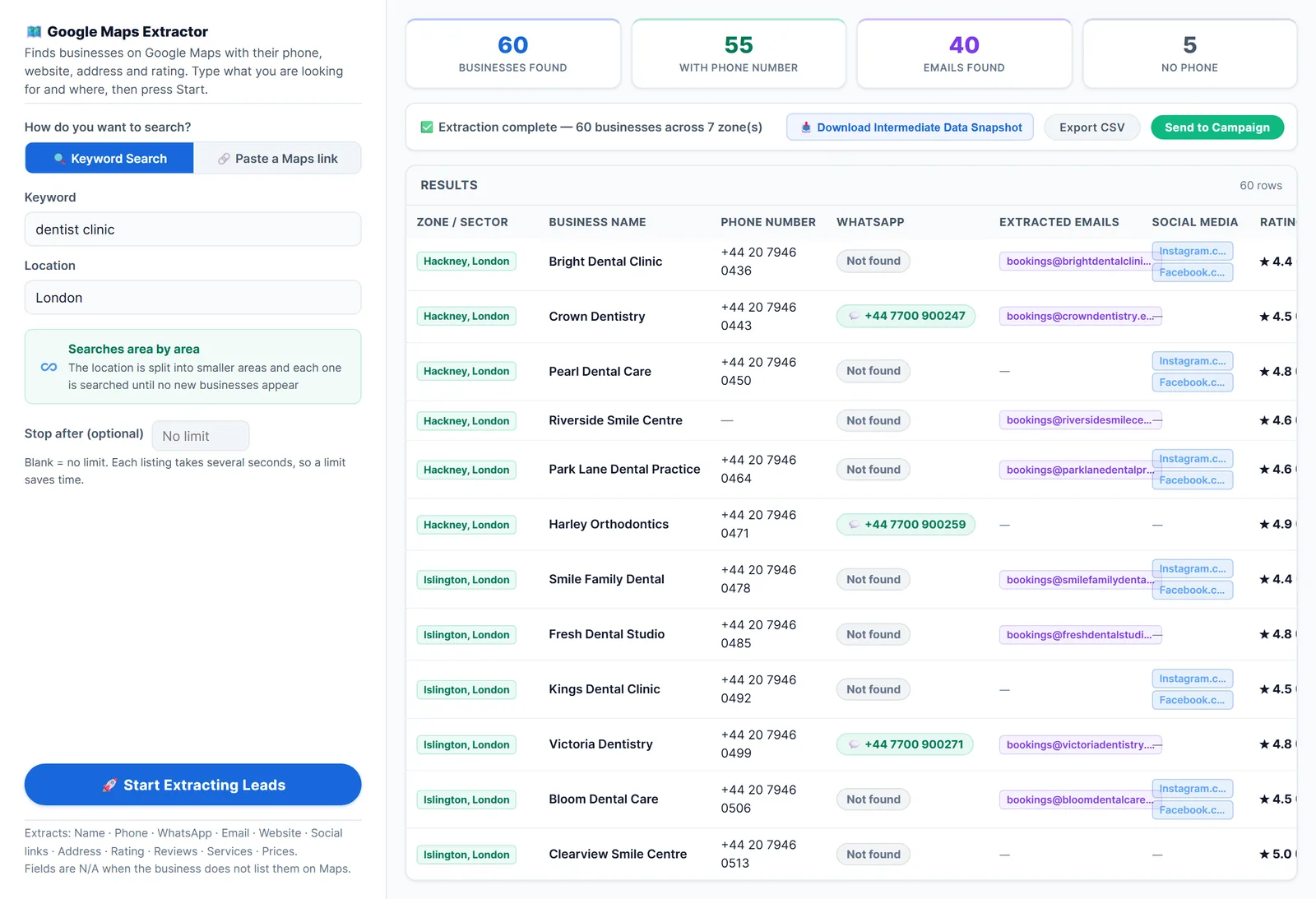
For the list itself, LeadTrapper’s Google Maps scraper is a Windows app with no Docker or API key: type a business type and city, and it searches the city district by district and exports name, phone, address, rating, review count, website and Maps link to CSV, plus emails and WhatsApp numbers when businesses publish them.
The three setups compared
| Compared | Claude Code kit | MCP + Places API | Ready app + Claude |
|---|---|---|---|
| Setup | Docker, Git, command line | API key, billing | Install a Windows app |
| Whole-city coverage | Yes, with grid | 60 results per search | Yes, area by area |
| Running cost | Free | Per request after free usage | $50 a year |
| Upkeep | You update it | Low | Updates from the vendor |
| Best for | Developers | Questions about places | Sales teams |
Prompts That Turn a Maps List into Meetings
Paste your CSV, or a part of it, and try:
From this list, pick the 20 businesses most likely to need a new website: many reviews, rating above 4, and an empty Website column. Give me name, phone and one reason each.
For each business below, write a first WhatsApp message of under 40 words that mentions its rating and area, offers a free mock-up, and ends with “Reply STOP and I won’t message again”.
Group these restaurants by area and flag any with fewer than 10 reviews and no recent activity as possibly closed.
Always read what Claude writes before sending. It can misread a column or invent a detail, and the message goes out under your name.
Limits and Risks
- AI doesn’t make Google’s rules go away. Google’s terms restrict automated access, and data-protection rules apply however the list was made; see is scraping Google Maps legal.
- Long chats lose track. Give Claude batches of 50 to 100 rows, not 5,000.
- Don’t let AI send at volume. Personal first lines help, but sending hundreds of messages quickly still gets numbers restricted. Use a sender with pacing and checks, such as the WhatsApp bulk sender, and message businesses that have a reason to hear from you.
Frequently Asked Questions
Not on its own. Claude can drive a scraper through a Claude Code skill, call Google's Places API through an MCP connector, or work with a list you already exported. The scraping itself is done by the tool or API it connects to.
It's an open-source package that wraps the gosom/google-maps-scraper project with a one-command Docker setup and a Claude Code skill, so you can start scrapes by typing commands to Claude. It exports phones, websites and, with options, emails and social links to CSV.
Yes, several MCP servers connect Claude to Google Maps through Google's Places API. They need your own API key and billing, and they inherit the API's limits, such as at most 60 results per text search.
Use it after scraping: to sort businesses by fit, read their websites, spot what they're missing (no website, few reviews, no booking) and draft a short personal first line for each. Check its work before sending anything.
About LeadTrapper
LeadTrapper is a Windows app for finding business leads and contacting them on WhatsApp. It collects business contacts from Google Maps, Instagram, Facebook, TikTok, LinkedIn and business websites, checks which numbers are on WhatsApp with its Number Filter, and sends personalised campaigns with automatic delays from one or more WhatsApp accounts. It also has a chatbot, a shared inbox for every account, and Store Orders for online shops. It installs from the Microsoft Store, and the full app is free for 14 days, then $50 a year. Free web tools, browser extensions and a Wix app are listed on the Free Tools page.
Get the Whole City First, Then Let AI Help
LeadTrapper's Google Maps scraper exports every business with phone, website, rating and reviews, ready for AI to qualify. $50/year, 14-day free trial.