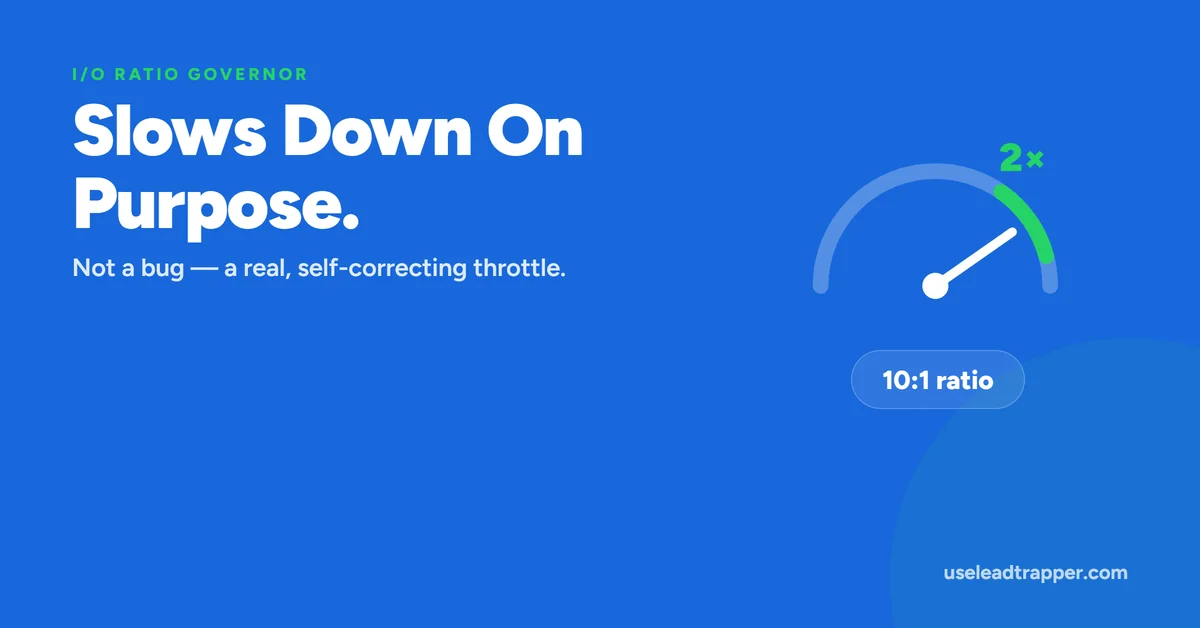
- The Governor doubles the delay between messages when an account's outbound-to-inbound message ratio crosses 10 to 1 — it's a timing throttle, not a message blocker.
- It's re-evaluated before every campaign and after every single message, so it reacts and recovers in near real time as replies come in.
- Below 20 total outbound messages with zero replies, the ratio is treated as balanced rather than flagged — the throttle doesn't fire on a brand-new account's first few sends.
- The 10:1 threshold is LeadTrapper's own engineering assumption about what an unbalanced sending pattern looks like — it isn't a number published by WhatsApp itself.
- The fix, if the Governor keeps activating, is getting real replies, not disabling the throttle — the underlying imbalance it's reacting to is a real signal either way.
A campaign that was sending at a normal pace suddenly gets noticeably slower partway through — no error, no warning dialog, just longer gaps between messages. This is almost always the IO Balance Governor doing exactly what it’s built to do, and it’s worth knowing precisely what triggers it before assuming something’s broken.
What Actually Triggers It
The Governor watches one number: how many messages an account has sent compared to how many it has received, expressed as outbound-to-inbound ratio. This is checked before a campaign starts, and again after every single message sent during it — not on a timer, but on every dispatch. Cross a ratio of 10 outbound sends for every 1 inbound reply, and the Governor doubles the delay applied between messages for that account, starting immediately with the next send.
What It Actually Does — and Doesn't Do
It’s worth being precise about the scope of this, because “safety governor” sounds like it could mean several different things. It means exactly one: the wait time between messages doubles. Nothing else changes. Contacts aren’t skipped, the campaign doesn’t pause, no message fails to send because of this. The only visible effect is that the campaign takes roughly twice as long to work through the remaining list while the elevated ratio persists.
The Account Safety Telemetry panel reflects this with a two-state badge: “✓ NORMAL” at the default 1x delay, “⚠ 2× ACTIVE” once the multiplier has doubled. There’s no intermediate warning state and no third, more severe tier — this is a binary throttle, on or off, not a graduated escalation.
A concrete example makes the trigger point easier to picture. An account that has sent 50 messages and received 3 replies sits at a ratio of roughly 16.7 to 1 — well past the 10:1 ceiling, so the Governor would be active and delays doubled. The same account after receiving 2 more replies, bringing the total to 5, drops to a 10:1 ratio exactly at the boundary; one more reply beyond that pulls it back under the ceiling and the multiplier returns to normal on the very next send. The number isn’t an abstract score — it’s a live ratio recalculated after every message, which is why it can move back and forth within a single campaign rather than settling into one state for good.
This same check isn’t limited to the main campaign sender, either. The identical ratio logic also runs during LeadTrapper’s bulk-add flow for growing group membership, applying its own delay multiplier there independently. It’s a shared safety mechanism across more than one feature, not something built once for a single sending path and left unused elsewhere.
The 20-Message Grace Period
A brand-new account, or one just starting a fresh campaign, hasn’t had time to receive any replies yet — technically an infinite ratio if measured naively. The Governor accounts for this: with zero inbound replies, the ratio is treated as balanced (effectively zero, not flagged) until the account has sent at least 20 outbound messages. Only past that point does a continued run of zero replies start counting as a genuinely lopsided ratio. This prevents the throttle from firing immediately on the first few sends of any new campaign, which would otherwise happen constantly and tell you nothing useful.
It Recovers on Its Own
Because the ratio is re-checked after every single message, the Governor is continuously responsive in both directions. If replies start coming in mid-campaign — genuinely likely once a list includes people who actually respond — the ratio drops, and the moment it crosses back under 10:1, the delay multiplier resets to 1x automatically. There’s no manual reset, no waiting period, no need to restart the campaign. The system tracks the current state of the ratio at all times, not a historical average that takes a long time to shift.
Where the 10:1 Number Actually Comes From
It’s worth being honest about what this threshold actually represents. It’s a design decision built into LeadTrapper’s own sending logic, based on a reasonable general principle: an account sending overwhelmingly one-directional traffic, with almost nobody replying, looks statistically different from an account having real back-and-forth conversations — a pattern that other messaging and email platforms have long treated as a meaningful signal. Gmail’s own sender guidelines, for instance, weigh recipient engagement as part of how a sender’s reputation is judged, for exactly the same underlying reason.
It is not a number WhatsApp itself has published as an enforcement threshold — WhatsApp doesn’t disclose the specifics of its own detection systems, on this or anything else. The 10:1 ceiling is LeadTrapper’s own considered assumption about where a genuinely imbalanced pattern begins, not a verified fact about WhatsApp’s internal rules. Treat the Governor activating as a real, useful signal about your own account’s ratio — worth paying attention to — rather than proof that a specific WhatsApp rule was crossed.
What actually improves the ratio is the same thing that improves any outreach campaign on its own merits: messages that prompt a response. A list built from people who have some real reason to reply — an actual inquiry, an existing relationship, a genuinely relevant offer — naturally produces enough inbound traffic to keep the ratio healthy without any special effort directed at the Governor itself. An account that’s frequently hitting 2× ACTIVE is often describing the same underlying problem a low reply rate would show up as anyway: the list or the message isn’t landing, and slower sending is the throttle’s response to that, not the actual fix for it. For how this fits alongside Ghost Chatting and the per-account proxy, see the full Account Safety Telemetry overview.
Frequently Asked Questions
Most likely the Governor activated because the account's outbound-to-inbound message ratio crossed 10 to 1 — it doubles the delay between sends automatically when that happens. Check the Account Safety Telemetry panel for the account; a '⚠ 2× ACTIVE' badge confirms it.
No. It only doubles the delay between messages. It never skips a contact, pauses the whole campaign, or blocks anything — it's strictly a timing adjustment.
It resets automatically. The ratio is re-checked after every message sent, so once enough replies come in to pull the ratio back under 10:1, the delay multiplier returns to 1x on its own — no manual action needed.
No. It's a threshold LeadTrapper's own code uses as a reasonable proxy for an imbalanced sending pattern, based on the general principle that a heavily one-directional message pattern looks different from a normal conversation. WhatsApp doesn't publish a specific ratio it enforces.
There's no toggle to disable it, and that's by design — the ratio it's reacting to is a real characteristic of the sending pattern regardless of whether the delay is doubled. The actual fix is the same either way: get more replies, which is also what the throttle itself is designed to encourage.
A Throttle That Reacts to Real Signals, Automatically
LeadTrapper's IO Balance Governor runs on every campaign without configuration. $50/year — all features included.
Related Articles
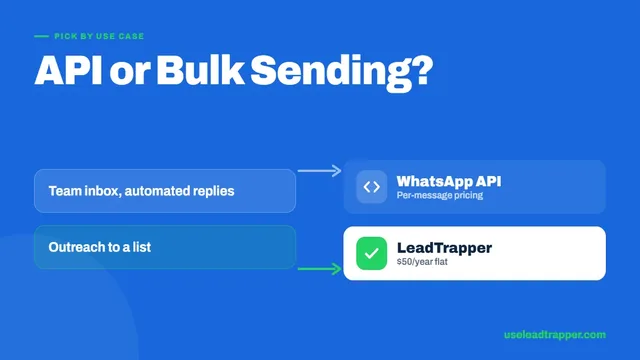
Do You Need the WhatsApp Business API, or Bulk Sending?
A real decision framework for the WhatsApp Business API versus bulk sending — by use case, team size…
Read article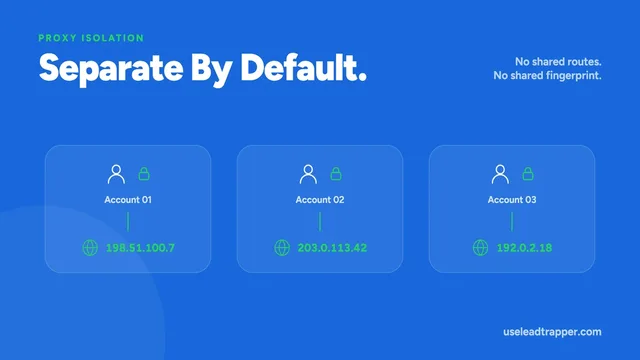
Running Multiple WhatsApp Numbers Without Overlap
Each WhatsApp account in LeadTrapper gets its own isolated browser session and proxy, so multiple nu…
Read articleBrowse All Articles
Lead generation, WhatsApp marketing, Google Maps, Instagram, and Facebook scraping guides.
See all