In this article 6 sections
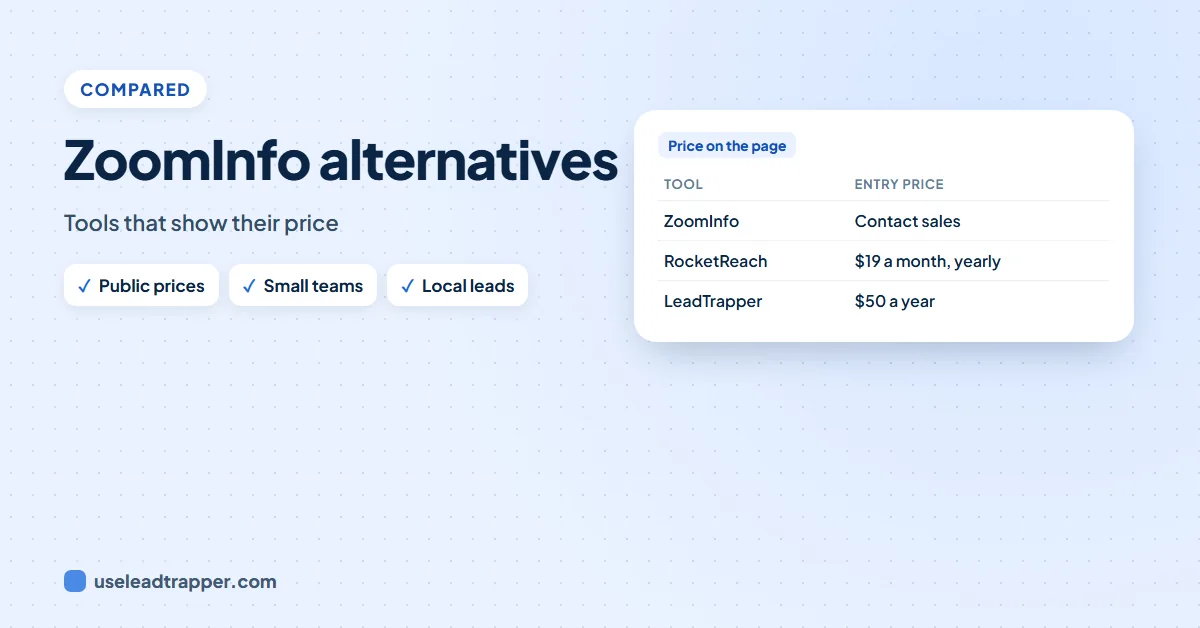
ZoomInfo publishes no prices: its pricing page asks you to contact sales and prices by licences, credits and features. Small businesses usually do better with a tool that shows its price, such as Apollo, RocketReach or Lusha for named people, or LeadTrapper at $50 a year for local business leads.
- ZoomInfo's pricing page on 19 November 2026 showed no prices, only Get Pricing. It says pricing depends on licences, credit usage and features.
- Each export costs one credit, for a contact or a company profile. Monthly payments aren't guaranteed: the sales team sets how often you pay, and integrations need a minimum bulk credit purchase.
- Apollo, RocketReach and Lusha publish their prices, from $19 a month billed yearly on RocketReach Essentials to $49 per seat a month billed yearly on Apollo Basic.
- For local and small businesses, the contacts are usually on the Maps listing and the business's own website. LeadTrapper collects those for $50 a year with no credits.
- ZoomInfo still makes sense for large sales and marketing teams that want company data, intent signals and integrations in one contract.
ZoomInfo is the name most people know in B2B data, and its pricing page is where many small businesses stop. There’s no price on it, just a form. If you’re a team of one to five, a sales process before you even know the cost is reason enough to look elsewhere. This guide covers what ZoomInfo does say about its pricing, the alternatives that publish theirs, and which fits which kind of customer. LeadTrapper is ours, and we say so wherever it appears.
What ZoomInfo's Pricing Page Says
On 19 November 2026 ZoomInfo’s pricing page showed a Get Pricing button and these facts:
- Prices depend on three things: the number of licences, how many credits you use, and which features you choose.
- Packages by team. Sales (ZoomInfo Professional, Copilot Advanced and Copilot Enterprise), Marketing (Marketing Demand with 75,000 included credits, ABM Lite, and ABM Enterprise with 150,000) and Talent.
- One credit per export. Exporting a contact or a company profile costs one credit.
- Payment terms are set by sales. Monthly payments aren’t guaranteed, and pre-packaged integrations need a minimum bulk credit purchase.
On 22 November 2026 the ZoomInfo pricing page still showed no figures, only a Get Pricing form and the line that packages are custom to your use case. Some vendor comparison pages say contracts run on annual commitments; that is a rival’s claim, so ask ZoomInfo for the term in writing.
We don’t repeat price estimates from review sites or forums, because they can’t be checked and contracts vary. The point for a small business is simpler: you can’t compare a price you can’t see.
Alternatives That Show Their Price
These database tools publish their prices and let you start without a sales call. Prices as each pricing page showed them on 19 November 2026:
| Tool | Entry paid plan | What it includes | Our guide |
|---|---|---|---|
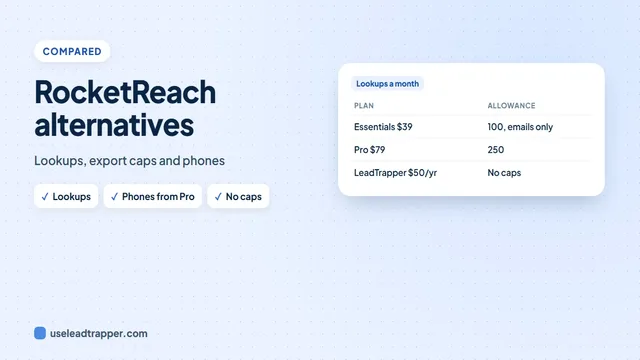
| RocketReach Essentials | $19 a month billed yearly ($229), or $39 monthly | Emails only, 1,200 exports a year on yearly billing | RocketReach alternative |
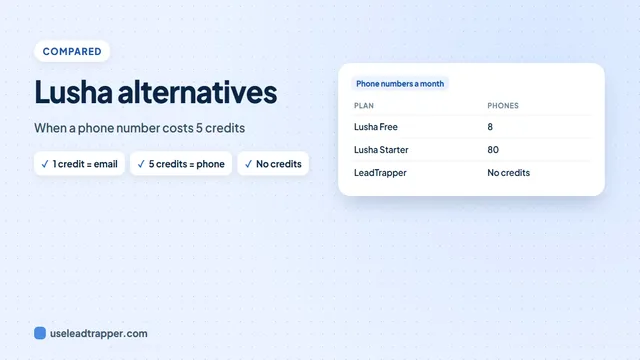
| Lusha Starter | $37.45 a month billed yearly, or $49.90 monthly | 400 credits a month; a phone costs 5 credits | Lusha alternative |
| Apollo Basic | $49 per seat a month billed yearly, or $65 monthly | 30,000 credits per seat a year, email sequences | Apollo.io alternative |
All three sell access to a database of named people, priced by credits or lookups, which is the same idea as ZoomInfo at a smaller scale. Seamless.AI also sells to small teams, but like ZoomInfo it shows no prices; see our Seamless.AI alternative guide.
Which Option Fits Which Customer
Pick by who you sell to, not by brand. Start from the table, then test the shortlist on your own accounts.
| You sell to | What matters most | Where to look |
|---|---|---|
| Named roles (VP, head of) at large companies | A database with org data and CRM sync | ZoomInfo, or a priced one: Apollo, RocketReach, Lusha |
| Local businesses (clinics, restaurants, agencies) | Their Maps listing and own website | Google Maps scraper plus website reading |
| Companies in Germany, Austria, Switzerland | Coverage in that country and the local consent rules | Test any vendor on 20 German companies first; see B2B leads in Germany |
| A team of one to five, no budget for a contract | A price you see before talking to anyone | Free tiers to test, then a plan with a public price |
| Phone or WhatsApp outreach | Numbers you can check before sending | A tool with a number check built in |
Two vendor guides (Clay and Cognism, both sell competing products, so treat this as their claim) say ZoomInfo’s coverage is thinner outside North America and that non-US data can cost extra. Whether that is true for your market is something only a test shows.
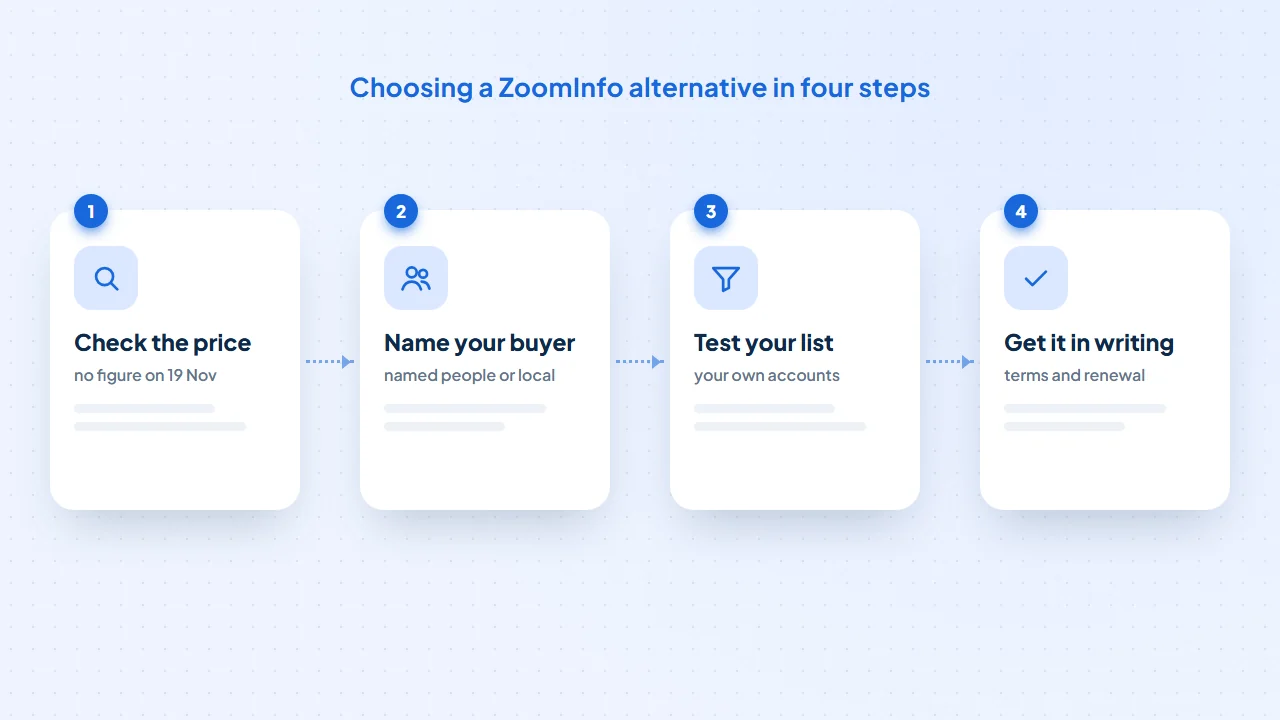
Before you pay anyone, run this checklist:
- Write down 20 companies you already know and check how many contacts each tool returns for them.
- Ask what exactly one credit buys, and whether a re-export costs another.
- Ask how often you pay and what happens at renewal.
- Check that a free tier or trial exists, and treat it as a test, not as production.
- Confirm in writing the price you will pay in month 13.
If Your Customers Are Local Businesses
A people database is built around companies with org charts. A dental clinic, a restaurant group or a building contractor has a few owners and managers, and they publish how to reach them: on Google Maps and on their own website.
LeadTrapper, a Windows app, collects exactly that:
- Every business of a type in a city. The Google Maps scraper searches any business type and splits big cities into districts to get past the roughly 120 results one search shows.
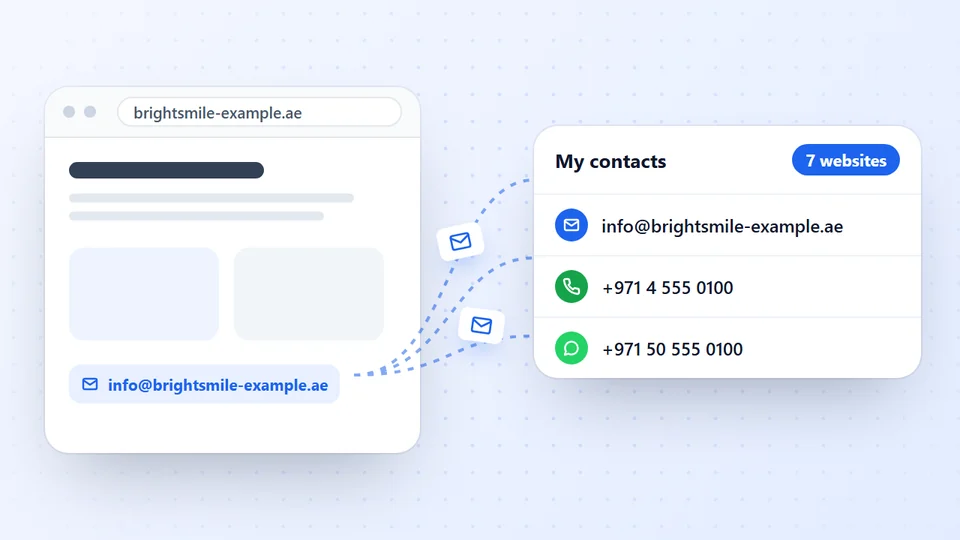
- The contacts on their website. LeadTrapper’s Email Finder reads each site’s contact, team, about and branch pages for emails, phones, WhatsApp numbers, addresses and social profiles, and marks the owners and managers the business names as decision makers.
- People by role, where you need them. The LinkedIn scraper lists profiles by keyword, job title and city, with name, headline and location. It collects no contact details, so you’d pair it with the Email Finder on the company’s website.
- WhatsApp, checked and sent. The Number Filter marks which numbers are on WhatsApp, and the bulk sender sends a personalised message to the list.
Our guide to finding the decision makers in a company walks through that method step by step.
Try the Email Finder free for 14 days
The Comparison Table
| Compared | ZoomInfo | LeadTrapper |
|---|---|---|
| Price | Not published; contact sales | $50 a year, shown on the site |
| Pricing model | Licences, credits and features in one contract | One yearly price, no credits |
| How you start | Sales call | 14-day free trial, no card |
| Data source | Its own database of companies and people | Google Maps and each business’s own website, read when you run it |
| Named people at large companies | Its main strength | Only people a business names on its site, plus LinkedIn profiles by role |
| Local businesses | Depends on its database | Any business type in any city on Google Maps |
| Not on its pricing page | Number check and bulk sending built in | |
| Where it runs | Online platform | Windows app on your own computer |
When ZoomInfo Is Still the Right Call
ZoomInfo makes sense for larger sales and marketing teams that want company data, contact data, intent signals and CRM integrations under one contract, and have the budget and time for a sales process.
For a small business, start with what you sell and to whom. Selling to named roles at bigger companies points to a priced database such as Apollo, RocketReach or Lusha. Selling to local businesses points to their own listings and websites, which is what LeadTrapper reads. Our guide to buying or building B2B lead lists covers the trade-off in more depth.
Whichever you choose, the contacts come with rules: CAN-SPAM in the US, and privacy law in the EU and UK for any email that names a person. This is not legal advice.
Where LeadTrapper Finds Leads
LeadTrapper collects leads from each of these sources in one Windows app, then checks the numbers and sends the WhatsApp messages from the same place.
- Google Maps Scraper: Business leads from any city.
- Facebook Scraper: Advertisers, pages and group members.
- Instagram Scraper: Leads from profiles and hashtags.
- TikTok Scraper: Creators, hashtags and commenters.
- LinkedIn Scraper: Profiles by role and city.
- Email Finder: Emails from business websites.
Frequently Asked Questions
One that shows its price and lets you pay monthly or yearly without a sales call. Apollo, RocketReach and Lusha do that for named people at companies. If your customers are local businesses, LeadTrapper builds the list from Google Maps and business websites for $50 a year.
ZoomInfo doesn't publish prices. On 19 November 2026 its pricing page asked visitors to get pricing from sales, and said the price depends on licences, credit usage and features. We don't quote third-party estimates, because they can't be checked.
Apollo has a free plan with 900 credits per seat a year, and Lusha has one with 40 credits a month. LeadTrapper has a 14-day free trial with every feature, then costs $50 a year.
Yes. ZoomInfo's pricing page says each export costs one credit, for a contact or a company profile. Its marketing packages list included credits, such as 75,000 on Marketing Demand.
Ask for the price in writing, what one credit buys, how often you pay, what happens at renewal, and how many contacts it holds in your country and niche. Then test it on a list of your own accounts, because demo data always looks complete and your own list shows the real fill rate.
No. It has no database of people, intent data or org charts. It finds businesses on Google Maps, reads each business's own website for emails, phones, WhatsApp numbers and named decision makers, and sends WhatsApp campaigns. For local businesses that's often all you need.
About LeadTrapper
LeadTrapper is a Windows app for finding business leads and contacting them on WhatsApp. It collects business contacts from Google Maps, Instagram, Facebook, TikTok, LinkedIn and business websites, checks which numbers are on WhatsApp with its Number Filter, and sends personalised campaigns with automatic delays from one or more WhatsApp accounts. It also has a chatbot, a shared inbox for every account, and Store Orders for online shops. It installs from the Microsoft Store, and the full app is free for 14 days, then $50 a year. Free web tools, browser extensions and a Wix app are listed on the Free Tools page.
A Price You Can See: $50 a Year
The Google Maps scraper, Email Finder, Number Filter and WhatsApp bulk sender all come with LeadTrapper. All features included, 14 days free.