In this article 9 sections
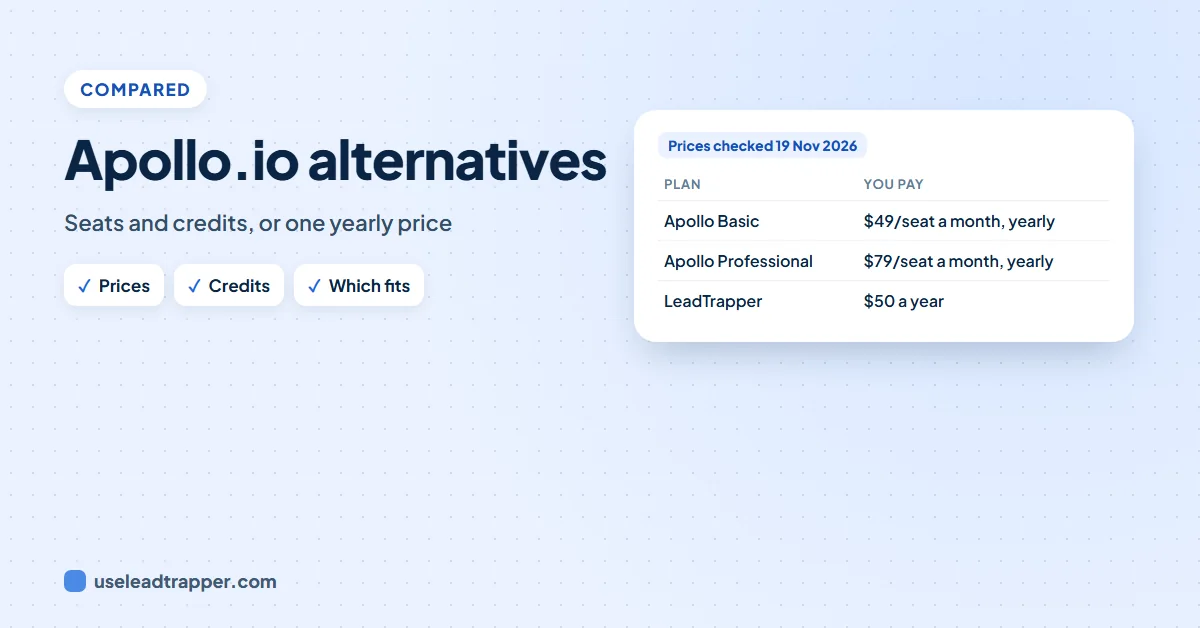
Apollo.io's Basic plan costs $49 per seat a month billed yearly, or $65 monthly, and its credits reset every cycle. If you sell to local businesses rather than named people at large companies, LeadTrapper builds the list from Google Maps and each business's own website for $50 a year, with no credits.
- On 19 November 2026 Apollo's pricing page showed Basic at $49, Professional at $79 and Organization at $119 per seat a month on annual billing, or $65 and $99 a month on monthly billing. Organization is annual only, with at least 3 seats.
- Basic includes 30,000 credits per seat a year on annual billing, or 2,500 a month on monthly billing. Unused credits expire at the end of each cycle, including add-on credits you bought.
- Apollo is a database of named people plus an email sequencing tool. It fits teams that sell to companies with their own domains and want to email named roles.
- LeadTrapper takes a different route: it finds businesses on Google Maps and reads the contacts each business publishes on its own website. It costs $50 a year with no credits and no seats.
- The honest split: Apollo for named people at mid-size and large companies, LeadTrapper for local and small businesses, where the website and the Maps listing hold the contacts.
Apollo.io is one of the most used prospecting tools, and its free plan pulls many people in. The questions start when a team grows past the free credits: every seat is billed, every seat on an account must be on the same plan, and credits that aren’t used by the end of the cycle are gone. This guide sets out what Apollo costs today, what it’s built for, and when a cheaper tool does the job. LeadTrapper is ours, and we say so wherever it appears.
What Apollo Costs
Apollo’s entry paid plan costs $49 per seat a month billed yearly, and every seat pays it. Prices as Apollo’s pricing page showed them on 19 November 2026, per seat:
| Plan | Billed yearly | Billed monthly | Credits |
|---|---|---|---|
| Free | $0 | $0 | 900 a year, granted monthly |
| Basic | $49 a month ($588 a year) | $65 a month | 30,000 a year upfront, or 2,500 a month |
| Professional | $79 a month ($948 a year) | $99 a month | 48,000 a year upfront, or 4,000 a month |
| Organization | $119 a month, minimum 3 seats | Annual only | 72,000 a year upfront |
| LeadTrapper | $50 a year | No credits |
A few terms from Apollo’s FAQ matter more than the headline price:
- Credits expire. Unused credits end with the billing cycle and don’t roll over. That includes add-on credits you paid for.
- Add-ons renew. Extra credits are charged straight away and renew every cycle until you drag the slider back to zero.
- One plan per account. You can’t put one person on Professional and the rest on Basic.
- Annual means annual. Moving from annual to monthly means waiting for the year to end; mid-cycle downgrades on annual plans aren’t allowed.
- Internal use only. Apollo’s standard plans don’t allow using its data to serve your own clients. An agency building lists for customers needs a separate agreement.
- Credits are pooled and granted upfront. On 21 November 2026 the pricing page said credits are shared across the team and granted at the start of each billing cycle. Apollo’s page about credits says an email never costs more than 1 credit per contact; it didn’t show a figure for phone numbers when we checked.
What You Get for the Money
Apollo sells access to a people database and a sales platform; the price only pays off if you use both. It is two products in one: a database of people and companies, and a sales platform with email sequences, a dialer, call recording and CRM sync. Credits pay for revealing emails and phone numbers, and for other actions in the platform.
That’s a good deal when your buyers are named roles at companies with their own domains, such as heads of marketing at software firms, and you’ll send sequences from the same tool. It’s less of a deal when:
- Your buyers are local businesses. Clinics, restaurants, real estate offices and trades often aren’t in a people database in any depth, and their best contact is the one on their own website or Maps listing.
- You sell on WhatsApp or by phone. In much of the Gulf, South Asia, Latin America and Africa, a business answers WhatsApp sooner than email.
- You’re one or two people. Seat pricing and expiring credits hurt most when usage is uneven from month to month.
A Different Route to the Same Leads
LeadTrapper doesn’t keep a database. It’s a Windows app that builds a fresh list each time, from the places local businesses publish their own details.
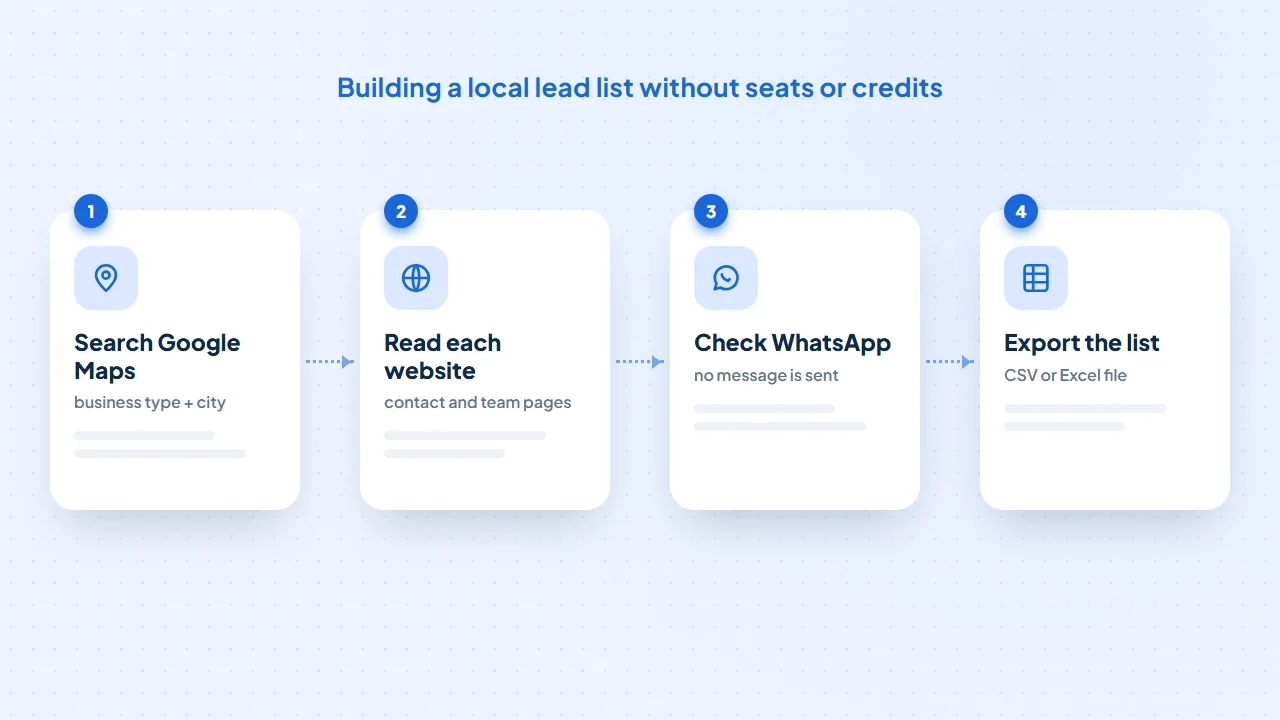
- Find the businesses. The Google Maps scraper searches a business type in any city and, in unlimited scan mode, splits the city into districts to get past the roughly 120 results one search shows. It collects name, phone, address, rating, reviews and website.
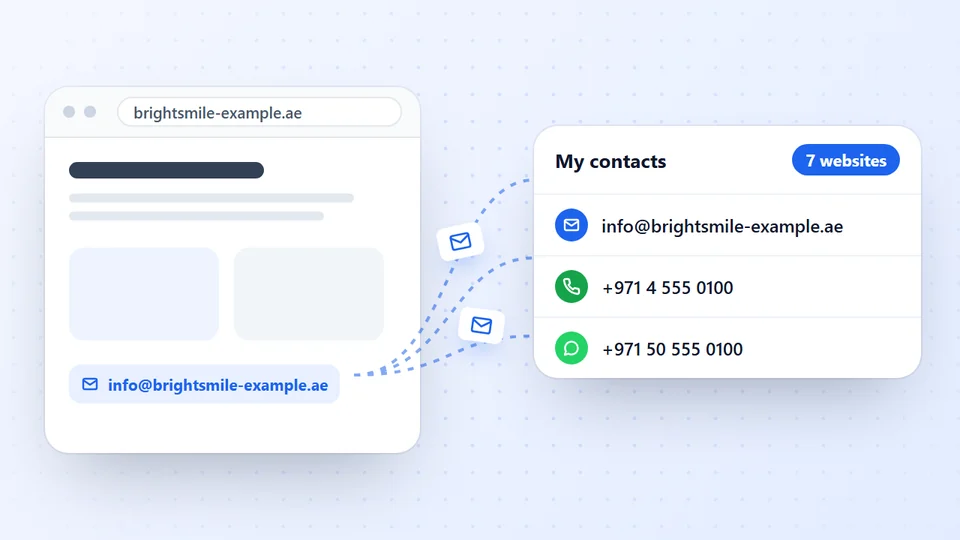
- Read their websites. LeadTrapper’s Email Finder opens each website’s contact, team, about and branch pages and collects the emails, phone and WhatsApp numbers, addresses and social profiles the business publishes. Owners, founders and managing directors named on the site are marked Decision maker, with their job title.
- Check and send. The WhatsApp Number Filter marks which numbers are on WhatsApp, and the list goes into the WhatsApp bulk sender or out as a CSV, or as HubSpot and Pipedrive import files.
It never guesses an address from a name pattern. When a site publishes no email, you get its contact form and phone numbers instead. We publish how often it finds what’s there in the hand-checked accuracy test of 190 websites, including what it misses.
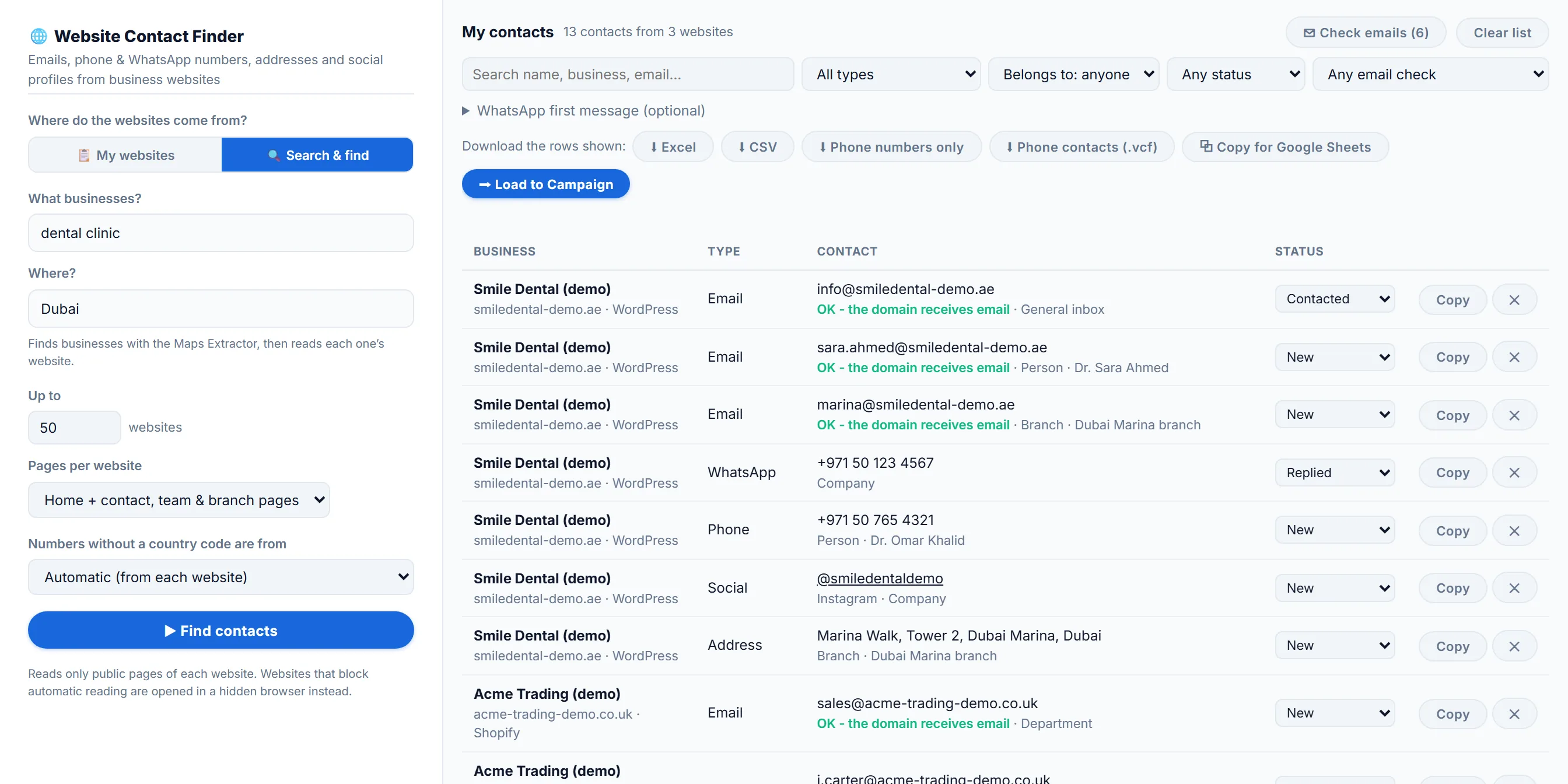
Try the Email Finder free for 14 days
Worked Example: 60 Agencies in Dubai
For a local market, the cost difference is easiest to see on one real list. On 24 September 2026 we ran the Google Maps scraper for real estate agencies in Downtown Dubai. It found 60 agencies in about 13 minutes, and the published results were:
| Field | Share of the 60 | About how many |
|---|---|---|
| Phone number | 98% | 59 |
| Website | 97% | 58 |
| 47% | 28 | |
| Social profile | 45% | 27 |
| WhatsApp link | 32% | 19 |
That run used no credits, and a second or tenth run costs nothing extra: the year is $50. On Apollo, the same agencies would first have to be in its database, and each email revealed draws on the seat’s credits, inside a seat that costs $588 a year on Basic. Other runs from the same day, including two that Google refused, are in the Google Maps scan results we published; the 28 emails can be topped up by running the 58 websites through the Email Finder.
The Comparison Table
| Compared | Apollo.io | LeadTrapper |
|---|---|---|
| How it finds contacts | Searches its own database of people and companies | Finds businesses on Google Maps, then reads each business’s website |
| Entry paid plan | $49 per seat a month billed yearly, or $65 monthly | $50 a year |
| Pricing model | Per seat, plus credits that expire each cycle | One yearly price, no seats or credits |
| Free option | Free plan, 900 credits per seat a year | 14-day free trial, every feature |
| Named people at large companies | Its main strength | Only people the business names on its own site |
| Local businesses | Limited to what’s in its database | Any business type in any city on Google Maps |
| Not on its pricing page | Number check and bulk sending built in | |
| Email sequences | Yes, on every plan | No; WhatsApp sending, or export to your email tool |
| Where it runs | In the browser, on Apollo’s servers | Windows app on your own computer |
Alternatives by What You Need
The right Apollo alternative depends on which part of Apollo you’re replacing: the people database, the email finding or the sequences. Vendor round-ups such as Clay’s and Kixie’s make the same point. This table matches the common needs to the kind of tool that fits, with prices from our own guides.
| What you need | Tool that fits | How it charges | Our guide |
|---|---|---|---|
| Named roles at mid-size companies, plus email sequences | Apollo | Per seat, credits expire each cycle | This page |
| Emails at companies whose domain you already know | Hunter.io, Snov.io | Monthly credits; Hunter from 34€ a month billed yearly | Hunter.io alternatives compared |
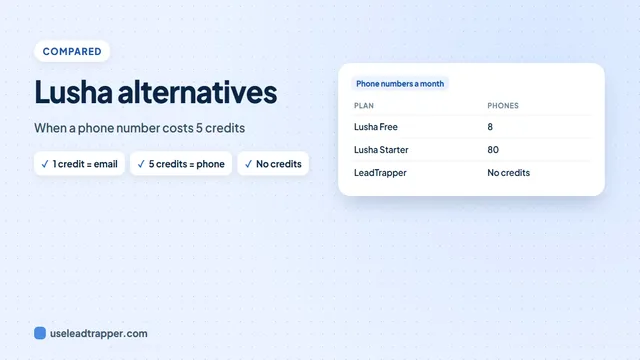
| Quick phone and email lookups of named people | Lusha | Credits: 1 for an email, 5 for a phone | Lusha alternative guide |
| Lookups and exports, capped per plan | RocketReach | Essentials $39 a month for 100 lookups, emails only | RocketReach alternative guide |
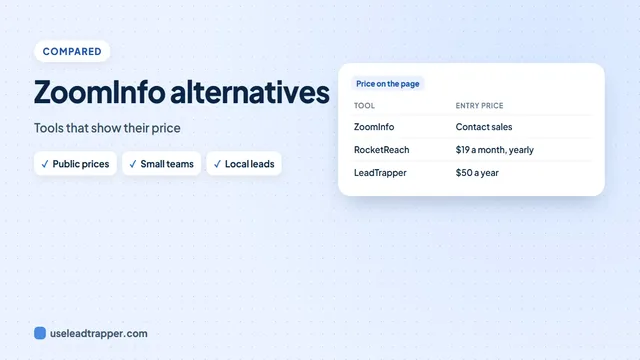
| Enterprise data with buying signals | ZoomInfo | No public prices; contact sales | ZoomInfo alternative guide |
| Local businesses, phone and WhatsApp first | LeadTrapper | $50 a year, no seats or credits | This page |
Test an Alternative Before You Switch
Run one real list through both tools before you cancel anything. A feature table can’t tell you whether a tool knows your market.
- Use 50 targets you'd really sell to. Same companies or the same business type and city in both tools, so the counts compare.
- Count what each one finds. Emails, direct phone numbers, WhatsApp numbers and named decision makers, not just rows.
- Send a small batch and watch bounces. Vendor guides such as Findymail's treat a bounce rate above 5% as a data problem; a high rate hurts your sending domain whatever the tool cost.
- Read the credit rules. Whether credits roll over, whether they're pooled across the team, and what an export or a phone number costs.
- Check the export. Open the CSV in your CRM or spreadsheet before you commit to a year.
- Price the real team. Multiply per-seat prices by every seat you need, for twelve months.
- Plan the opt-outs. Keep one do-not-contact list that every tool and every sender checks.
Which One Fits
Apollo fits a sales team selling to mid-size and large companies, where the buyer is a named role and email sequences are the main channel. If that’s you but Apollo’s price is the problem, compare the per-lookup plans in our guides to the RocketReach alternative and the Lusha alternative, and the enterprise end in the ZoomInfo alternative guide.
LeadTrapper fits if you sell to local or small businesses, if your market answers WhatsApp faster than email, or if you’d rather pay once a year than track credits. Agencies use it to find clients for websites and ads, as our guide on how to find clients for a marketing agency shows, and suppliers use it to list every clinic, cafe or contractor in a city.
Some teams use both: Apollo for named contacts at larger accounts, LeadTrapper for the long tail of local businesses Apollo doesn’t cover well. For the free end of the market, our list of free lead generation tools covers Apollo’s free plan next to the others.
Whichever tool you pick, the rules on using the contacts are the same: in the US, CAN-SPAM requires your identity, an honest subject line and a working opt-out, and in the EU and UK, privacy law applies to any email that names a person. This is not legal advice.
The details are short enough to read before your first campaign. The FTC’s CAN-SPAM compliance guide says opt-outs must be honoured within 10 business days and puts penalties at up to $53,088 for each email that breaks the law. In the UK, the ICO’s guide to electronic mail marketing says you can email companies without prior consent, but sole traders and some partnerships count as individuals and need consent. Many small local businesses are sole traders, so check before you send.
Sources
- Apollo. Pricing, checked 19 and 21 November 2026.
- Apollo. What are Apollo credits?, checked 21 November 2026.
- Federal Trade Commission. CAN-SPAM Act: A Compliance Guide for Business.
- Information Commissioner's Office. Electronic mail marketing.
- LeadTrapper. Google Maps scan results, runs of 24 September 2026.
Where LeadTrapper Finds Leads
LeadTrapper collects leads from each of these sources in one Windows app, then checks the numbers and sends the WhatsApp messages from the same place.
- Google Maps Scraper: Business leads from any city.
- Facebook Scraper: Advertisers, pages and group members.
- Instagram Scraper: Leads from profiles and hashtags.
- TikTok Scraper: Creators, hashtags and commenters.
- LinkedIn Scraper: Profiles by role and city.
- Email Finder: Emails from business websites.
Frequently Asked Questions
It depends on who you sell to. For named people at companies with their own domains, other databases such as RocketReach or Lusha work the same way Apollo does, with credits or lookups. For local and small businesses, LeadTrapper finds them on Google Maps and reads each business's own website, for $50 a year with no credits.
On 19 November 2026 Apollo showed Free at $0 with 900 credits per seat a year, Basic at $49 per seat a month billed yearly or $65 monthly, Professional at $79 billed yearly or $99 monthly, and Organization at $119 per seat a month, annual only, with a minimum of 3 seats.
For local business leads, yes. LeadTrapper costs $50 a year for every feature, against $588 a year for one Apollo Basic seat on annual billing. It doesn't hold a database of named people, so it isn't a like-for-like replacement for prospecting large companies.
No. Apollo's FAQ says unused credits expire at the end of each billing cycle, and that applies to purchased add-on credits too. Add-on credits also renew automatically each cycle until you remove them.
LeadTrapper has a 14-day free trial with every feature and no card. After that it costs $50 a year. Apollo's Free plan stays free with 900 credits per seat a year.
Only the ones a business names on its own website. The Email Finder marks owners, founders, managing directors and general managers as decision makers, with their job titles, from team pages, legal notices and contact cards. It doesn't guess personal emails from name patterns.
Take 50 companies you'd really sell to and run the same list through Apollo and the alternative. Count how many emails and phone numbers each finds, send a small batch and check the bounce rate, and read the credit rules: whether credits roll over, are pooled across the team, and what an export costs. Then compare the yearly price for the number of seats you need.
Usually, but the rules depend on the country. In the US, the FTC's CAN-SPAM guide requires your identity, an honest subject line, a working opt-out honoured within 10 business days, and a postal address. In the UK, the ICO says you can email companies without prior consent but sole traders need consent. Keep a do-not-email list either way. This is not legal advice.
About LeadTrapper
LeadTrapper is a Windows app for finding business leads and contacting them on WhatsApp. It collects business contacts from Google Maps, Instagram, Facebook, TikTok, LinkedIn and business websites, checks which numbers are on WhatsApp with its Number Filter, and sends personalised campaigns with automatic delays from one or more WhatsApp accounts. It also has a chatbot, a shared inbox for every account, and Store Orders for online shops. It installs from the Microsoft Store, and the full app is free for 14 days, then $50 a year. Free web tools, browser extensions and a Wix app are listed on the Free Tools page.
Local Business Leads Without Seats or Credits
The Google Maps scraper, Email Finder, Number Filter and WhatsApp bulk sender all come with LeadTrapper. $50/year, all features included.