In this article 8 sections
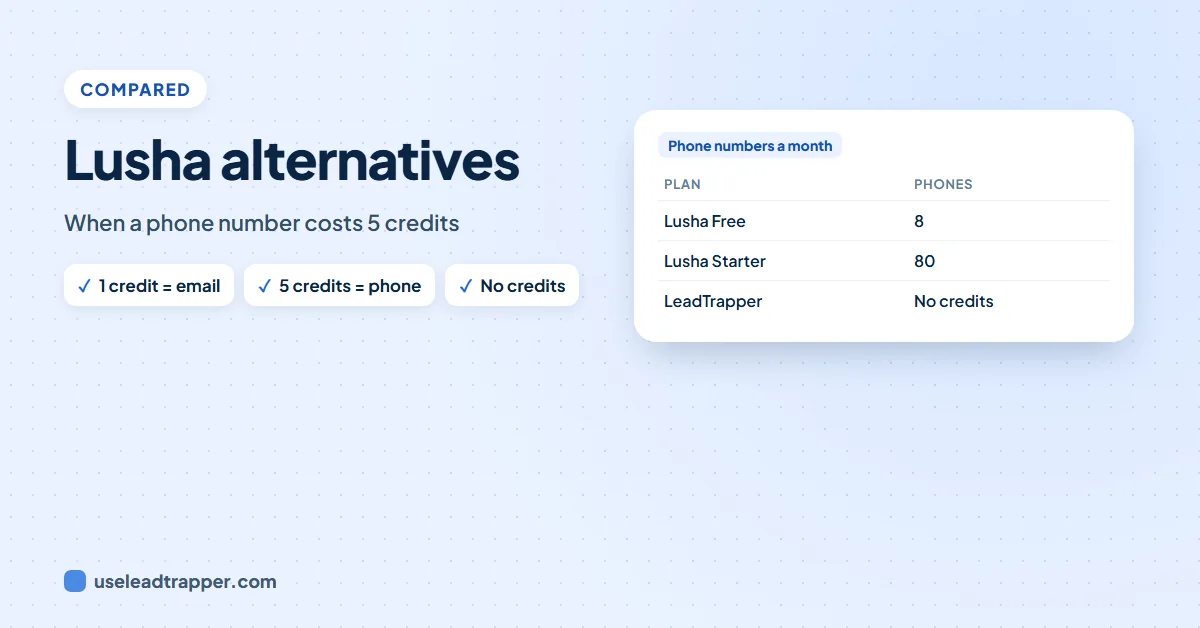
Lusha charges 1 credit for an email and 5 for a phone number, so its $49.90 Starter plan's 400 monthly credits buy 80 phone numbers. For local businesses, LeadTrapper collects the phone numbers they publish on Google Maps and their websites for $50 a year, with no credits.
- Lusha's pricing page on 19 November 2026 showed Free with 40 credits a month, Starter at $49.90 a month for 400 credits, Pro at $69.90 for 600 and Premium at $399.90 for 3,400. Yearly billing brings Starter to $37.45 a month ($449.10 a year).
- An email costs 1 credit and a phone number costs 5. Starter's 400 credits are 400 emails, or 80 phone numbers, or a mix.
- Monthly plans carry unused credits over up to twice the monthly amount; yearly plans reset unused credits at the end of the year. Plans renew automatically.
- Lusha's strength is direct contact details for named people. Phone numbers a business publishes for customers are a different thing, and they're free to collect.
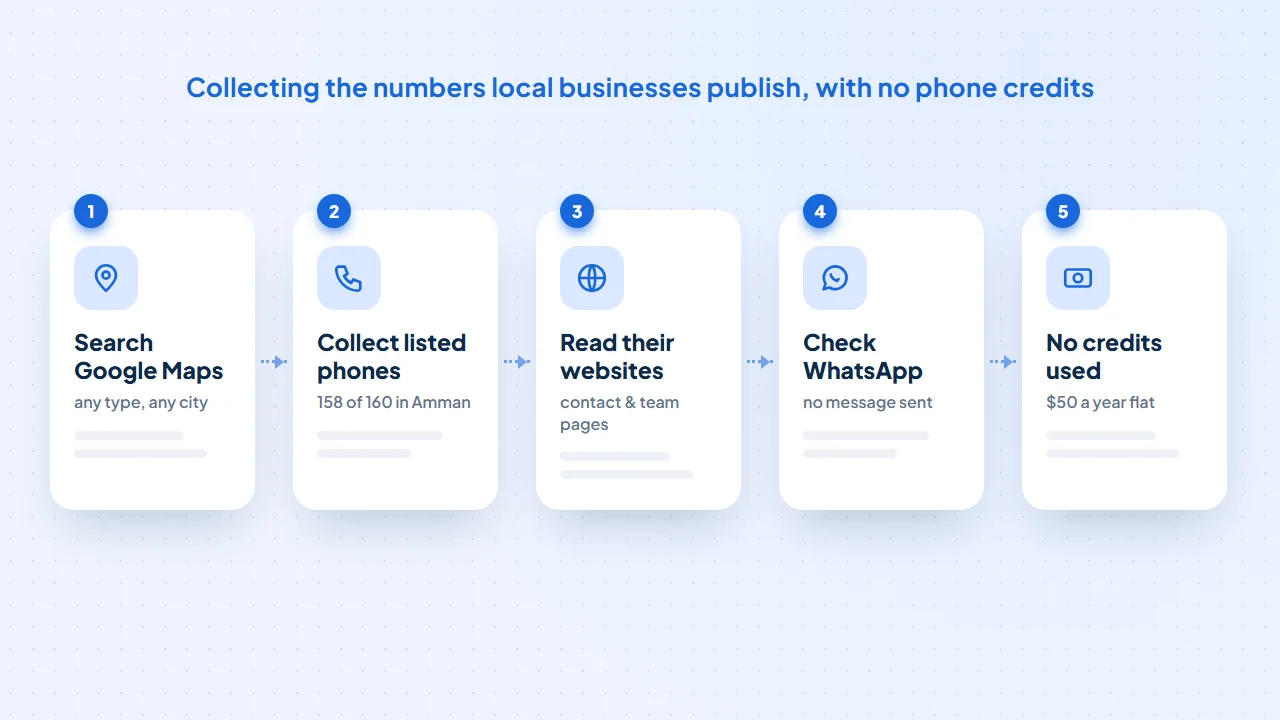
- LeadTrapper collects the numbers local businesses publish on Google Maps and their own websites, checks which are on WhatsApp, and costs $50 a year with no credits.
- Lusha's help docs say a single reveal that finds nothing is free and re-viewing a contact costs 0 credits, but bulk reveals charge for partial matches and wrong data is not refunded automatically.
People usually look for a Lusha alternative after the first month of calling. Lusha prices a phone number at five times an email, so a phone-first team burns through credits much faster than the plan name suggests. This guide shows what Lusha’s credits really buy, and when a different kind of tool is the better fit. LeadTrapper is ours, and we say so wherever it appears.
What Lusha Costs
Lusha is free for 40 credits a month, and paid plans start at $49.90 a month for 400 credits. Prices as Lusha’s pricing page showed them on 19 November 2026, and still showed them on 21 November, in US dollars:
| Plan | Monthly | Billed yearly | Credits |
|---|---|---|---|
| Free | $0 | $0 | 40 a month |
| Starter | $49.90 | $37.45 a month ($449.10 a year) | 400 a month, or 4,800 a year |
| Pro | $69.90 | $52.45 a month ($629.10 a year) | 600 a month, or 7,200 a year |
| Premium | $399.90 | $299.95 a month ($3,599.10 a year) | 3,400 a month, or 40,800 a year |
| Scale | Contact sales | Contact sales | Custom |
| LeadTrapper | $50 a year | No credits |
Plans renew automatically. Monthly plans carry unused credits over, up to twice the monthly amount; yearly plans reset unused credits at the end of the year. Teams of more than five users go through Lusha’s sales team.
The 5-Credit Phone Number
Lusha’s pricing page states it plainly: a verified email costs 1 credit, a phone number costs 5. Here’s what each plan covers if you only reveal phone numbers:
| Plan | Credits a month | Phone numbers a month | Cost per phone number |
|---|---|---|---|
| Free | 40 | 8 | Free |
| Starter, monthly | 400 | 80 | About $0.62 |
| Pro, monthly | 600 | 120 | About $0.58 |
| Premium, monthly | 3,400 | 680 | About $0.59 |
The same maths by daily calling volume, assuming every reveal finds a number and you reveal phones only (20 working days a month, monthly billing):
| Calls a day | Phones a month | Credits needed | Smallest Lusha plan that covers it | Price a month |
|---|---|---|---|---|
| 2 | 40 | 200 | Starter (400) | $49.90 |
| 5 | 100 | 500 | Pro (600) | $69.90 |
| 6 | 120 | 600 | Pro (600) | $69.90 |
| 10 | 200 | 1,000 | Premium (3,400), or Pro plus bought credits | $399.90 |
| 20 | 400 | 2,000 | Premium (3,400) | $399.90 |
| 34 | 680 | 3,400 | Premium (3,400) | $399.90 |
| 50 | 1,000 | 5,000 | Scale | Contact sales |
Lusha’s pricing page says you can buy extra credits at any time but doesn’t list their price, so the 10-a-day row may cost less than Premium.
For a team that calls 20 businesses a day, that’s roughly 400 numbers a month, which is past Pro and into Premium territory. That’s fine if each number is a decision maker’s direct line you couldn’t get any other way. It’s expensive if most of those numbers are already printed on the business’s own website.
Lusha's Credit Rules, Action by Action
A reveal costs credits only when Lusha finds the data, but bulk reveals and wrong numbers are where credits leak. These are the rules on Lusha’s help page on how credits are counted, read on 21 November 2026:
| What you do | Credits |
|---|---|
| Reveal an email | 1 |
| Reveal a phone number | 5 |
| Reveal email and phone together | Up to 6 |
| Waterfall, confirmed work email | 2 per contact |
| Waterfall, confirmed phone number | 8 per contact |
| Re-view a contact you already revealed | 0 |
| Single reveal that finds nothing | 0 |
| Bulk reveal | Charged for every contact in the selection, including partial matches |
| Data that turns out wrong | Not refunded automatically |
On wrong data, Lusha’s page on reporting incorrect data says you can flag the detail in the product and ask support for a manual review, decided case by case.
A worked example. A two-person team reveals 100 contacts in a month and wants both email and phone for each. That’s up to 6 credits a contact, so up to 600 credits: the whole Pro plan at $69.90. If they reveal 60 phones and 100 emails instead, it’s 300 + 100 = 400 credits, exactly Starter. If they select 150 contacts in one bulk reveal and 40 come back with only an email, Lusha still charges for all 150.
Competitor guides say the same thing in other words. Clay’s guide says credit caps arrive quickly on the lower tiers, and Snov.io’s says users find the free plan limited because a phone costs 5 credits. Both are vendors ranking their own tools first, so test any tool on a sample of your own target list before you pay.
Published Numbers Are a Different Job
Most local businesses want to be called. Clinics, salons, restaurants, contractors, shops and agencies put their number on Google Maps and on their website, often with a WhatsApp button. Collecting those numbers needs no database and no credits; it just takes time to do by hand.
Which source fits depends on which contact you need:
| Contact you need | Where it usually is | Credits on Lusha | With LeadTrapper |
|---|---|---|---|
| Main business phone | Google Maps listing and website | 5 | Collected from the listing |
| WhatsApp number | WhatsApp button or link on the listing or website | Not on its pricing page | Collected, then checked with the Number Filter |
| General email (info@, bookings@) | Contact page | 1 | Collected from the website |
| Owner or manager the business names | Team or about page | 1 for email, 5 for phone | Collected when the site names them |
| A named person’s private mobile | Not published | 5 | Not found |
| A buyer at a large company | Not published | 1 to 6 | Not found |
LeadTrapper does that part for you, on your own Windows computer:
- Find the businesses. The Google Maps scraper searches any business type in any city. In a September 2026 test search for dentists in Amman, 158 of 160 businesses came back with a phone number.
- Read their websites. LeadTrapper’s Email Finder reads each website’s contact, team and branch pages for more numbers and emails, labels phones as mobile or landline where the format shows it, and marks the best contact for each business. Our guide to finding a business phone number shows where businesses publish them.
- Check WhatsApp. The WhatsApp Number Filter marks which numbers are on WhatsApp, so you can message the ones that are and call the rest.
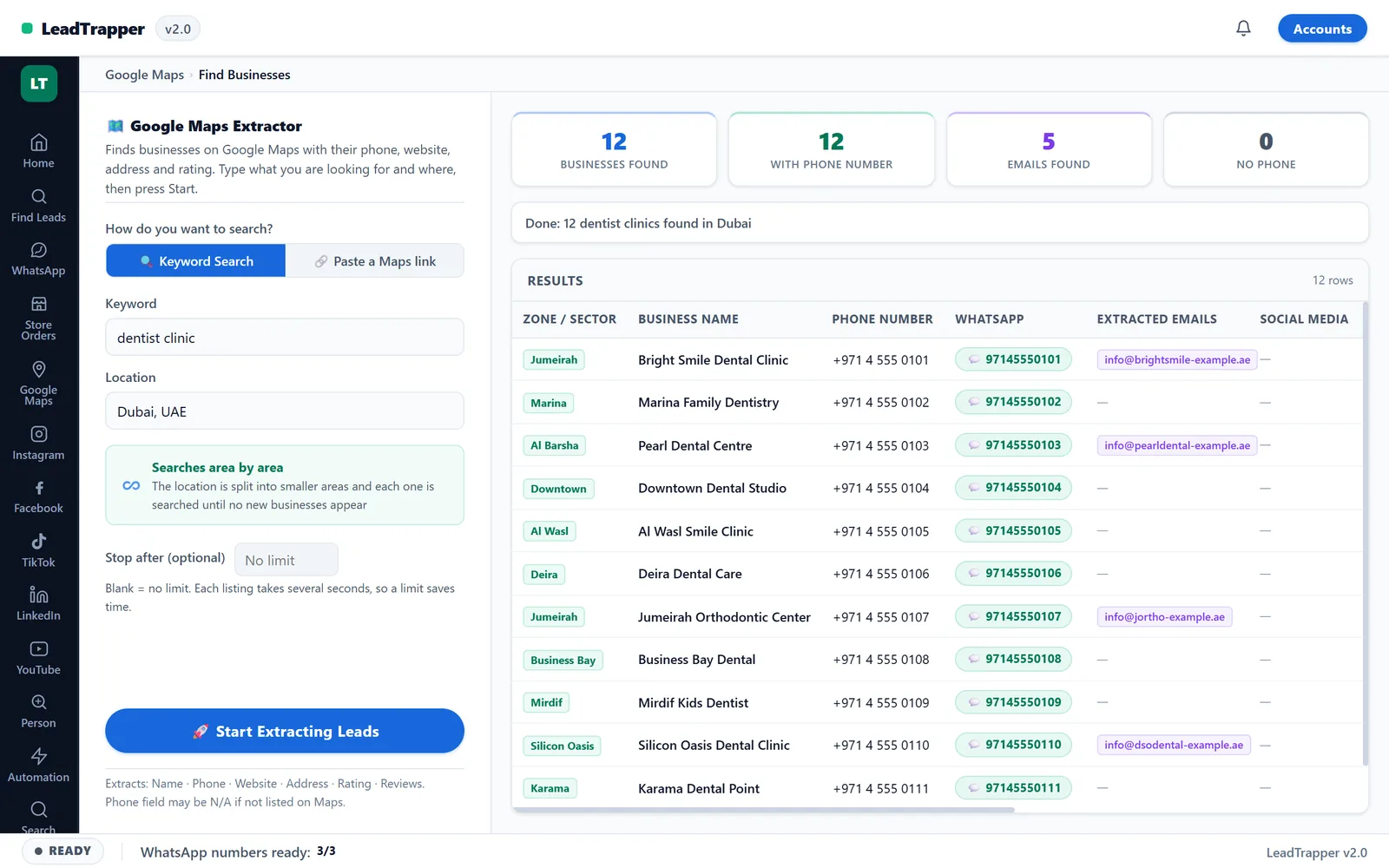
How many numbers come back depends on the trade and the city. In our own September 2026 runs, 98% of 60 real estate agencies in Downtown Dubai and 93% of 60 dentists in Cairo’s Nasr City had a phone number, while emails were rarer (47% and 18%). The full figures are in our Google Maps scan results test.
What it won’t do is find a private mobile number a person never published. For that, a database like Lusha is the tool, and our guide to how reliable B2B lead phone numbers are covers what to expect from bought numbers.
Try the Email Finder free for 14 days
The Comparison Table
| Compared | Lusha | LeadTrapper |
|---|---|---|
| Where numbers come from | Its database of people | Google Maps listings and each business’s own website |
| Entry paid plan | $49.90 a month, or $37.45 billed yearly | $50 a year |
| Cost of a phone number | 5 credits | No credits |
| Free option | 40 credits a month | 14-day free trial, every feature |
| Named people’s direct numbers | Its main strength | Only numbers the business publishes |
| WhatsApp check | Not on its pricing page | Built in, with the Number Filter |
| Bulk messaging | Not on its pricing page | WhatsApp bulk sender included |
| Where it runs | In the browser, on Lusha’s servers | Windows app on your own computer |
Which One Fits
Lusha fits a sales team calling named decision makers at companies, where one direct line is worth a few dollars because it skips the switchboard.
LeadTrapper fits a team calling or messaging local businesses, where the published number is the right number and paying 5 credits for it makes no sense. It’s also the better fit where WhatsApp matters more than email.
Comparing database tools? Our guides to the ZoomInfo alternative, the Apollo.io alternative and the RocketReach alternative set out their prices the same way, and our list of free lead generation tools covers Lusha’s free plan next to the others.
Checklist Before You Switch
Run these six checks on any Lusha alternative, ours included, before you pay:
- Test your own list. Take 20 businesses you already know and count how many correct numbers each tool returns.
- Price a real month. Count phones and emails separately, since Lusha charges 5 credits for one and 1 for the other.
- Check what a miss costs. On Lusha a single not-found reveal is free, but a bulk reveal charges for partial matches.
- Check renewal and rollover. Lusha plans renew automatically, and yearly credits reset at the end of the year.
- Check the channel. If your customers answer WhatsApp faster than email, you need a WhatsApp check, which Lusha’s pricing page doesn’t list.
- Check the region. Vendor guides from Cognism and Snov.io both say Lusha’s coverage varies by region, so test numbers in the countries you sell to.
Calling and Email Rules by Country
The data source doesn’t change the rules: a number from Lusha and a number from a Maps listing are treated the same. These apply to most B2B teams, as the regulators’ own pages state them:
| Where | Calls to businesses | Emails to businesses |
|---|---|---|
| United States | The FTC’s Do Not Call Q&A for sellers says most calls to a business to sell to that business are exempt; if you must use the registry, refresh your list at least every 31 days | The FTC’s CAN-SPAM guide says there’s no exception for business email, and opt-outs must be honoured within 10 business days |
| United Kingdom | The ICO’s business-to-business marketing guidance says to screen against both the TPS and CTPS registers, plus your own do-not-call list | Companies don’t need to opt in, but sole traders and some partnerships do; a named person’s work email is still personal data under UK GDPR |
| WhatsApp, anywhere | WhatsApp expects people to have agreed to hear from you | Not applicable |
Many other countries keep their own do-not-call lists. Check the rules where your contacts are. This is not legal advice.
Where LeadTrapper Finds Leads
LeadTrapper collects leads from each of these sources in one Windows app, then checks the numbers and sends the WhatsApp messages from the same place.
- Google Maps Scraper: Business leads from any city.
- Facebook Scraper: Advertisers, pages and group members.
- Instagram Scraper: Leads from profiles and hashtags.
- TikTok Scraper: Creators, hashtags and commenters.
- LinkedIn Scraper: Profiles by role and city.
- Email Finder: Emails from business websites.
Frequently Asked Questions
For named people's direct numbers, other databases such as Apollo or RocketReach work the same way, with credits or lookups. For local and small businesses, the number they publish on Google Maps and their own website is usually the right one to call, and LeadTrapper collects those for $50 a year with no credits.
Five. Lusha's pricing page on 19 November 2026 said a verified email costs 1 credit and a phone number costs 5, so the Starter plan's 400 monthly credits cover 80 phone numbers if you only reveal phones.
Lusha itself has a free plan with 40 credits a month, which is 8 phone numbers. Copying numbers from Google Maps by hand is free but slow past a few dozen businesses. LeadTrapper has a 14-day free trial with every feature, then costs $50 a year.
Only when the business publishes them. It collects the phone and WhatsApp numbers on the Maps listing and the business's own website, labels each as mobile or landline where the number format shows it, and marks the people a business names as owners or managers. It doesn't sell private mobile numbers from a database.
On monthly plans, unused credits roll over up to twice the monthly limit. On yearly plans, unused credits reset at the end of the cycle, according to Lusha's pricing page on 19 November 2026.
Not for a single reveal. Lusha's help page on how credits are counted says a not-found result is always free, and re-viewing a contact you already revealed costs 0 credits. Bulk reveals are different: they deduct credits for every contact in the selection, including those with only partial data. Credits for wrong data are not refunded automatically, though support will review a request.
It depends on the country. The US FTC says most calls to a business to sell to that business are exempt from the Do Not Call rules. In the UK, the ICO says to screen numbers against both the TPS and CTPS registers, plus your own do-not-call list, before live B2B calls. Check the rules where your contacts are; this is not legal advice.
About LeadTrapper
LeadTrapper is a Windows app for finding business leads and contacting them on WhatsApp. It collects business contacts from Google Maps, Instagram, Facebook, TikTok, LinkedIn and business websites, checks which numbers are on WhatsApp with its Number Filter, and sends personalised campaigns with automatic delays from one or more WhatsApp accounts. It also has a chatbot, a shared inbox for every account, and Store Orders for online shops. It installs from the Microsoft Store, and the full app is free for 14 days, then $50 a year. Free web tools, browser extensions and a Wix app are listed on the Free Tools page.
Every Number a Business Publishes, No Credits
The Google Maps scraper, Email Finder, Number Filter and WhatsApp bulk sender all come with LeadTrapper. $50/year, all features included.