In this article 6 sections
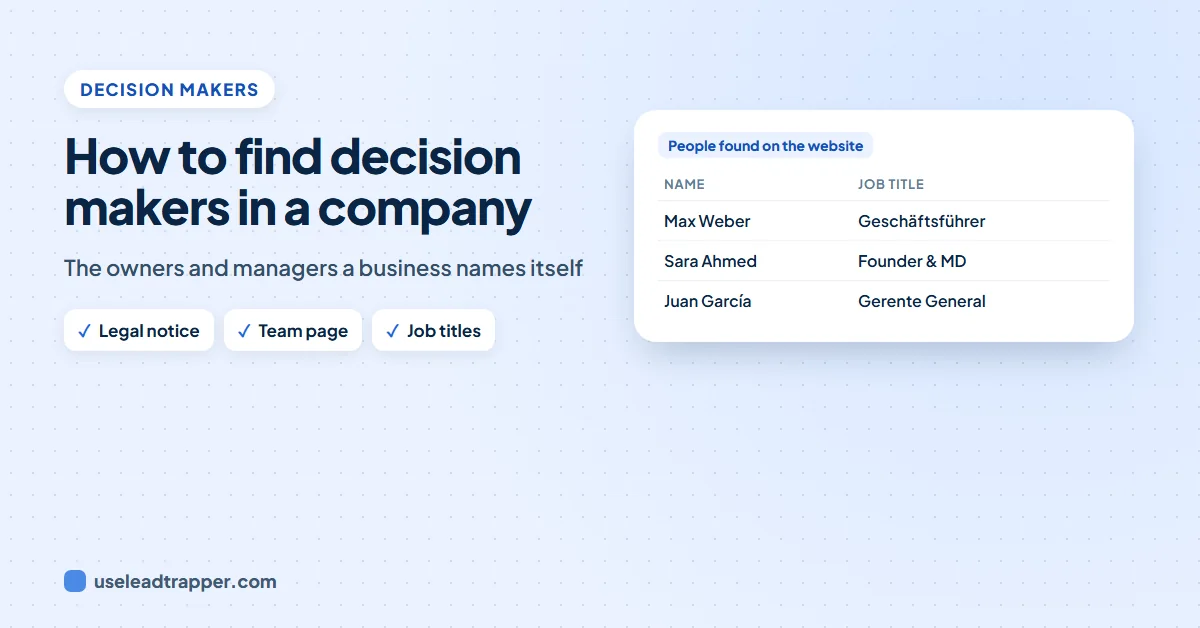
The decision maker is usually the owner of a small business, the managing director of a medium one, or the relevant department head at a large one. Companies publish these names in their legal notice (Impressum), team pages and public registers. The LeadTrapper app reads them from each website in bulk and marks them as decision makers, with job titles.
- At a small business the decision maker is usually the owner; at a medium one, the managing director or general manager; at a large one, the head of the department you sell to.
- Companies publish these names themselves: the legal notice (in Germany the Impressum must name who represents the company), the team or about page, contact cards and the website's built-in business details.
- Public registers such as Companies House in the UK list the directors of every registered company, free.
- A name is not an email. Write to an address the business published; a guessed one can bounce and is more sensitive under privacy laws.
- The LeadTrapper app reads the names and job titles each website publishes, in English, German, Spanish, Portuguese, Russian, Turkish and Arabic, marks owners, founders, managing directors and general managers as decision makers, and links an email only when the address is plainly theirs.
Selling to a company means reaching the person who can say yes. Writing to info@ often works at a small business, where the owner reads it, and rarely works at a company with fifty staff. This guide covers who that person is at different sizes of company, where companies publish their names, and how to collect them for a whole list of businesses without guessing anyone’s email.
Who the Decision Maker Is
The answer depends on the size of the company and on what you are offering.
| Company size | Usually decides | Where to find them |
|---|---|---|
| Owner-run, under about 10 people | The owner | Legal notice, about page, the general inbox |
| Small to medium | Managing director or general manager | Legal notice, team page, company register |
| Large | The head of the department you sell to, with the managing director signing off on large amounts | Team or leadership page, press releases |
A dental clinic buys through its owner or practice manager, an estate agency through its managing director, a hotel’s marketing software through its marketing or sales head. Match the role to the offer before you write.
Where Companies Publish Their Names
Most of the time you do not need a database. Companies publish their decision makers themselves, because the law asks them to or because they want to be found.
The legal notice. In Germany and Austria every business website must carry an Impressum. For a company it names the people who represent it, usually under “Geschäftsführer” (managing director) or “Vertreten durch” (represented by); for a sole trader it names the owner. Sites in France, Spain and Italy often name the director of publication or the company’s representative in their legal notice too.
The team, about and leadership pages. Clinics list their doctors, agencies their partners, larger companies their leadership team, each with a job title. Look for cards with a name and a role under it.
Contact cards and the website’s built-in business details. Some sites offer a downloadable contact card (.vcf) with the person’s job title, and many carry business details for search engines in their code, which can name the founder.
Public company registers. In the UK, Companies House lists the directors of every registered company, free, at find-and-update.company-information.service.gov.uk. Germany’s Handelsregister shows each company’s managing directors. Registers give you the name and role, not an email.
LinkedIn. A company page’s People tab lists staff with their job titles. Our LinkedIn scraper collects the name, headline and location from LinkedIn searches, but no emails or phone numbers.
Job Titles in Other Languages
When you sell abroad, the title on the page is in the local language. These are the ones that mean the person decides:
| Language | Owner or founder | Managing director or general manager |
|---|---|---|
| German | Inhaber, Inhaberin | Geschäftsführer, Geschäftsführerin, Vorstand |
| Spanish | Propietario, Fundador | Director General, Gerente General |
| Portuguese | Proprietário, Fundador, Sócio | Diretor Geral, Sócio-gerente |
| Russian | Владелец, Основатель | Генеральный директор, Директор |
| Turkish | Sahibi, Kurucu | Genel Müdür, Yönetim Kurulu Başkanı |
| Arabic | المالك، المؤسس | المدير العام، الرئيس التنفيذي |
A “manager” alone is usually not the person who decides: a sales manager or store manager runs a team, and the managing director signs.
A Name Is Not an Email
Once you have a name, the temptation is to guess the address: max.weber@company.de for Max Weber. Finder tools such as Hunter do this from a company’s usual pattern and show a confidence score. It works best at large companies with consistent patterns and often fails at small ones, where the owner reads info@ or uses a personal address. Our Hunter.io alternative guide compares the two approaches.
Two cautions. A guessed address that bounces harms your sending reputation; check that the domain can receive mail first, as our guide to checking if an email is valid shows. And a personal address you guessed is more sensitive under privacy laws than one the business published for contact. When the site gives a name but no personal email, write to the published address and name the person in your first line.
A Whole List at Once
Reading the legal notice and team page of fifty companies by hand takes a morning. The email finder in the LeadTrapper Windows app does the reading:
- Give it the companies. Paste a list of websites or load them from Excel or CSV, or type a business type and one or more cities and let the Google Maps scraper find the businesses first.
- It reads each website and its contact, team, about, branch and legal pages, one website at a time with a pause between them.
- It picks out the people. Names with their job titles from the Impressum or legal notice, team cards, contact cards and the website’s built-in business details, in English, German, Spanish, Portuguese, Russian, Turkish and Arabic. Owners, founders, managing directors and general managers are marked Decision maker; other staff are marked as team members.
- It links emails only when they are plainly theirs. max.weber@ next to “Geschäftsführer: Max Weber” becomes his email. A name with no matching address stays a name, with the company’s best contact next to it.
- Filter and use the list. In My contacts choose Belongs to: Decision makers (owner, director…), and How sure: ★ Best contact per business to keep one email and one phone per company. Every email and phone shows High, Medium or Low with the reasons.
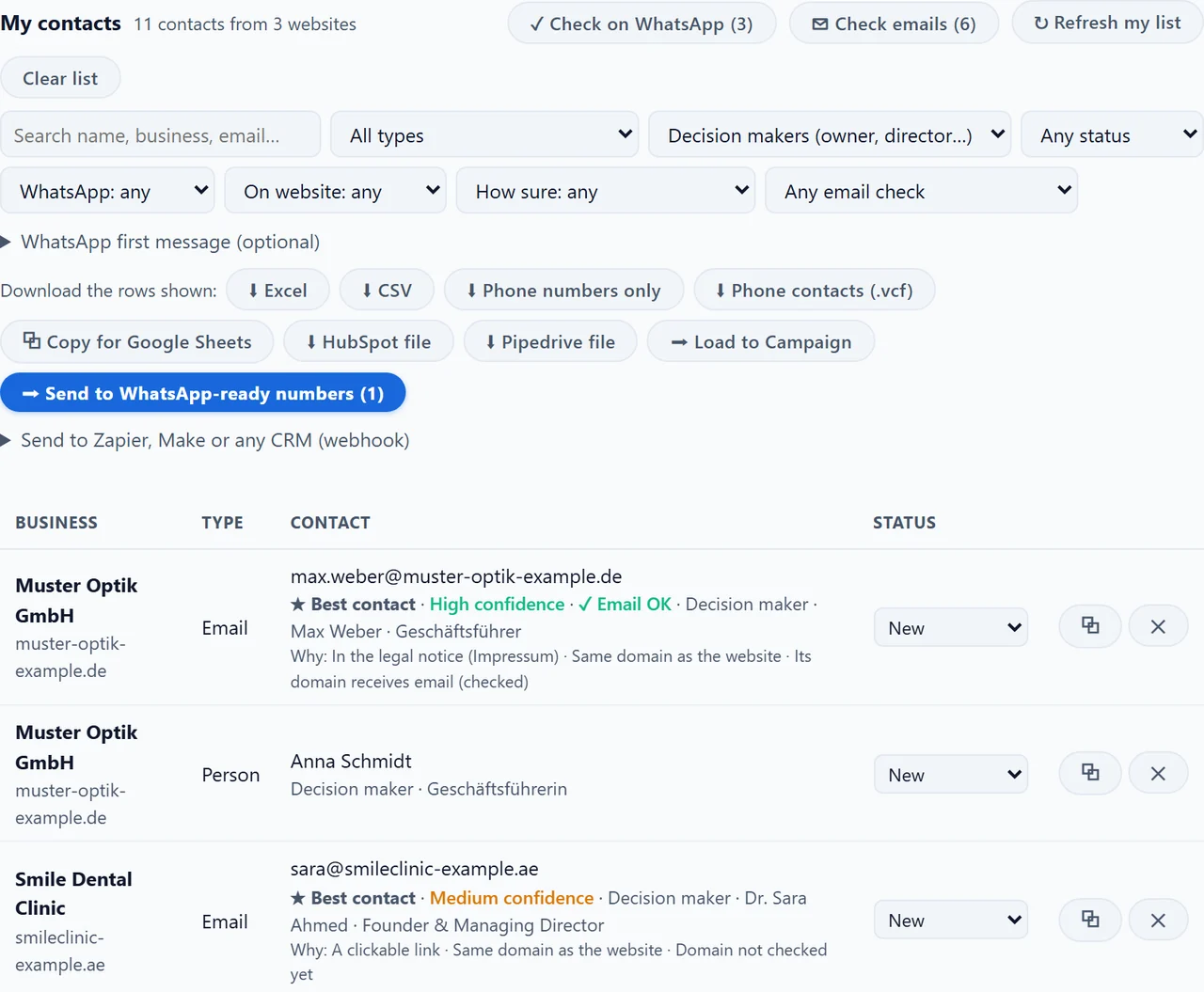
Then download the list as Excel or CSV, as a ready file for HubSpot or Pipedrive, or send it to Zapier or Make; our guide to exporting leads to HubSpot shows each step. The app can also mark which of the phone numbers are on WhatsApp and load those into the WhatsApp bulk sender.
For the general method, from footers to legal pages, see finding a website owner’s email and how to find business email addresses.
What the App Will Not Do
- It finds only the people a business names. If the website lists no one, there is no decision maker to find, and the company’s general inbox and phone are your way in.
- It never guesses an email address from a name or a pattern.
- It skips people who are not the business’s own: a client quoted in a testimonial, a “CEO at” another company, the web designer in the footer.
- It does not read LinkedIn profiles for this. Use the LinkedIn scraper separately when you need people a website does not show.
Write to decision makers the way you would want to be written to: one short, relevant message, who you are, and an easy way to say no.
Frequently Asked Questions
Usually the owner. In a business with a handful of staff the owner decides on suppliers, marketing and software, and often reads the general inbox (info@) themselves. The Impressum or legal notice usually names them.
The managing director or general manager decides on company-wide purchases. For anything that belongs to one team, such as marketing tools or recruitment, the head of that department decides, and the managing director signs off on large amounts.
On the company's own website: the legal notice, team, about and contact pages. Public registers list them too: Companies House in the UK shows the directors of every registered company for free, and the German Handelsregister shows the managing directors of German companies.
Tools can guess from a pattern such as firstname@company.com, but a guessed address can bounce, and writing to a personal address you guessed is more sensitive under privacy laws than writing to one the business published. LeadTrapper never guesses: it links an email to a person only when the site shows it and the address is plainly theirs.
Use a tool that reads each company's website and its legal, team and contact pages. In the LeadTrapper app, run the Email Finder on your list of websites, or on a business type in one or more cities, then choose Belongs to: Decision makers in My contacts. Each one shows their job title and how sure the app is about the contact.
About LeadTrapper
LeadTrapper is a Windows app for finding business leads and contacting them on WhatsApp. It collects business contacts from Google Maps, Instagram, Facebook, TikTok, LinkedIn and business websites, checks which numbers are on WhatsApp with its Number Filter, and sends personalised campaigns with automatic delays from one or more WhatsApp accounts. It also has a chatbot, a shared inbox for every account, and Store Orders for online shops. It installs from the Microsoft Store, and the full app is free for 14 days, then $50 a year. Free web tools, browser extensions and a Wix app are listed on the Free Tools page.
Reach the People Who Decide
LeadTrapper for Windows reads every business website for emails, phones, WhatsApp numbers and the decision makers each business names, then sends with safe delays. $50/year, 14-day free trial.