In this article 6 sections
For commercial solar, list businesses with big roofs and high power use, such as warehouses, farms, cold stores and dealerships, from Google Maps and reach the owner or facilities manager. For homeowners, calling rules apply: check the Do Not Call Registry before any call or text.
- Commercial and residential solar are two different businesses to market: commercial buyers are listed in public business data and decided by a few people; homeowners are protected by consumer calling and texting law.
- Good commercial prospects have large flat roofs, long daytime hours and high power bills: warehouses, cold storage, farms, schools, dealerships, factories and self-storage.
- In the US, the federal residential credit under section 25D ended for systems placed in service after 31 December 2025, according to the IRS; check current state, utility and lease or PPA options before you quote a homeowner.
- Most calls to a business that solicit sales are exempt from the US Do Not Call Registry, but calls and texts to homeowners need a registry check, and texts and autodialled calls need written consent.
- Tax-credit rules change the pitch and the deadline. Put the date in the message and confirm eligibility with a tax adviser before you promise a saving.
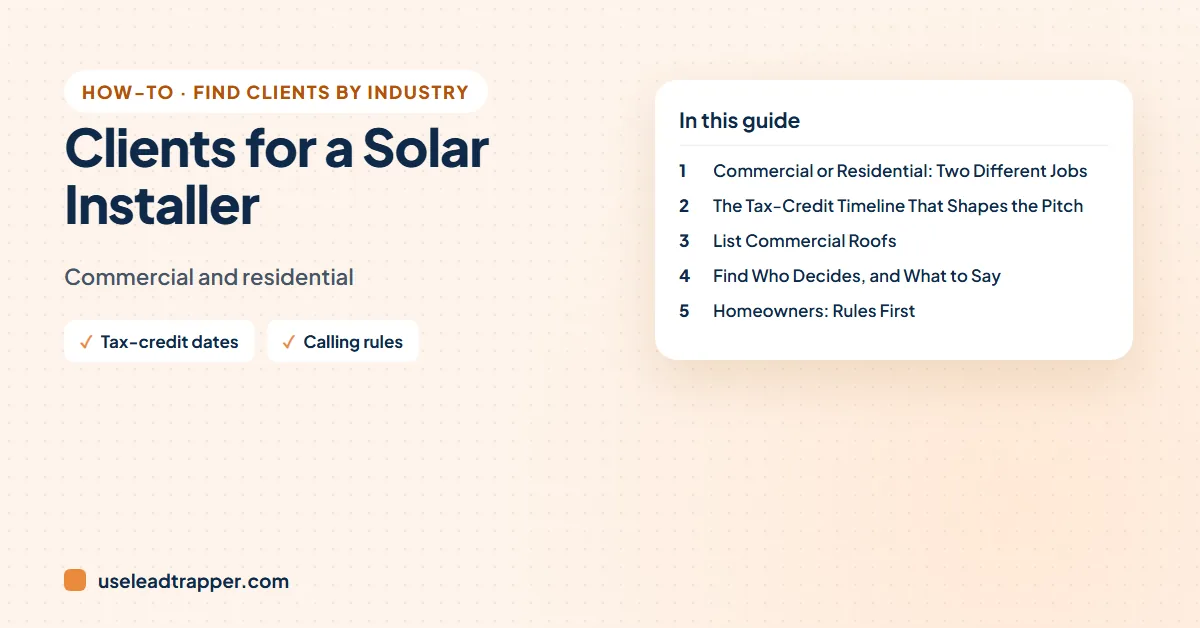
A solar installer’s best prospects are easy to see from the street and harder to reach by phone. Commercial buildings are listed on Google Maps and have a person who signs off energy spending. Homeowners are far more numerous, but they are protected by calling and texting law, and in the US the main federal incentive for them has ended. This guide treats the two separately. We make LeadTrapper, which we use in the commercial steps, and we say so where it appears.
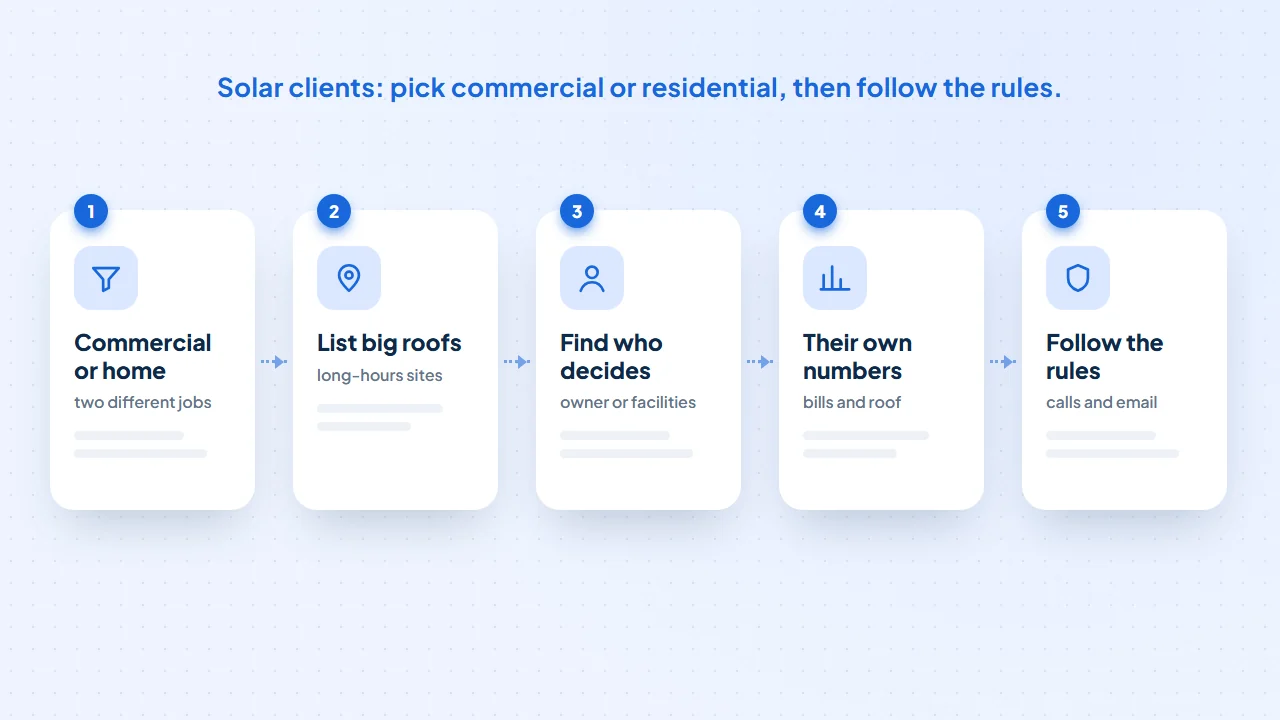
Commercial or Residential: Two Different Jobs
Commercial solar is won by a few decision makers looking at payback; residential solar is won by volume, trust and consumer-protection compliance. The same installer can do both, but the prospecting is different enough to treat as two lists.
| Compared | Commercial | Residential |
|---|---|---|
| Who decides | Owner, operations or facilities manager, finance lead | The homeowner, often with a partner |
| Where prospects are listed | Google Maps by business type, company websites, LinkedIn titles | No public list you can use for cold calling; inbound, referrals, local events |
| Sales cycle | Months, site survey, financing | Days to weeks |
| Calling rules (US) | Most calls to businesses soliciting sales are exempt from Do Not Call | Registry check, 8 a.m. to 9 p.m., written consent for autodialled calls and texts |
| What to send | A building-specific savings estimate | A quote and a site visit |
| Tax situation (US, 2026) | Section 48E for businesses and third-party owners, with deadlines | Homeowner credit 25D ended after 2025 |
The Tax-Credit Timeline That Shapes the Pitch
In the US, the 30% federal credit for homeowner-owned solar ended with 2025, and the commercial credit now has deadlines. The IRS page on the residential clean energy credit says it is not available for property placed in service after 31 December 2025.
For businesses, the Solar Energy Industries Association’s explainer on the clean energy provisions in the 2025 budget law and the Tax Adviser’s article on safe-harbor rules for solar and wind section 48E facilities describe the position we read: projects that began construction by 4 July 2026 are not subject to the 2027 deadline, while later projects must be placed in service by 31 December 2027. We read these in November 2026 and rules and guidance can change, so a tax adviser should confirm any specific project.
What this means for your messaging:
- Commercial: a deadline is a reason to act. Say the date in your first message and offer a site survey before the end of the year.
- Residential: you can no longer lead with 30% off for a homeowner who buys the system. Look at state and utility incentives and at lease or power purchase agreement structures, where the owner is a company. Check each state’s rules; they vary.
- Outside the US: national incentives differ. Do not copy a US pitch into the UK, Australia or the Gulf.
List Commercial Roofs
A Google Maps search by business type, city and district gives you every candidate building and its listing details. Good commercial prospects share three traits: a large, flat or gently pitched roof, daytime operating hours, and a power bill that matters to them. Search for types such as warehouse, cold storage, distribution centre, manufacturer, farm or packhouse, school, car dealership, self-storage, supermarket, hotel and care home.
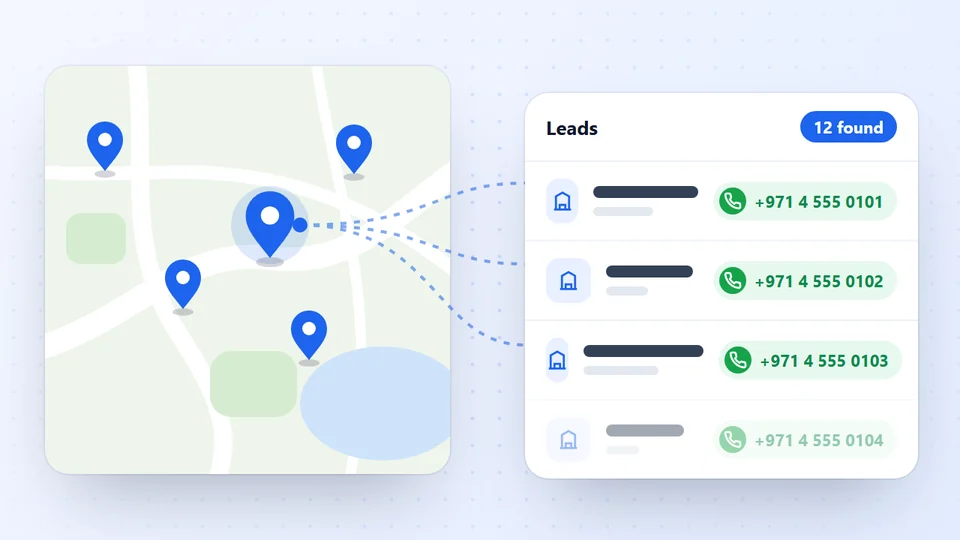
LeadTrapper’s Google Maps scraper runs one search per type and exports one row per business as a CSV with name, phone, WhatsApp, email, website, social links, rating, review count and address. It does not measure roof area or energy use, so open the address in satellite view for each shortlisted site. Sort by review count and by repeated names: a business with several branches is a candidate for a portfolio-wide proposal. A single Maps search shows about 120 places, so cover larger areas by district; our guide on getting more than 120 Google Maps results shows how.
Check how much contact data a type usually has before you plan around email. In our scans of 24 September 2026, 15% of 160 Amman dentists and 47% of 60 Downtown Dubai estate agencies had an email on their listing or homepage (see the full Google Maps scan results); a warehouse listing will often give only a phone number and a website, so plan to find the rest on the company site.
Find Who Decides, and What to Say
In a small commercial business the owner decides; in a larger one the facilities, operations or finance manager does, often with the owner’s sign-off. Paste each company’s website into LeadTrapper’s Email Finder: it reads the contact and team pages and returns the emails, phone and WhatsApp numbers the business publishes, labels each as a general inbox, a department or a person, and marks owners, founders and managing directors as decision makers.
For larger sites, LeadTrapper’s LinkedIn scraper can search by keyword, job title and city, for example “Facilities Manager” in Leeds, and returns name, headline and location but no contact details. LinkedIn’s rules ban scraping and the risk is yours; our guide on whether LinkedIn allows scraping covers it, and finding the decision makers in a company shows the rest of the method.
Open with the building, not with solar in general: “Your distribution centre on Hill Road has about 9,000 square metres of flat roof facing south and runs two shifts. I’d like to show what a rooftop system could cut from your daytime bill, and which tax deadline applies.” Offer a site survey and a one-page estimate. Do not state a saving until you have the bills.
List commercial roofs free for 14 days
Homeowners: Rules First
Homeowners are protected by telemarketing law, so check the rules before you call or text anyone. Marketing by phone, text and email to individuals is regulated in most countries, and the penalties are real.
United States. The FTC’s Telemarketing Sales Rule, at 16 CFR 310.4, bans calls to numbers on the National Do Not Call Registry unless you have the person’s signed written agreement or an established business relationship that has not included a do-not-call request. It also allows calls only between 8:00 a.m. and 9:00 p.m. at the called person’s location.
The FTC’s questions and answers for telemarketers say most calls to a business made to solicit sales from that business are exempt. Separately, the Telephone Consumer Protection Act requires prior express written consent for autodialled or prerecorded telemarketing calls and texts to cell phones; see the FCC’s guide to unwanted calls and texts. State laws add their own limits, so check the state you call into.
United Kingdom. The ICO says that you generally cannot make live marketing calls to numbers on the TPS or CTPS unless the subscriber has specifically agreed, and that sole traders and some partnerships are treated as individual subscribers. See the ICO’s rules on live direct marketing calls. The ICO says this guidance is under review, so check the live page.
Because of those rules, a bought homeowner phone list is a poor foundation. Most residential installers use consented enquiries: their own website, local search, referrals, community and trade events, and paid forms where the homeowner asks to be contacted. LeadTrapper does not supply homeowner data, and we do not recommend building a homeowner call list from scraped sources. This is not legal advice.
A Worked Example
An installer in the Midlands who targets “warehouses and distribution centres in Coventry” could build a shortlist in a day. The figures are illustrative, not measured.
| Step | Result |
|---|---|
| Scan “warehouse”, “distribution centre”, “cold storage” in Coventry | 210 businesses |
| Remove duplicates and sites under about 2,000 m² on satellite view | 64 |
| Prospects with a named owner or manager on their website | 41 |
| Prospects with a company-owned building (not leased) | About half; ask on the first call |
| First batch for personalised proposals | 15 |
Fifteen carefully researched messages and calls beat 200 generic ones. Keep a note of each building’s roof, hours and the date you contacted them, and follow up in a week. The FTC’s CAN-SPAM guide says the law makes no exception for business email, so include your postal address and an opt-out; for the wider routine, our guide on finding clients for a commercial cleaning business applies the same building-by-building method.
Where LeadTrapper Finds Leads
LeadTrapper collects leads from each of these sources in one Windows app, then checks the numbers and sends the WhatsApp messages from the same place.
- Google Maps Scraper: Business leads from any city.
- Facebook Scraper: Advertisers, pages and group members.
- Instagram Scraper: Leads from profiles and hashtags.
- TikTok Scraper: Creators, hashtags and commenters.
- LinkedIn Scraper: Profiles by role and city.
- Email Finder: Emails from business websites.
Frequently Asked Questions
Search business types with big roofs and long hours, such as warehouses, cold storage, farms, schools, dealerships and factories, on Google Maps in your service area. Sort by branch count and reviews, find the owner, facilities or operations manager on the company website, and open with the building's own numbers.
In the US you must not call numbers on the National Do Not Call Registry without consent or an established business relationship, you may call only between 8 a.m. and 9 p.m. local time, and autodialled or prerecorded marketing calls and texts to cell phones need the person's prior express written consent. Rules differ by state and country. This is not legal advice.
In the US, the FTC says most phone calls to a business made to solicit sales from that business are exempt from the Do Not Call provisions. In the UK, live calls to companies must be screened against the Corporate TPS, and sole traders and some partnerships count as individuals on the TPS.
It depends on the buyer. The IRS says the residential clean energy credit, section 25D, is not available for property placed in service after 31 December 2025. Businesses and third-party owners can still use the section 48E credit if rules and deadlines are met; solar that begins construction after 4 July 2026 must be in service by the end of 2027. Check current guidance before quoting.
No. LeadTrapper lists businesses from Google Maps and the contact details those businesses publish on their own websites. It does not provide homeowner names, phone numbers or addresses, and we would not recommend scraping them. Use it for commercial prospecting.
About LeadTrapper
LeadTrapper is a Windows app for finding business leads and contacting them on WhatsApp. It collects business contacts from Google Maps, Instagram, Facebook, TikTok, LinkedIn and business websites, checks which numbers are on WhatsApp with its Number Filter, and sends personalised campaigns with automatic delays from one or more WhatsApp accounts. It also has a chatbot, a shared inbox for every account, and Store Orders for online shops. It installs from the Microsoft Store, and the full app is free for 14 days, then $50 a year. Free web tools, browser extensions and a Wix app are listed on the Free Tools page.
List Warehouses, Farms and Schools Near You
The Google Maps scraper, Email Finder, LinkedIn scraper and WhatsApp tools all come with LeadTrapper. $50/year, all features included.