In this article 8 sections
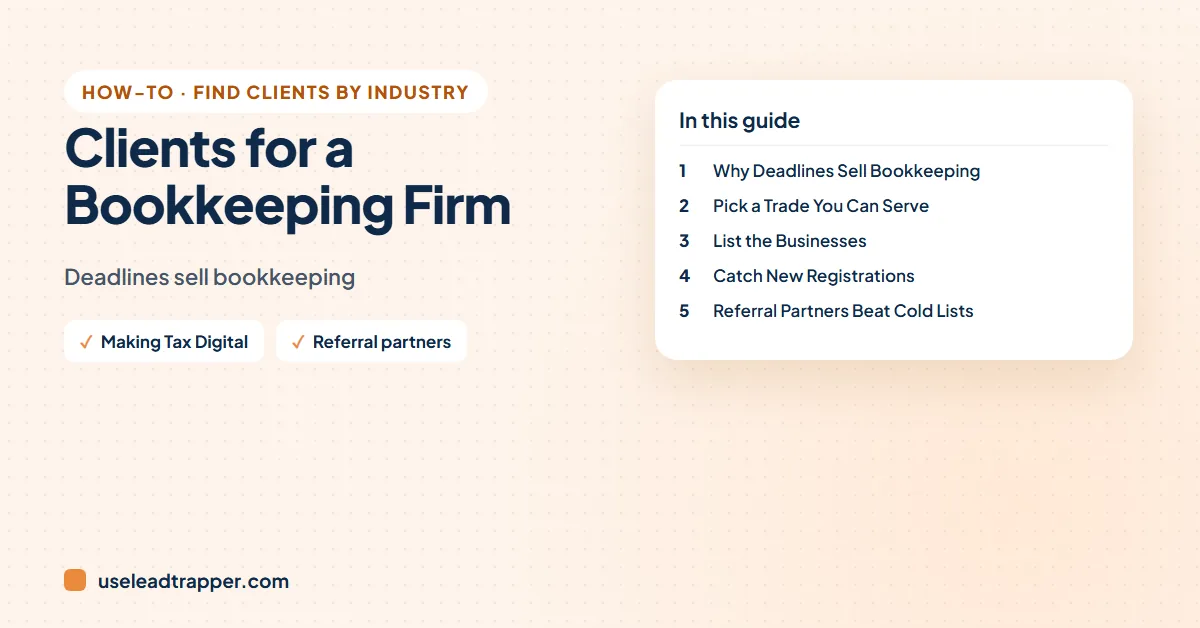
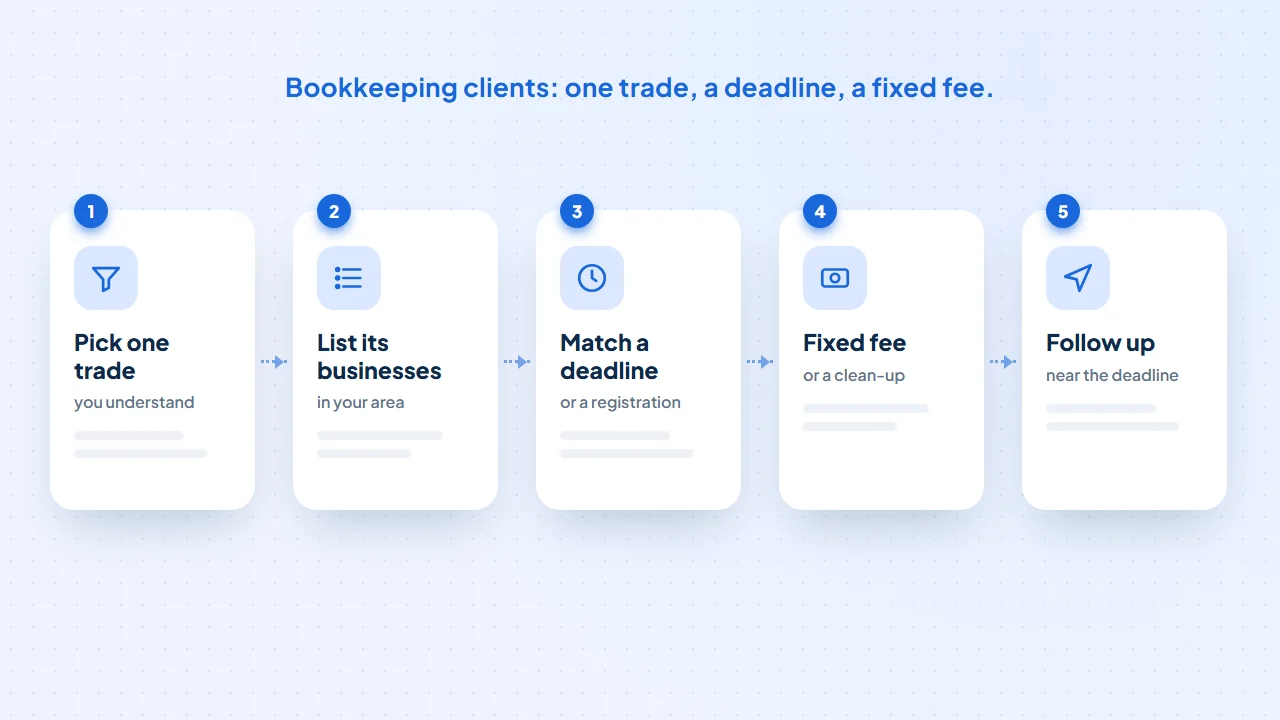
Bookkeeping clients buy when a deadline or a registration forces them to. List one trade of small businesses from Google Maps, watch for new registrations and tax-rule changes such as UK Making Tax Digital, and offer a fixed monthly fee or a one-off catch-up clean-up.
- Bookkeeping is bought on deadlines: a new registration, a year-end, a tax filing date or a rule change. Time your message to the trigger and it is a useful reminder, not a cold pitch.
- In the UK, Making Tax Digital for Income Tax started for sole traders and landlords above 50,000 pounds of qualifying income in April 2026, with 30,000 pounds from April 2027 and 20,000 pounds from April 2028 according to GOV.UK.
- Pick a trade you can learn, such as builders, restaurants, online sellers or landlords, so you know their invoices, VAT or sales tax and typical software.
- Referral partners, such as company formation agents, solicitors, banks and software partner directories, usually send better clients than cold lists.
- Sell a fixed monthly fee and a clean-up project for neglected books. Never promise tax savings in a cold message.
Most small business owners know their books are a chore long before they hire anyone. What turns the chore into a purchase is an event: a first registration, a letter from the tax office, a missed deadline, a new rule. A bookkeeping or accounting firm that finds clients well watches for those events. Common advice from software vendors such as FreshBooks, Xero and QuickBooks is similar: use referrals, join local business groups, pick a niche and keep a Google profile. This guide adds a method for the outbound side. We make LeadTrapper, which we use in two steps, and we say so where it appears.
Why Deadlines Sell Bookkeeping
Bookkeeping is a service people postpone, so the moment you contact them matters more than the wording. These are the triggers to watch:
| Trigger | Who it affects | Where you see it |
|---|---|---|
| New company or new trader | A founder with no system yet | Company registers, new Google Maps listings |
| Tax-rule change, such as UK Making Tax Digital | Self-employed people and landlords above an income threshold | Government announcements with dates |
| Year-end and filing dates | Every business with a fixed accounting year | The calendar: your own diary of deadlines |
| Sales tax or VAT registration | A business growing past the registration threshold | Conversations; the business’s growth signs |
| Books months behind | A business that stopped recording | Often only learned on a call |
| Moving off spreadsheets or a part-time helper | A growing business with staff or stock | Hiring posts, new branches, new van |
The UK case is concrete. GOV.UK’s guidance on when you need to use Making Tax Digital for Income Tax and its policy page on reducing the mandation threshold from 30,000 to 20,000 pounds from April 2028 set the dates we read as 50,000 pounds of qualifying income from April 2026, 30,000 pounds from April 2027 and 20,000 pounds from April 2028. Anyone with income in the next band is a prospect a year ahead. Check GOV.UK for the current rules and exemptions before you quote them, because they have changed before and the details depend on a person’s income.
Pick a Trade You Can Serve
A bookkeeper who knows one kind of business can quote faster, spot mistakes and talk about the client’s real problems. Good starting groups are builders and tradespeople, restaurants and cafes, online sellers, landlords, clinics and salons. Each has its own pattern: cash takings, subcontractor payments, stock, platform payouts, rental statements.
The test is whether you can name the three biggest mistakes in that trade’s books. If you can, say them in your message. If you cannot, spend a week with a few owners before you start outbound work.
List the Businesses
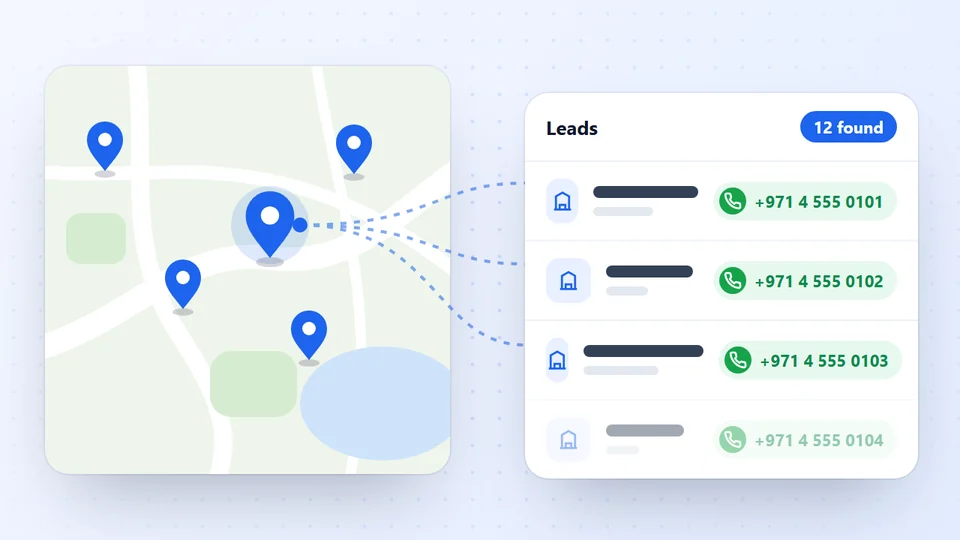
Google Maps lists nearly every local business of a type with its phone number and website, which is enough to build a list of a trade in your area. LeadTrapper’s Google Maps scraper exports one row per business as a CSV with name, phone, WhatsApp, email, website, social links, rating, review count and address. Sort by review count: a business with a few hundred reviews has real revenue, and probably real paperwork.
For the owner’s name and email, paste the websites into LeadTrapper’s Email Finder. It reads the contact, team and about pages and labels each email as a general inbox, a department or a named person, and marks owners and directors as decision makers. In a small business that is the person who decides. A solo trader often has only a phone number, so plan a call. Our guide on finding business email addresses covers the other routes, and B2B leads in the UK shows where UK companies publish contacts.
Build your trade list free for 14 days
Catch New Registrations
A business in its first months has no bookkeeper, so a new registration is the best-timed lead you can get. In the UK, Companies House lets you search by incorporation date; its blog explains the advanced search function, and the Companies House data products guidance explains the bulk data. In the US, state Secretary of State offices run business searches; the filters and fees differ by state.
A register gives you the name, the date and a registered address, which is often an agent’s office or a home. Match the name to a Google Maps or website listing, then use the contact the business publishes. Registered directors are named persons, so follow the data-protection rules of your country when you use their details.
Referral Partners Beat Cold Lists
Most bookkeeping firms get their best clients from people who already advise small businesses. The competitor guides agree: ask CPAs or accountants who do not offer bookkeeping, volunteer with small-business groups such as SCORE or Small Business Development Centers in the US, and keep your online profiles current. Add these:
- Company formation agents and solicitors: their clients have just registered.
- Business banks and merchant-service sellers: they meet new businesses first.
- Software partner directories: Xero, QuickBooks and similar vendors list accountants and bookkeepers who hold their certifications.
- Related trades: payroll providers, business coaches, commercial landlords.
Give each partner a one-line description of the client you want, and thank them in writing. One partner who sends two clients a quarter is worth more than a list of 500 cold contacts.
The Offer and the First Message
Offer something small and concrete, tied to the trigger. Two offers cover most cases:
- Fixed monthly fee: transactions up to an agreed number, bank reconciliation, monthly report and tax-ready records. State the price, the software and the month-end date.
- Catch-up project: a one-off clean-up of months that are behind, priced per month or per account, followed by the monthly service.
A message to a trader near an MTD threshold: “Hi Sam, I’m a bookkeeper working with builders in Leeds. If your self-employed income is over 30,000 pounds, GOV.UK says Making Tax Digital applies from April 2027, with quarterly updates. I can set your records up in the right software this winter for a fixed monthly fee. Would a 15-minute call help?” Do not say the client will pay less tax, and do not give tax advice in a cold message.
A Worked Example
A UK bookkeeper who picks “builders and tradespeople in Leeds” can build a first month’s outreach as shown below. The figures are illustrative, not measured.
| Step | Result |
|---|---|
| Scan “plumber”, “electrician”, “builder” in Leeds | 320 businesses |
| With 50 or more reviews | 120 |
| With a named owner or an email on the website | 70 |
| Contacted this month (10 a day, 5 days a week) | 40 |
| Calls booked from the first batch | Unknown until you test it; log every reply |
Match each business to its trigger in the spreadsheet: new registration, income near a threshold, growing team. Phone the highest ten.
Rules to Follow
Contact businesses through the phone numbers and emails they publish, keep each message honest, and stop when asked. The FTC’s CAN-SPAM guide says the law makes no exception for business email: use your postal address and an opt-out. The FTC also says most calls to a business made to solicit sales are exempt from the Do Not Call provisions. In the UK, the ICO’s business-to-business marketing guidance separates companies from sole traders, who are treated like individuals; since many bookkeeping prospects are sole traders, check before you email.
If your market uses WhatsApp, LeadTrapper’s WhatsApp Number Filter shows which numbers are on WhatsApp, and our guide on B2B outreach on WhatsApp covers the rules. Accountants and bookkeepers also have professional duties on confidentiality and advertising set by their own bodies, so check yours. This is not legal advice. Service firms with the same deadline-driven approach, such as a recruitment agency, also start from one niche list.
Where LeadTrapper Finds Leads
LeadTrapper collects leads from each of these sources in one Windows app, then checks the numbers and sends the WhatsApp messages from the same place.
- Google Maps Scraper: Business leads from any city.
- Facebook Scraper: Advertisers, pages and group members.
- Instagram Scraper: Leads from profiles and hashtags.
- TikTok Scraper: Creators, hashtags and commenters.
- LinkedIn Scraper: Profiles by role and city.
- Email Finder: Emails from business websites.
Frequently Asked Questions
Choose one kind of small business, list them from Google Maps, and contact them around a deadline or registration. Referrals from solicitors, banks and company formation agents, plus accounting-software partner directories, are the other main sources. Offer a fixed monthly fee or a one-off catch-up clean-up.
Mostly at four moments: when they register a company or start trading, when a tax deadline or rule change arrives, when the books are months behind, and when they have outgrown a spreadsheet or the owner's spouse. A message that mentions the trigger gets more attention than a general offer.
In the UK, sole traders and landlords above a qualifying income threshold must keep digital records and send quarterly updates to HMRC. GOV.UK lists 50,000 pounds from April 2026, 30,000 pounds from April 2027 and 20,000 pounds from April 2028. Each step creates a new group of self-employed people who may want help.
Often yes with conditions. In the US, CAN-SPAM makes no exception for business email, and most business-to-business sales calls are exempt from Do Not Call rules. In the UK, sole traders and some partnerships are treated as individuals for email and calls, so many of your prospects may need consent. This is not legal advice.
No. LeadTrapper lists businesses from Google Maps and reads contact details on their websites; it does not know when a company registered or when its books are due. Use the official company register for new registrations and LeadTrapper for contacts.
About LeadTrapper
LeadTrapper is a Windows app for finding business leads and contacting them on WhatsApp. It collects business contacts from Google Maps, Instagram, Facebook, TikTok, LinkedIn and business websites, checks which numbers are on WhatsApp with its Number Filter, and sends personalised campaigns with automatic delays from one or more WhatsApp accounts. It also has a chatbot, a shared inbox for every account, and Store Orders for online shops. It installs from the Microsoft Store, and the full app is free for 14 days, then $50 a year. Free web tools, browser extensions and a Wix app are listed on the Free Tools page.
List the Small Businesses in Your Trade
The Google Maps scraper, Email Finder and WhatsApp tools all come with LeadTrapper. $50/year, all features included.