In this article 7 sections
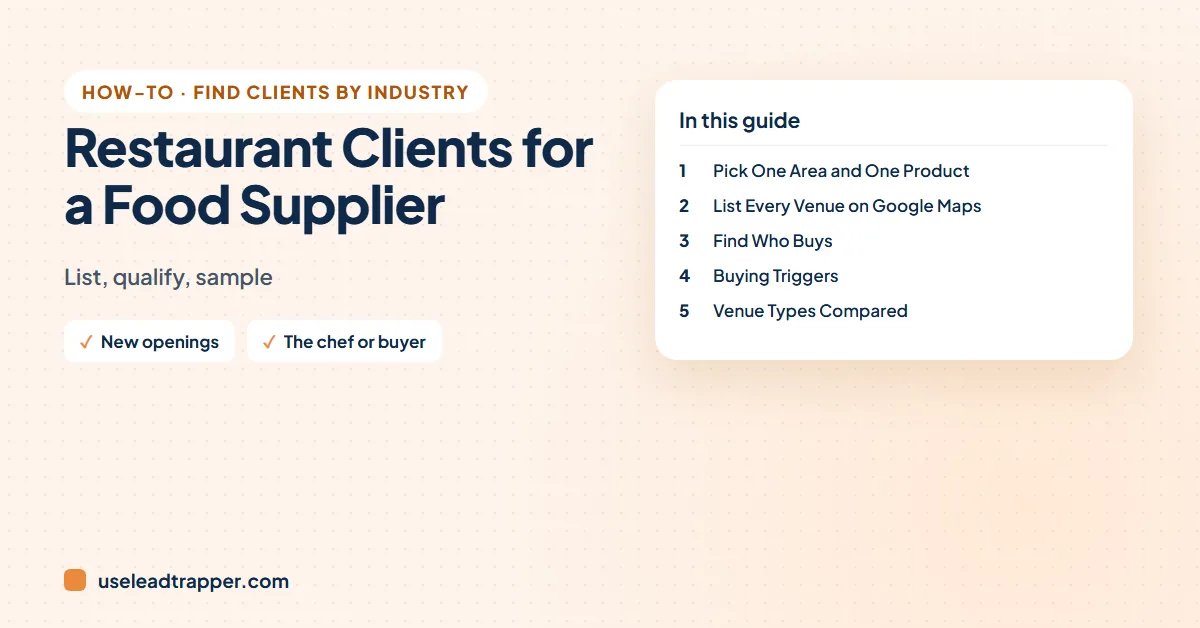
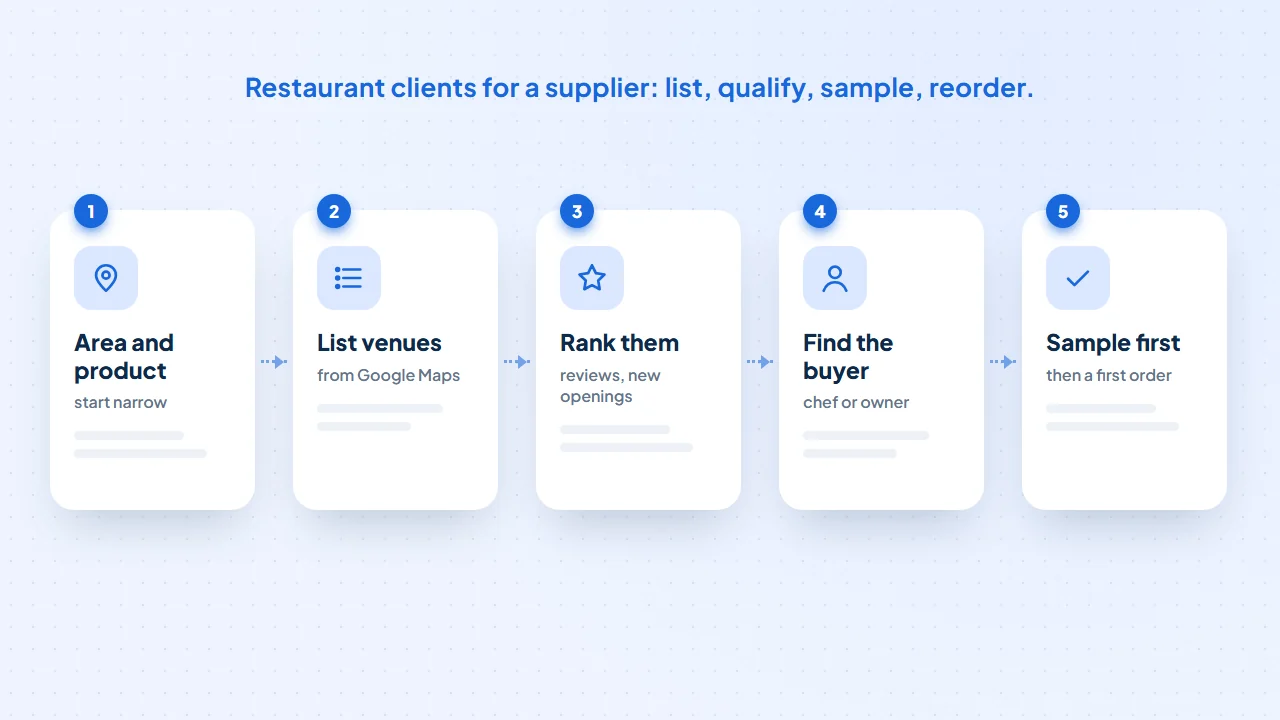
To find restaurant clients as a food supplier, list every restaurant, cafe, hotel and caterer in your delivery area from Google Maps, rank them by review count and new listings, find the chef or owner, and bring a sample. A new opening with few reviews is usually still choosing suppliers.
- Start with one delivery area and one product type. A produce, coffee, packaging or equipment supplier can name every venue worth a visit within a day's drive.
- List every restaurant, cafe, bakery, hotel and caterer from Google Maps by type and town, then sort by review count (busy) and newness (still choosing suppliers).
- Independent restaurants decide with the chef or owner; groups and hotels buy through a purchasing or operations manager. Find which one you are dealing with before you pitch.
- A sample on the first visit beats an email. Offer a small trial order, a clear price list and a delivery day.
- Check your own paperwork: US food suppliers must register with the FDA (restaurants are exempt), and UK food businesses register with the local council at least 28 days before trading.
A good food supplier can deliver on time and at a fair price, and still have too few restaurant accounts. The problem is usually the list: you do not know every venue in your area, who buys, or which ones are changing supplier. This guide builds that list and shows how to approach each type of venue. We make LeadTrapper, which we use in some steps below, and we say so where it appears.
Pick One Area and One Product
Start with the area you can deliver to on a normal day and the one product you can supply best. A supplier of fresh produce, coffee, frozen goods, bar drinks, takeaway packaging or kitchen equipment has a different best customer for each:
- Produce, meat and dairy: restaurants that cook from scratch, hotels and caterers; they reorder weekly.
- Coffee, pastries and milk: cafes, bakeries, hotel breakfast rooms and offices with a canteen.
- Drinks and glassware: bars, pubs, brewery taprooms and wine bars.
- Packaging: takeaway-heavy places such as fast casual, pizza, burger and food trucks.
- Equipment and hire: new openings, caterers and banquet halls.
The test is simple: if you searched Google Maps for that venue type in your area, would the results be your client list? If yes, the niche works. Sellers of similar local services can use the same method; our guide on finding clients for a commercial cleaning business applies it to offices and clinics.
List Every Venue on Google Maps
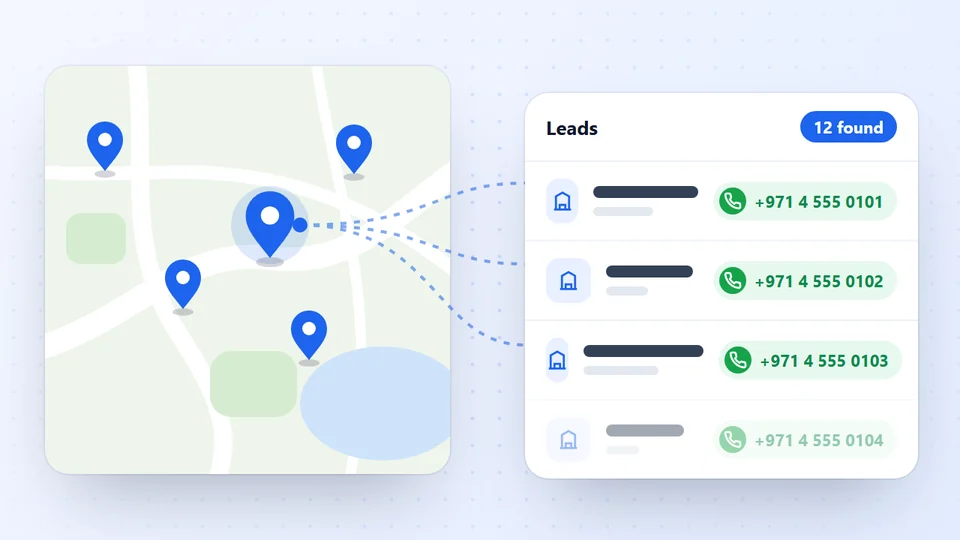
Google Maps is the quickest way to list every venue of a type in your delivery area, with phone, address, website, rating and review count. One search shows about 120 places, so a big city needs several searches by district.
Search by the words venues use for themselves, one type per search: restaurant, cafe, bakery, pizza restaurant, coffee shop, bar, hotel, catering service, banquet hall. LeadTrapper’s Google Maps scraper on Windows does this for you: type a keyword (for example “pizza restaurant”) and a location (a city or town), and it searches the location area by area until no new businesses appear, then exports a CSV. Add each of your delivery towns as its own search. Our guide on getting more than 120 Google Maps results explains why the area-by-area search matters.
A worked example (illustrative numbers). Say you supply fresh mozzarella and tomatoes within 20 miles of Leeds. You search “pizza restaurant” and “Italian restaurant” for Leeds, Bradford, Wakefield and Harrogate. Suppose the lists total 210 venues after you remove duplicates. You keep the 80 with 100 or more reviews because they are busy, flag 12 with fewer than 30 reviews that appeared in the last few months as new openings, and put the 6 with several locations under one name in a separate group list. You now have 98 venues to visit, in four routes, instead of 210 to guess at. These numbers are an example, not a measured result.
List your delivery area free for 14 days
Find Who Buys
In an independent restaurant, the buyer is the chef or owner; in a group, hotel or chain, it is a purchasing or operations manager. Asking for the wrong person wastes the visit, so find out before you go.
| Venue | Who usually buys | How to find them |
|---|---|---|
| Independent restaurant or cafe | Owner or head chef | Website about page, social media, or ask the front of house when the chef orders |
| Small group (2 to 10 sites) | Owner, group chef or operations manager | Website team page; LinkedIn |
| Hotel | Purchasing manager, food and beverage manager or executive chef | Switchboard; LinkedIn |
| Caterer or banquet hall | Owner or head chef | Website; the contact form |
| Chain or franchise | Head office purchasing, often via approved distributors | Corporate website; ask which distributor serves the site |
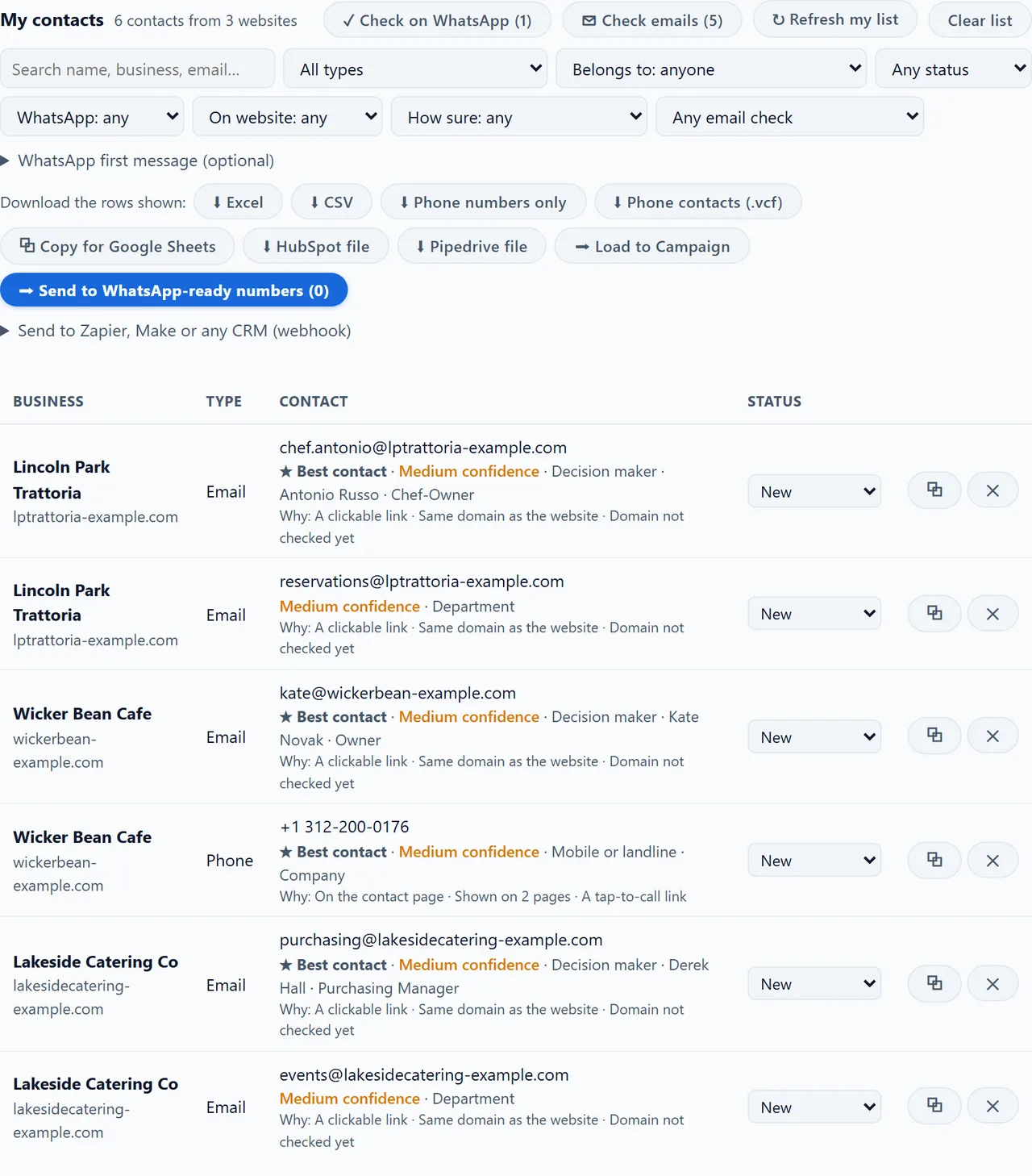
LeadTrapper’s Email Finder reads each venue’s home, contact, team and branch pages and saves the emails, phone and WhatsApp numbers they publish. It labels each email as a general inbox, department, team member or branch, and flags owners and managers the business names. Many restaurants publish only a general inbox, so the chef often has to be reached by phone or in person.
Our guide on finding the decision makers in a company shows the method. For group and hotel purchasing managers, the LinkedIn scraper lists profiles by keyword, title and city with name, headline and location; it collects no emails or phones, and LinkedIn’s rules ban scraping, so see whether LinkedIn allows scraping first.
Farm Credit Canada’s guide Selling to chain restaurants adds that small and medium chains are a good entry point because they offer more menu variety than large chains and buy closer to how independents do, and that some brands share a parent company, so one approach can reach several brands.
Buying Triggers
A restaurant is most open to a new supplier when something changes. Watch for these triggers:
- A new opening. A listing with few reviews and a recent first date is still choosing suppliers. One vendor guide, MapGopher, calls new listings the best leads, for that reason (vendor advice, not a measurement). Compare each month’s search with the last to spot them.
- A new menu or season. Summer and winter menus, Ramadan or festive menus, and new dishes need new ingredients.
- A price rise or a problem. A supplier’s price increase or a missed delivery makes a venue open to a quote. Ask “who supplies you now, and what would you change?”
- A new branch. A second location under the same name often means central purchasing.
- A busy venue with poor reviews. MapGopher suggests this may mean a supply problem, so approach carefully. Do not mention a venue’s bad reviews in your pitch.
Keep the dates you saw each trigger in the same spreadsheet as the list.
Venue Types Compared
Different venue types buy in different ways, so they need different first offers. A short guide:
| Venue type | What they buy | Order pattern | First offer |
|---|---|---|---|
| Independent restaurant | Fresh produce, proteins, dairy | Weekly, often daily | A small trial order with a tasting sample |
| Cafe and bakery | Coffee, milk, flour, pastries | Weekly | A sample bag and a delivery day |
| Pizza and fast casual | Flour, cheese, sauces, packaging | Weekly, high volume | A price per case against what they pay now |
| Bar and pub | Drinks, glassware, mixers | Weekly | A short price list and a tasting |
| Hotel | Wide range, high volume | Contract, formal purchasing | A supplier pack and a meeting with purchasing |
| Caterer and banquet hall | Bulk orders, hire equipment | Per event | A quote for their next event |
Independents are more flexible and buy a wider range, while chains give volume but need consistency and patience. Farm Credit Canada says selling to chains takes proven supply capacity, preparation instructions, and often a limited-time offer first.
The First Visit and Offer
The first visit should leave a chef with something to taste, a price list and a reason to try you. A visit routine that works:
- Visit outside service. One vendor guide suggests 2pm to 4pm and avoiding Fridays, Saturdays and the hour before service. Test this locally.
- Bring a sample. Chefs judge quality by taste. A small sample, a price list on one page and a business card is enough.
- Ask three questions: who supplies you now, what would make you switch, and what day and time do you order?
- Offer a small trial order with a delivery day, with no long contract.
- Follow up within a day by message or phone with the price list and the delivery day.
A short message after a visit might read:
Hi Marco, thanks for the time today. Here is the price list for the mozzarella and tomatoes you tasted, with delivery on Tuesdays and Fridays. A first order of one case is fine, and if you would rather not hear from me, tell me and I won’t contact you again.
WhatsApp marketing for restaurants covers how venues themselves use WhatsApp with guests. As a supplier, you can use WhatsApp for orders and delivery times with customers who have agreed to it; LeadTrapper’s WhatsApp Number Filter shows which venue numbers are on WhatsApp, and our guide to WhatsApp B2B outreach covers messaging businesses without getting your number restricted. Guests of a restaurant are consumers and are not part of this method.
Before you email in bulk, see our guide to whether email scraping is legal; the rules differ by country. This is not legal advice.
Your Own Rules and Paperwork
Restaurants expect their suppliers to be registered, so check your own paperwork before you sell.
- United States. The FDA’s food facility registration Q&A says restaurants are exempt, but a facility that manufactures, processes, packs or holds food for consumption in the US generally has to register, with no fee. Registrations must be renewed every other year between October 1 and December 31 of each even-numbered year, which includes the current window through December 31, 2026. A central kitchen that supplies other businesses is not a “restaurant” for this purpose.
- United Kingdom. The government’s food business registration page says food businesses register with their local council, free of charge, at least 28 days before trading.
- Email and calls. The FTC’s CAN-SPAM guide says the US law makes no exception for business-to-business email, so include your identity, a postal address and an opt-out. In the UK, the ICO’s email marketing guidance says sole traders and some partnerships count as individuals and need consent first; a one-owner cafe may be one of these, so visit or call instead.
- Allergen and labelling rules apply to the food you sell. Check your local authority.
Keep the list alive: rerun the Maps search every month, sorted for new venues, and add them to your visit route. For a wider view of finding business contacts in your country, see our guides on B2B leads in the UK and B2B leads in the USA.
Where LeadTrapper Finds Leads
LeadTrapper collects leads from each of these sources in one Windows app, then checks the numbers and sends the WhatsApp messages from the same place.
- Google Maps Scraper: Business leads from any city.
- Facebook Scraper: Advertisers, pages and group members.
- Instagram Scraper: Leads from profiles and hashtags.
- TikTok Scraper: Creators, hashtags and commenters.
- LinkedIn Scraper: Profiles by role and city.
- Email Finder: Emails from business websites.
Frequently Asked Questions
Search Google Maps for restaurants, cafes, bakeries, hotels and caterers in your delivery area, export the list, and rank it by review count and newest listings. Find the chef or owner on the venue's website, then visit or call with a sample and a price list. A weekly check for new openings keeps the list fresh.
In an independent restaurant, the chef or owner. In a group or chain, a purchasing or operations manager, often with an approved supplier list. In hotels, a purchasing manager or food and beverage manager. Ask on the first call who handles ordering and when, so you do not pitch the wrong person.
Not always. Many independent restaurants buy directly from local producers and suppliers. Larger chains and hotels often buy only through approved or broadline distributors, so you may need to be listed with one. Farm Credit Canada says selling to both chains and independents builds the volume that can help you get listed.
Outside service. One Google Maps lead guide suggests 2pm to 4pm and avoiding Fridays and Saturdays and the hour before any service. This is the vendor's advice, not a rule, so test it in your own area and ask the chef when a visit suits them.
It depends on the country. In the US, CAN-SPAM allows business emails with your identity, an honest subject and an opt-out. In the UK, company addresses are generally allowed with an opt-out, while sole traders are treated as individuals. Phone and visit are often the better first contact. This is not legal advice.
Only if the restaurant publishes it on its own website. The Email Finder reads a venue's home, contact, team and branch pages, labels each email as a general inbox, department, team member or branch, and flags owners and managers the business names. Many restaurants publish only a general inbox, so plan to call.
About LeadTrapper
LeadTrapper is a Windows app for finding business leads and contacting them on WhatsApp. It collects business contacts from Google Maps, Instagram, Facebook, TikTok, LinkedIn and business websites, checks which numbers are on WhatsApp with its Number Filter, and sends personalised campaigns with automatic delays from one or more WhatsApp accounts. It also has a chatbot, a shared inbox for every account, and Store Orders for online shops. It installs from the Microsoft Store, and the full app is free for 14 days, then $50 a year. Free web tools, browser extensions and a Wix app are listed on the Free Tools page.
Every Restaurant in Your Delivery Area, in One List
The Google Maps scraper, Email Finder and WhatsApp tools all come with LeadTrapper. $50/year, all features included.