In this article 7 sections
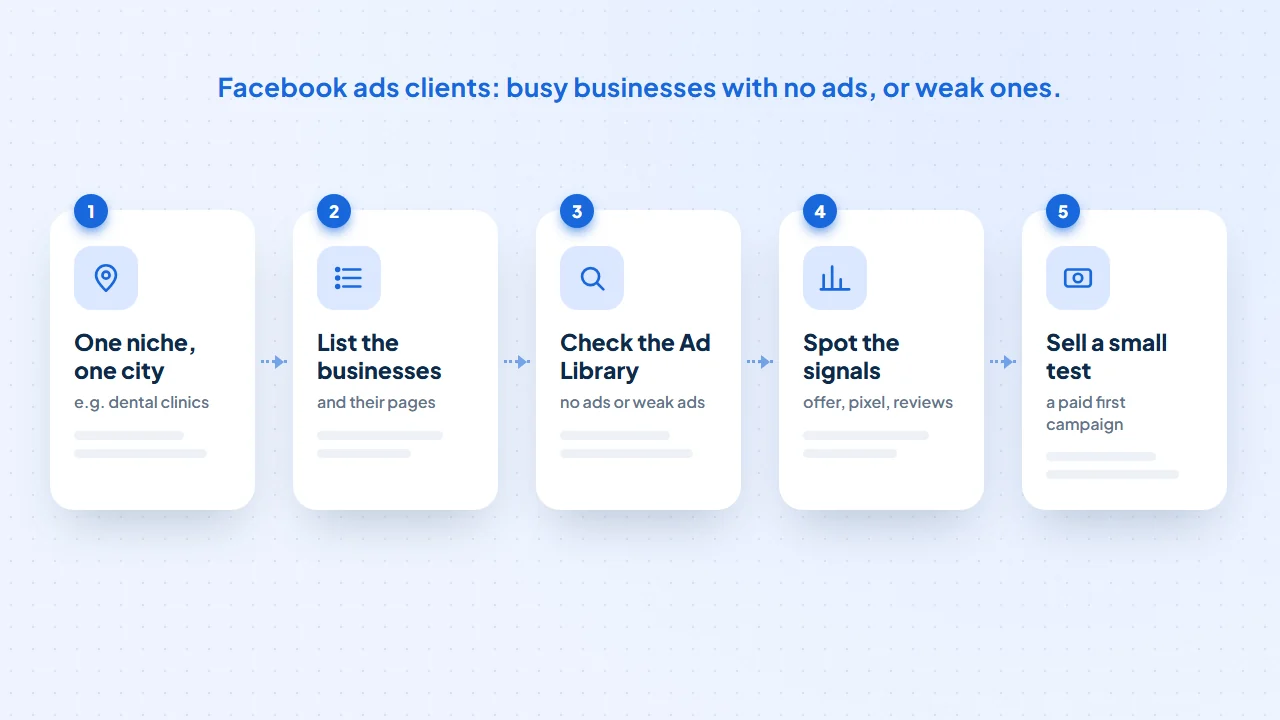
Find local businesses that are busy but run no Meta ads or only weak ones, check them in Meta's Ad Library and on their own site, then offer a small paid test with a stated budget and one clear goal. Example: a dentist with no active ads and no booking page.
- A Facebook ads client pays twice: your fee and the ad spend. Pick businesses that can afford both, with a clear way to count leads or sales.
- Meta's Ad Library shows which pages have ads running now. No ads on a busy local business, or one tired ad pointing at a homepage, is your opening.
- Check from outside before you pitch: is there a booking page or form, a working Meta Pixel, a clear offer, and a phone or WhatsApp button for the ad to send people to?
- Sell a small paid test, not a retainer: one offer, one audience, one goal, a stated ad budget and 2 to 4 weeks, with the budget paid to Meta on the client's own ad account.
- Promise work and measures, not results. Cost per lead depends on the business, the offer and the market, and Meta itself says ad sets need about 50 results to leave the learning phase.
A Facebook ads client is different from a social media client. You are asking them to spend money twice: your fee, and the ad budget that goes to Meta. That makes picking clients the most important job. This guide is for Meta ads freelancers and agencies, and it is about finding and screening prospects. If you sell monthly content as well, see our guide to finding clients for a social media agency, and for the broader marketing agency picture see how to find clients for an agency. We make LeadTrapper, which we use in some steps, and we say where.
Who Buys Facebook Ads Management
The best buyers are businesses that earn money from each new customer, can handle more enquiries, and have a simple way to count them. A one-off sale that is worth little cannot carry ad spend and a fee. Competitor guides, such as those from Metrics Watch and Graphed, mostly advise niching down, running your own ads, cheap pilots for case studies and referrals from partner agencies. Those are fair advice, from tool vendors. This guide adds how to find and screen individual prospects before you pitch.
| Business type | Why ads can work | What to check first |
|---|---|---|
| Dentist, clinic, physio | Each new patient is worth a lot | Booking page or phone button, reviews |
| Gym or studio | Trial offers and sign-up peaks | Free trial offer, class page |
| Home services (roofing, cleaning, solar) | High-value jobs, local area | Quote form, phone number, service area |
| Estate agent | Listings and valuation leads | Valuation page, number of listings |
| Restaurant or venue | Events and bookings | Booking link, event page |
| Online shop | Product ads at scale | Meta Pixel, product feed, margin |
| Course or coach | Leads into a funnel | Landing page, email follow-up |
Avoid businesses that cannot take more customers, have no way to record where a lead came from, or want ads to fix a weak product.
List Businesses by Niche and City
Start from Google Maps, which lists every business of one type in a city with phone, website and rating. LeadTrapper’s Google Maps scraper exports one row per business with name, phone, WhatsApp, email, website, social links, rating, review count and address as a CSV. A busy business with hundreds of reviews and a thin website is usually a better prospect than a new one with five reviews.
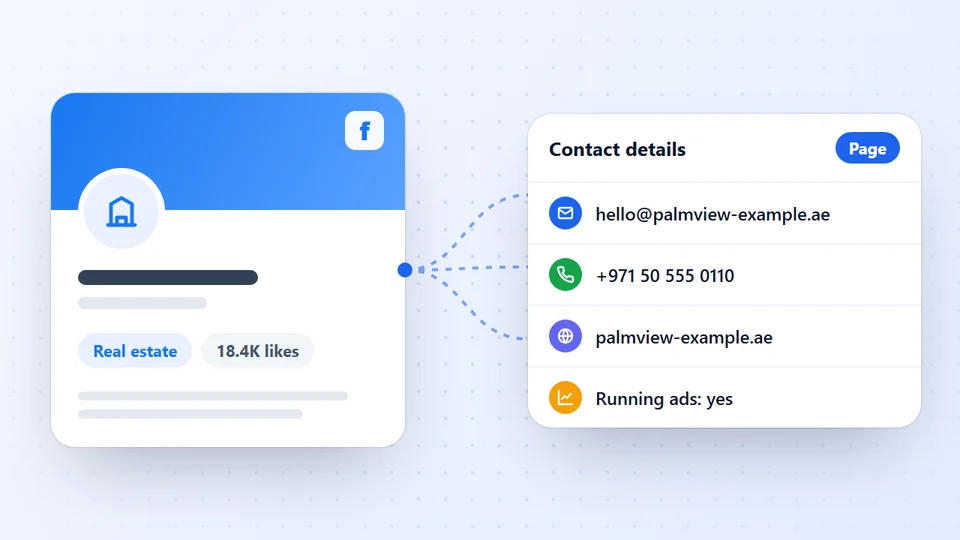
Then read their pages. LeadTrapper’s Facebook scraper collects page name, category, bio, followers, likes, rating, phone, website and one email it finds in the page text, and it adds a Running ads or Not running ads flag per page. Our guide to the Facebook business page scraper shows how to run that step. The flag is a first filter, not proof, as the next section explains.
Check the Ad Library
Meta’s Ad Library is the public, official way to see which ads a page is running now. It is a free search by page name or keyword on Meta’s Ad Library. For each prospect, search the business name and set the country; three outcomes are common:
| What you see | What it means | Your angle |
|---|---|---|
| No active ads | Not advertising now in that country | A first campaign, usually simplest to sell |
| One or two old ads, same photo, link to homepage | Tried once, then stopped or never tested | A test with a clear offer and landing page |
| Many ads, fresh creative, specific offers | Probably an agency or in-house team already | Skip, or offer a narrow service such as video or reporting |
| Ads running, but the link goes to a broken or slow page | Money is leaking | Audit the page and the follow-up first |
The same tool is also a research source for competitors. For a keyword such as “dental implants” you can see which local clinics advertise and what they offer, which gives you a pitch such as “three clinics near you are running implant ads and you are not.” LeadTrapper’s Ad Library tool lists advertisers for a keyword and country that have active ads, with ad count and start date when Meta’s data includes them. Our guide to the Facebook Ad Library scraper covers it in detail, so this guide does not repeat it.
Build your prospect list free for 14 days
Signals That an Ad Would Work
An ad sends people somewhere. If that place is weak, good ads waste money, so check these from outside before you write to the owner:
- A clear offer. “Free consultation”, “first class free” or “book a valuation” is easier to advertise than a general “we offer many services”.
- A landing page or booking form. Open the site on your phone. If you cannot book or enquire in under a minute, the ads would not convert well.
- A way to reach them. A phone button, WhatsApp link or form that actually sends. Ads that lead to a message need someone to answer fast.
- A Meta Pixel. Meta describes the pixel as code on a website that helps measure the actions people take after seeing ads; see Meta’s page on Meta Pixel. The Meta Pixel Helper browser extension shows whether it is installed and firing. No pixel does not rule a client out, since you can install it, but it tells you what the first month’s work will be.
- Reviews and photos. Ads that look good need a business that looks good. Two blurry photos and no reviews hurt results.
- Seasonality. A heating engineer in October or a gym in January is a better time to pitch than the quiet months.
Put these into a spreadsheet next to the Ad Library result and score each prospect. A busy business with no ads, a clear offer and a working booking page is the best score.
Budgets and the First Test Campaign
Be clear with the owner that Meta’s minimum daily budget is a technical floor, not a useful test budget. Meta’s Help Center says minimums depend on buying type, bid strategy and currency, and Ads Manager shows “Budget Is Too Low” if you go under; its guide to minimum budgets sets a floor that depends on how you are charged, widely reported as about USD 1 a day for impression-charged ad sets, and a cost cap should be well below the daily budget. Check the exact figure in Ads Manager.
What matters more is the learning phase. Meta’s page on learning limited says an ad set needs about 50 optimisation events after its last significant edit to move out of learning limited. If a lead costs $8, then 50 leads is $400 a week, around $57 a day for one ad set. If a lead costs $30, it is $1,500 a week. Small budgets spread over many ad sets will stay in learning limited, so run one ad set for one offer.
A first test campaign that a small local client can say yes to:
- One offer and one goal, such as “free first consultation, goal: booked calls”.
- One or two ad sets, with one audience each, such as people within 15 km of the business.
- Three to five ads: different images or short videos, one clear line each.
- A named test length and budget: for example 3 weeks and $50 a day, so about $1,050.
- Ad spend on the client’s own ad account and your fee on top, written down. You never hold their money.
- Weekly report: spend, leads, cost per lead, and which ad produced them, in a one-page note.
- A decision date at the end: scale, change the offer, or stop.
Say what you need: access to their Meta business account, a booking page, someone to answer leads the same day and a way to tell you which became customers.
A Worked Example
The figures below are illustrative, not measured. An agency chooses “dental clinics in Leeds” and wants a first paying test client within a month.
| Step | Result |
|---|---|
| Scan “dentist” in Leeds, by district | 120 clinics |
| Have a website and a Facebook page | 95 |
| No active ads in Meta’s Ad Library | 61 |
| Have a booking page or form, plus 100+ reviews | 24 |
| Top 10 by score get a one-page audit | 10 messages |
The message: “Hi, I run Meta ads for clinics in Yorkshire. Searching Meta’s Ad Library today shows no active ads for your practice, but three clinics near you are advertising implants and whitening. Your booking page works well on a phone. I would run a 3-week test for new patient bookings and send a plan with budget and reporting. Can I send it?” Follow up once after four working days. If two of the ten reply, one call is a normal result for a first week; do not expect one yes from every list.
Honest Results and Rules
Never promise a cost per lead or a return. Results depend on the business, the offer, the creative, the audience and the market, and Meta itself describes learning limited as a signal about delivery, not a guarantee. Contract for work you control: setup, creative testing, weekly reports and a review date. Case studies from your own pilots, with the client’s agreement, will sell better than any claim.
Contact prospects by the phone, WhatsApp or email the business publishes. The FTC’s CAN-SPAM guide says business email has no exception: include your postal address and honour opt-outs. In the UK, sole traders count as individuals under the ICO’s business-to-business marketing guidance. If you message on WhatsApp, LeadTrapper’s WhatsApp Number Filter checks which numbers are on WhatsApp first, and B2B outreach on WhatsApp explains how to keep numbers safe. This is not legal advice.
Meta restricts automated data collection in its Automated Data Collection Terms, so any scraper, including ours, is used at your own risk. The Facebook scraper needs you to be logged in to Facebook, pauses if Facebook shows a security check, reads one email per page and can leave the ad status blank. It does not build or run ads, install a pixel or read ad performance. Use it to build the list and check the shortlist by hand. A client who already has leads from Facebook may also want to connect them to WhatsApp; see Facebook lead ads to WhatsApp.
Where LeadTrapper Finds Leads
LeadTrapper collects leads from each of these sources in one Windows app, then checks the numbers and sends the WhatsApp messages from the same place.
- Google Maps Scraper: Business leads from any city.
- Facebook Scraper: Advertisers, pages and group members.
- Instagram Scraper: Leads from profiles and hashtags.
- TikTok Scraper: Creators, hashtags and commenters.
- LinkedIn Scraper: Profiles by role and city.
- Email Finder: Emails from business websites.
Frequently Asked Questions
Choose one niche and city, list every business in it from Google Maps, and check each one in Meta's Ad Library to see whether ads are running. Contact the busy ones with no ads or weak ads, and offer a small paid test with a stated budget, one offer and one goal.
Meta's Help Center says the minimum daily budget depends on the buying type, bid strategy and currency; for impression-charged ad sets it is widely reported as about USD 1 a day. That is a technical floor, not a useful test budget. To get the roughly 50 results Meta wants per ad set in a week, a client usually needs far more, and the figure depends on their cost per result.
Yes. Meta's Ad Library is a public search of ads running now on Facebook and Instagram, searchable by page name or keyword. Search the business by name; if nothing appears, it has no active ads in that country.
Either works if it is written down. A flat monthly fee keeps costs predictable for a small client. A percentage of spend pays you more when budgets grow but can look like a reason to push spend up. Whichever you choose, keep ad spend on the client's own Meta ad account so they see every pound or dollar.
Partly. The Facebook scraper's Ad Library tool lists advertisers for a keyword and country that have active ads. Its page results also carry a Running ads or Not running ads flag, but that flag is read from the page text and can be blank, so confirm in the Ad Library before you pitch.
Meta's Automated Data Collection Terms restrict automated collection of data from its products without permission. Using any scraper is at your own risk, so read the terms, keep volumes small and prefer manual checks for the shortlist you will actually contact.
About LeadTrapper
LeadTrapper is a Windows app for finding business leads and contacting them on WhatsApp. It collects business contacts from Google Maps, Instagram, Facebook, TikTok, LinkedIn and business websites, checks which numbers are on WhatsApp with its Number Filter, and sends personalised campaigns with automatic delays from one or more WhatsApp accounts. It also has a chatbot, a shared inbox for every account, and Store Orders for online shops. It installs from the Microsoft Store, and the full app is free for 14 days, then $50 a year. Free web tools, browser extensions and a Wix app are listed on the Free Tools page.
A Local Business List With Ad Status
The Google Maps scraper, Facebook scraper and WhatsApp tools all come with LeadTrapper. $50/year, all features included.