In this article 7 sections
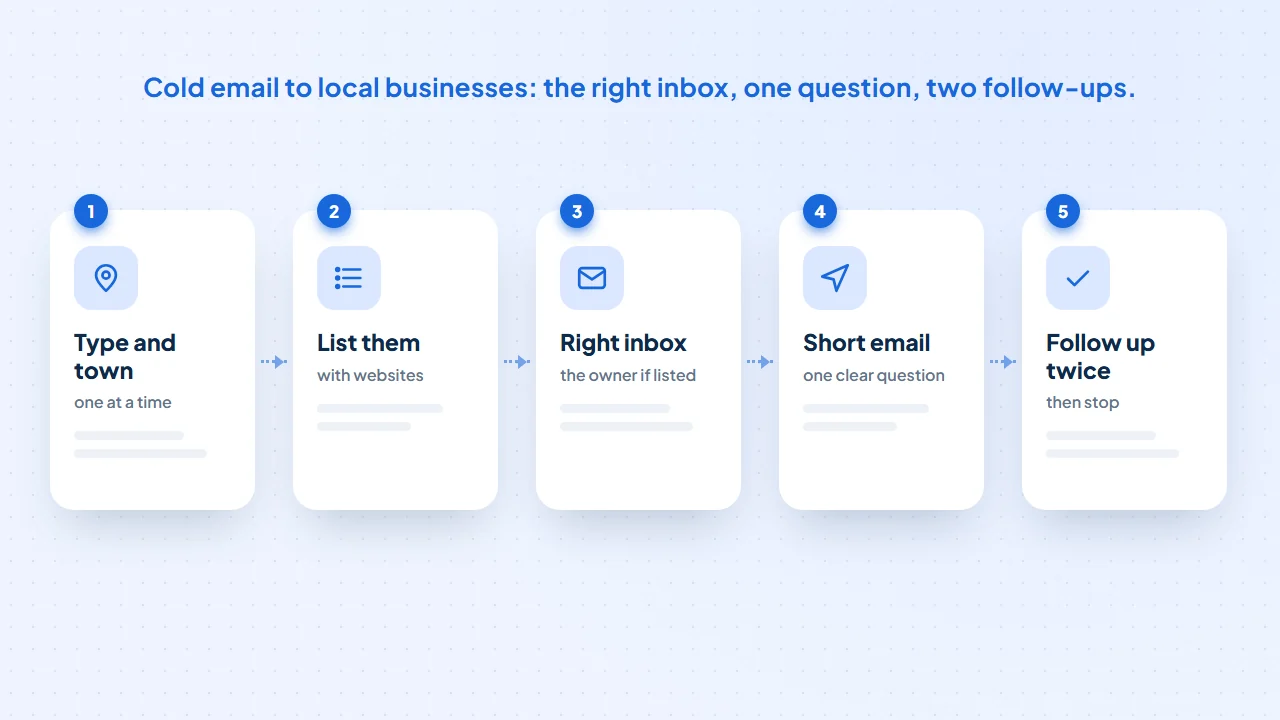
Cold email to a local business works when it is short, about their business, and asks one easy question. Example: tell a dentist you noticed their booking page has no online slots, offer one fix, and ask for a 10-minute call. Include who you are, a postal address and an opt-out.
- Write to one type of business in one town at a time. A message that names their kind of business and their street gets more answers than a message that fits everyone.
- Keep the email under about 100 words with one question. Local owners read on a phone between customers.
- Follow up once or twice. Hunter's 2025 report found 4.9% replies for campaigns with follow-ups against 3% without.
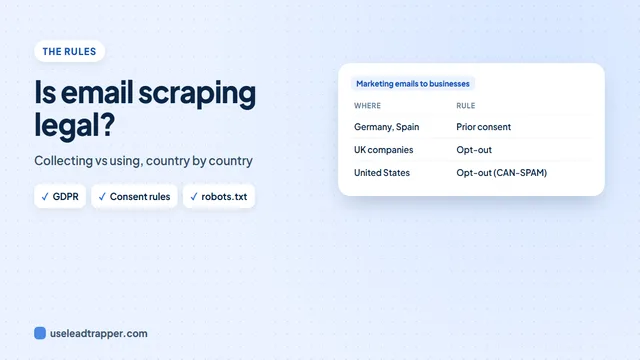
- The rules differ by country: the US has no business exception, the UK allows emails to companies but treats sole traders as individuals, and Germany expects consent.
- Small lists beat big blasts. Hunter found 5.8% replies for campaigns of 50 recipients or fewer and 2.1% for 1,000 or more.
Local business owners are busy and rarely read long emails. A cold email that works is short, specific to their business, and easy to answer. This guide covers the rules first, then how to build a local list, which address to use, how to write the message, and when to follow up. We make LeadTrapper, which finds the emails in some steps below, and we say so where it appears.
Start With the Rules, Briefly
Cold email to a business is legal in many countries if you identify yourself and give an opt-out, but the United States, the United Kingdom and Germany each set different conditions. Check the country of the person you write to, not your own. This is a summary, not legal advice; our guide on whether email scraping is legal goes deeper.
| Country | What the rule says | Official source |
|---|---|---|
| United States | CAN-SPAM has no business-to-business exception. Use accurate sender details, an honest subject, a clear note that it is an ad, a postal address and an opt-out honoured within 10 business days. Up to $53,088 per violating email (page updated January 2024, read 24 November 2026). | FTC CAN-SPAM guide |
| United Kingdom | The PECR email rule does not apply to corporate subscribers such as limited companies. Sole traders and some partnerships are individuals and need consent. Never hide your identity and give a valid opt-out. A named person’s work email is personal data under UK GDPR, and they can object. | ICO business-to-business marketing |
| Germany | Section 7 treats advertising email sent without the addressee’s prior express consent as an unacceptable nuisance, with no exception for businesses (read 24 Nov 2026). | German Unfair Competition Act (English) |
| Other EU countries | Rules vary by country under the ePrivacy Directive and the GDPR. Check the national regulator before you send. | Your national data protection authority |
The ICO’s advice for a doubtful case is useful everywhere: if you cannot tell whether an address belongs to a company or to a person, treat it as belonging to a person. In practice that means a one-owner plumber or a single-practitioner clinic may be a sole trader, so a phone call or a visit can be the safer first contact.
Build a Local List
The fastest way to list local businesses is Google Maps: search the business type and the town, such as “dentist in Leeds”, and work through the results. Each listing shows the phone, address, website and review count, and the website usually holds the email.
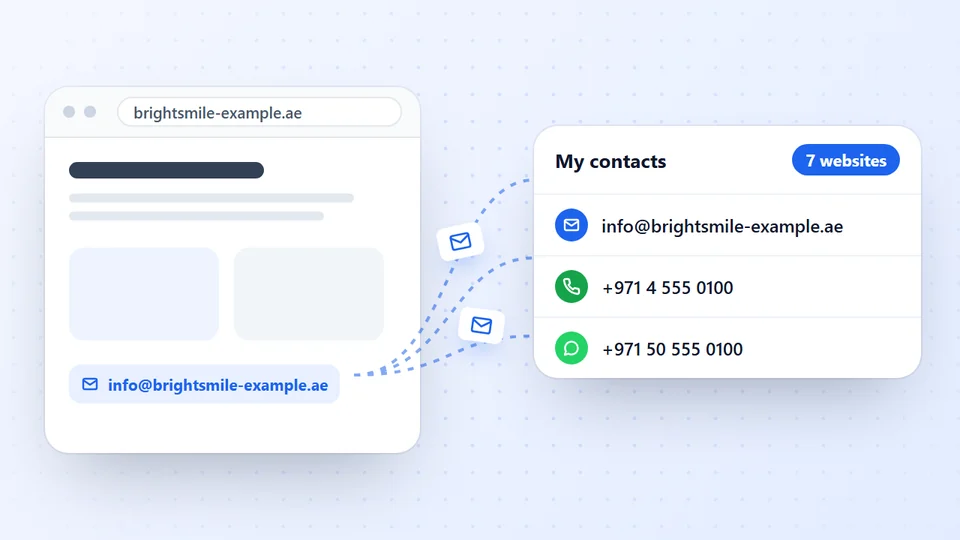
By hand, that is slow beyond twenty or thirty businesses. LeadTrapper’s Google Maps scraper lists the businesses of one type in one area on Windows, and the Email Finder then reads each business’s own website for the emails, phone numbers and WhatsApp numbers it publishes. Our guide to the Google Maps email extractor shows the full route from a search to a list of emails.
Keep the list small and specific. Hunter’s State of Cold Email 2025 report, based on emails sent in 2024 by Hunter’s own users, found 5.8% replies for campaigns of 50 recipients or fewer and 2.1% for campaigns of 1,000 or more. It is a vendor report, so treat it as a direction, not a promise. Thirty well-chosen businesses beat three hundred random ones.
Build your local list free for 14 days
Pick the Right Address
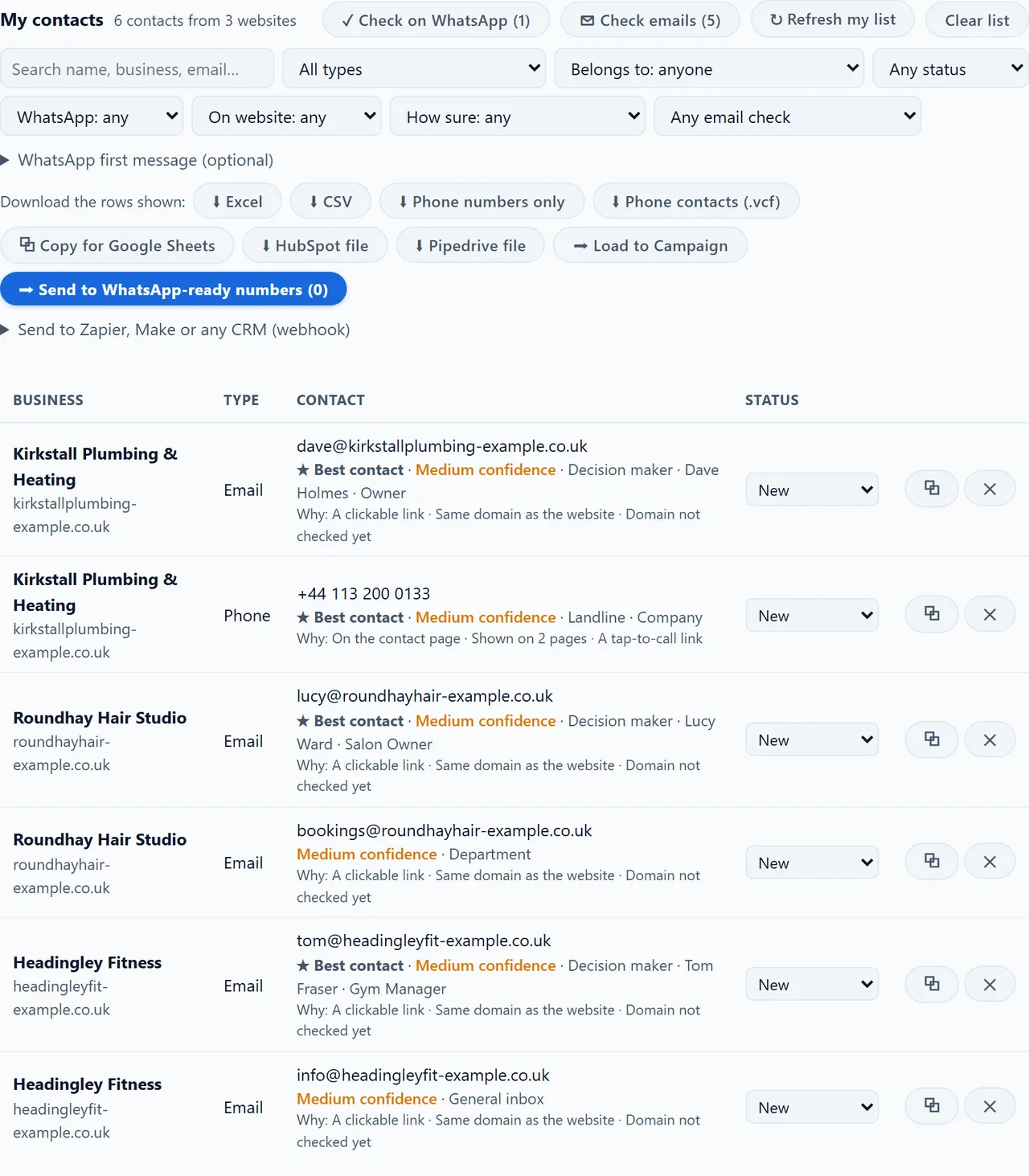
Write to the owner or manager when the business names them on its own website, and to the general inbox when it does not. A named owner is more likely to decide, while a general inbox is read by whoever opens the mail, who may pass it on.
Small businesses often publish only one address, such as info@ or hello@. That is fine. Address the message to the owner by name if you know it, or write “Hi, I’m writing to whoever looks after bookings” if you do not.
LeadTrapper’s Email Finder labels every email it finds as a general inbox, a department, a team member (with their name) or a branch, and marks owners, founders and managing directors as decision makers when the business names them itself. It never guesses an address from a name, and it never claims an email is verified: it shows how sure it is, with the reasons. See our guide on how to find business email addresses for the labels, and info@ against a personal email for which to choose.
Write a Short Email
A good first email has five parts: a subject that names their business, one sentence that proves you looked, one offer, one question, and your details with an opt-out. Local owners care about results such as bookings, calls and visits more than about long-term plans, according to a lemlist guide on pitching local businesses, which also advises asking questions rather than pointing out flaws.
- Subject: plain and specific, such as “Online booking for Smile Dental”. Hostinger’s guide to cold email suggests writing the subject you would open yourself.
- Opening line: something you actually saw, such as their booking page, a new branch or a recent review. Not “I came across your website”.
- Offer: one thing, in one sentence, tied to a result.
- Question: one easy yes or no, such as “Would a 10-minute call on Thursday help?”
- Footer: your name, business, postal address and a line like “If this is not useful, reply STOP and I won’t write again.”
A worked example. Priya runs a small web design studio in Leeds. In an example campaign she lists 40 dental clinics, finds that 31 publish an email, and sends 31 short emails over two days. If she gets Hunter’s 4.9% figure for campaigns with follow-ups, she should expect about one or two replies. That is a modest but realistic result. She wants two good conversations.
Templates by Situation
These are starting points. Change the details for every business; the templates only work when the specific line is true.
| Situation | Subject | Core message |
|---|---|---|
| Web designer to a clinic | Online booking for | “Your booking page asks patients to phone. I build simple online booking for clinics in . Would a 10-minute call on Thursday help?” |
| Photographer to a restaurant | Photos for the menu | “Your online menu has no photos, and your two nearest competitors have them. I shoot menus for restaurants in from 250 pounds (example price). Can I send three sample shots?” |
| Supplier to a cafe | Oat milk delivery in | “I deliver oat and almond milk to cafes in twice a week. Could I drop a free sample on Monday?” |
| Cleaner to an office | Office cleaning near | “I clean offices on and nearby. Who looks after cleaning for you? I can send a price for your size of office.” |
The , and `` fields are filled in for each message from your list. Here is the first one written out:
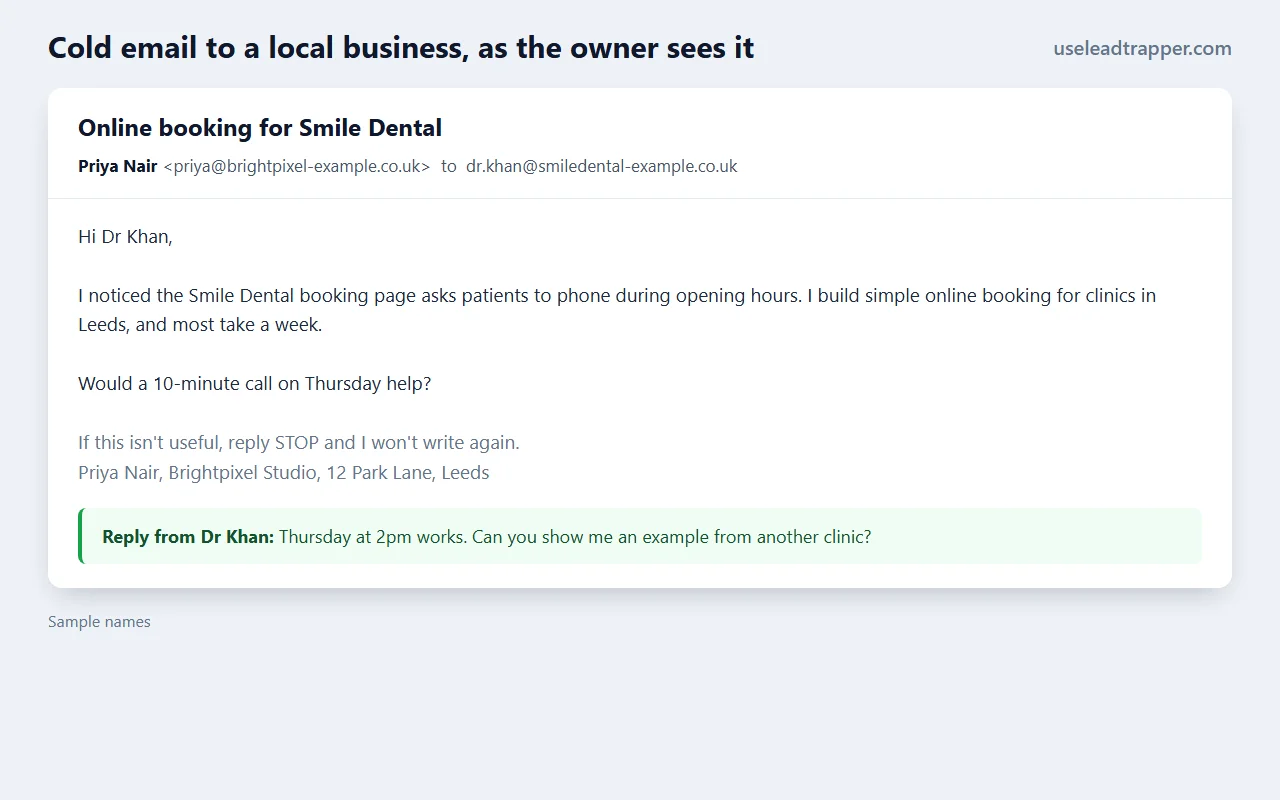
Hi Dr Khan, I noticed the Smile Dental booking page asks patients to phone during opening hours. I build simple online booking for clinics in Leeds, and most take a week. Would a 10-minute call on Thursday help? If this isn’t useful, reply STOP and I won’t write again. Priya Nair, Brightpixel Studio, 12 Park Lane, Leeds.
Follow Up, Then Stop
Follow up once or twice, about a week apart, and then stop. Hunter’s 2025 report found 4.9% replies for campaigns with follow-ups and 3% for campaigns without. Backlinko’s 2019 study of 12 million outreach emails, with data from Pitchbox, found that one extra follow-up raised replies by 65.8%. Both are vendor studies, and the second is old, so the direction matters more than the numbers.
Make each follow-up add something new: a sample, a price, or a one-line result from a similar business. Do not write “just bumping this”. If someone says no or asks you to stop, stop at once and keep their address on a do-not-contact list, because under UK GDPR the right to object to direct marketing is absolute (ICO).
Track who you have written to. LeadTrapper’s contact list lets you mark each contact as New, Contacted, Replied, Not interested or Customer, so a follow-up never goes to someone who has said no.
When Email Is the Wrong Channel
Email is the wrong first channel for sole traders in the UK, for businesses with no published email, and for countries where owners answer WhatsApp or the phone instead. In those cases, call, visit, or message on WhatsApp where that is normal and allowed.
Our guide on contacting a business without email covers the options. For WhatsApp, LeadTrapper’s WhatsApp Number Filter shows which numbers are on WhatsApp, and our guide to WhatsApp B2B outreach explains how to message businesses without getting your number restricted. For UK lists and where UK businesses publish their contacts, see B2B leads in the UK.
What LeadTrapper cannot do: it does not send email, it does not write your message, and it cannot find an email a business has not published. It finds and organises; the writing, sending and following the law are yours.
Where LeadTrapper Finds Leads
LeadTrapper collects leads from each of these sources in one Windows app, then checks the numbers and sends the WhatsApp messages from the same place.
- Google Maps Scraper: Business leads from any city.
- Facebook Scraper: Advertisers, pages and group members.
- Instagram Scraper: Leads from profiles and hashtags.
- TikTok Scraper: Creators, hashtags and commenters.
- LinkedIn Scraper: Profiles by role and city.
- Email Finder: Emails from business websites.
Frequently Asked Questions
Pick one type of business in one town, find the address the business publishes on its own website, and send a short message that names something specific about them. Say who you are, make one offer, ask one easy question, and add an opt-out. Follow up once or twice over the next two weeks.
Often yes, with conditions. In the US, CAN-SPAM covers business email too and needs your identity, an honest subject, a postal address and an opt-out. In the UK, emailing a limited company is allowed with your identity and an opt-out, but sole traders need consent. Germany expects consent. This is not legal advice.
Use the owner or manager when the business names them on its own website, and the general inbox when it does not. Small businesses often have only a general inbox, and a short message there that names the owner works. Our guide on info@ against personal emails compares the two.
One or two, about a week apart. Backlinko's 2019 study of 12 million outreach emails found one extra follow-up raised replies by 65.8%. Stop at once if the person says no or asks you to stop, and add them to a do-not-contact list.
Vendor figures range from under 1% to about 8%. Hunter's 2025 report averaged 4.1%, and Backlinko's 2019 study 8.5%. Both come from companies that sell outreach tools and measure different things, so use them as rough guides and track your own numbers.
No. LeadTrapper finds businesses on Google Maps and reads the emails each business publishes on its own website, but it does not send email. You send from your own mailbox. Its WhatsApp tools can send messages, which suits countries where businesses answer WhatsApp.
About LeadTrapper
LeadTrapper is a Windows app for finding business leads and contacting them on WhatsApp. It collects business contacts from Google Maps, Instagram, Facebook, TikTok, LinkedIn and business websites, checks which numbers are on WhatsApp with its Number Filter, and sends personalised campaigns with automatic delays from one or more WhatsApp accounts. It also has a chatbot, a shared inbox for every account, and Store Orders for online shops. It installs from the Microsoft Store, and the full app is free for 14 days, then $50 a year. Free web tools, browser extensions and a Wix app are listed on the Free Tools page.
A Local Business List With the Emails Each One Publishes
The Google Maps scraper and Email Finder come with LeadTrapper. $50/year, all features included.