In this article 8 sections
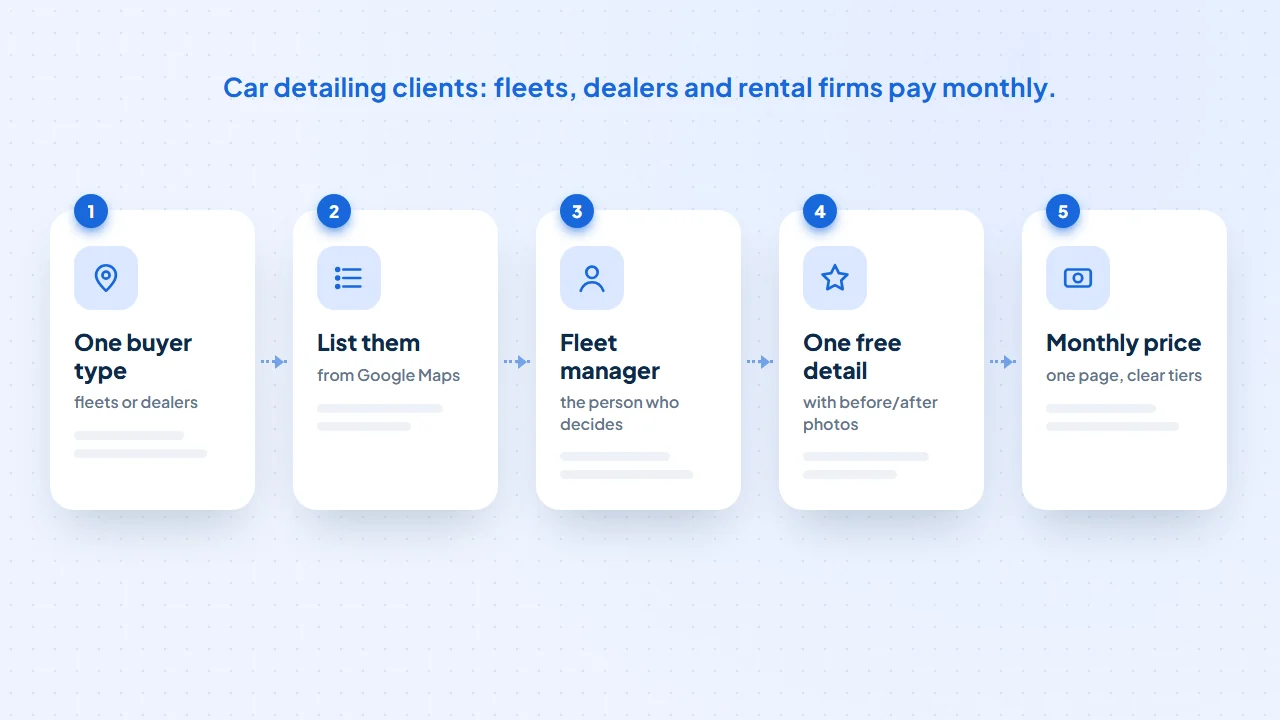
Target businesses that keep many vehicles clean: car dealerships, rental firms, taxi and delivery fleets, and trades with branded vans. List them from Google Maps, find the fleet or operations manager, and offer one free detail on one vehicle plus a one-page monthly price, such as $90 per vehicle for fortnightly exterior washes.
- One owner-driver pays once. A dealership, rental firm or van fleet pays every month, so one account can be worth dozens of single customers.
- Choose vehicles that must look clean for the business to work: sales stock, rental cars, taxis and ride-hail cars, and branded vans for trades and estate agents.
- List every dealer, rental office and fleet-heavy trade in your area from Google Maps. Then ask the main line who handles vehicle vendors, because the buyer is rarely the owner.
- Offer one free detail on one vehicle, send before-and-after photos, and follow with a one-page price within 24 hours.
- Keep wash water out of storm drains. In the US, the EPA says storm drains lead to local waterways, not treatment plants, and many fleet buyers ask about this.
A detailer who relies on private customers starts from zero each month. A detailer with five fleet and dealer accounts starts each month with booked work. The businesses that need vehicles cleaned all the time are easy to find and easy to list, but most of them do not advertise for a detailer. This guide shows how to find them, whom to ask for, and what to offer. We make LeadTrapper, which we use in some steps below, and we say so where it appears.
Who Buys Detailing Every Month
Commercial buyers pay for clean vehicles because the vehicles earn money or sell the business. Each type has a different pattern:
| Buyer | What they need | Buying trigger | Who books |
|---|---|---|---|
| Used and new car dealerships | Preparing stock before sale, showroom cars | New stock arrives, trade-ins, weekend sales | Used-car manager or general manager |
| Car and van rental offices | Cleaning between rentals, deep clean at intervals | Busy seasons, bad reviews about cleanliness | Branch or fleet manager |
| Taxi, minicab and ride-hail operators | Interior cleans, odour removal | Rating drops, driver turnover | Operations manager or owner |
| Trades with branded vans (plumbers, electricians, HVAC, roofers) | Exterior washes, interior tidy | Company image, new vehicle livery | Owner or office manager |
| Estate agents and property managers | Company cars that clients ride in | New hires, viewing days | Branch manager |
| Delivery, courier and landscaping fleets | Exterior maintenance, interior | Regular schedule | Dispatch or fleet manager |
| Driving schools | Cars used all day by learners | Start of term | Owner |
| Offices | On-site detailing in the staff car park as a perk | HR wellbeing budgets, new office opening | HR or office manager |
One detailing guide recommends local businesses with branded vehicles such as real estate brokerages, trades, used-car dealerships and property managers, and says to skip government contracts, long-haul trucking and companies that need committee approval (DetailPro, read on 24 November 2026). Another says used-car lots are a steady niche, giving an example of 10 to 20 cars a week at $60 to $100 each, which the author gives as an illustration, not market data (read on 24 November 2026).
Large corporate fleets often have approved-supplier lists and tender processes. That is a second stage. Local fleets of 5 to 25 vehicles are where a small detailer wins first.
List Them From Google Maps
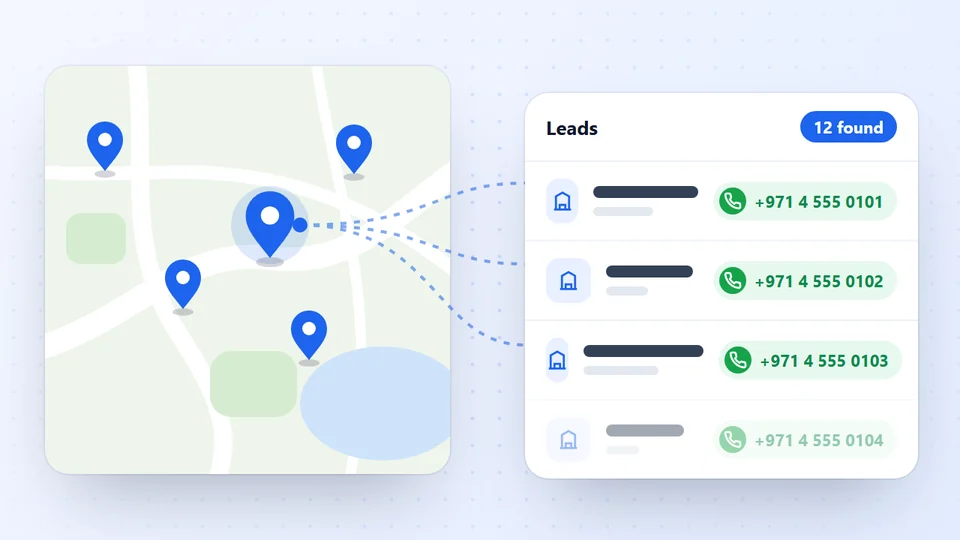
Search Google Maps for each buyer type and your area, such as “used car dealer Birmingham”, “car rental Tampa”, “taxi service Leeds”, “plumber Phoenix” or “estate agent Sydney”. Each listing shows phone, address, website, rating and review count. One search shows about 120 places, so a big area needs several searches by district.
LeadTrapper’s Google Maps scraper does this on Windows. You type the business type and the area, it searches area by area until no new businesses appear, and you export a CSV. Sort the export by address to plan routes, since accounts close together mean shorter travel between jobs. The guide to getting more than 120 Google Maps results explains the method.
What a list looks like. In our own test on 24 September 2026, a full scan for dentists in Amman returned 160 businesses in about 21 minutes, with 99% showing a phone number, 69% a website and 15% an email address (see the full Google Maps scan results). Car dealers will show a similar pattern: a phone on nearly every listing, a website on most, and an email on a minority. So the phone is your first contact.
Useful signals on the list.
- Reviews that mention dirty cars. For rental offices and taxi firms, search the reviews for “dirty”, “smell” or “sticky”. A business whose customers complain has a reason to take your call.
- Many vehicles in the photos. Maps photos of a dealership forecourt, a depot or a row of branded vans show the size of the fleet before you call.
- Branches. The same rental brand at several addresses means several sites to serve.
- New businesses. A listing with few reviews is often a new dealer or depot, and new sites often need to set up suppliers. Rerun your search every quarter and compare.
Our guide to finding clients for a commercial cleaning business uses the same list-and-trigger method for buildings.
Find the Person Who Books
The owner of a large dealership rarely arranges detailing. The person who does is lower down and answers a different phone. In a small business, the owner decides.
| Business size | Who usually decides | How to reach them |
|---|---|---|
| Owner-run, up to about 10 vehicles | The owner | The main number, early morning or end of day |
| 10 to 50 vehicles | Fleet manager, operations manager, shop foreman or dispatcher | Ask the main line who handles vehicle vendors |
| Larger | Fleet or facilities manager with approved suppliers | A trial request through the manager and a supplier form |
One guide suggests building a list of 10 named companies with a specific contact such as an owner or office manager, and asking the main line who handles vehicle vendors (DetailPro, read on 24 November 2026).
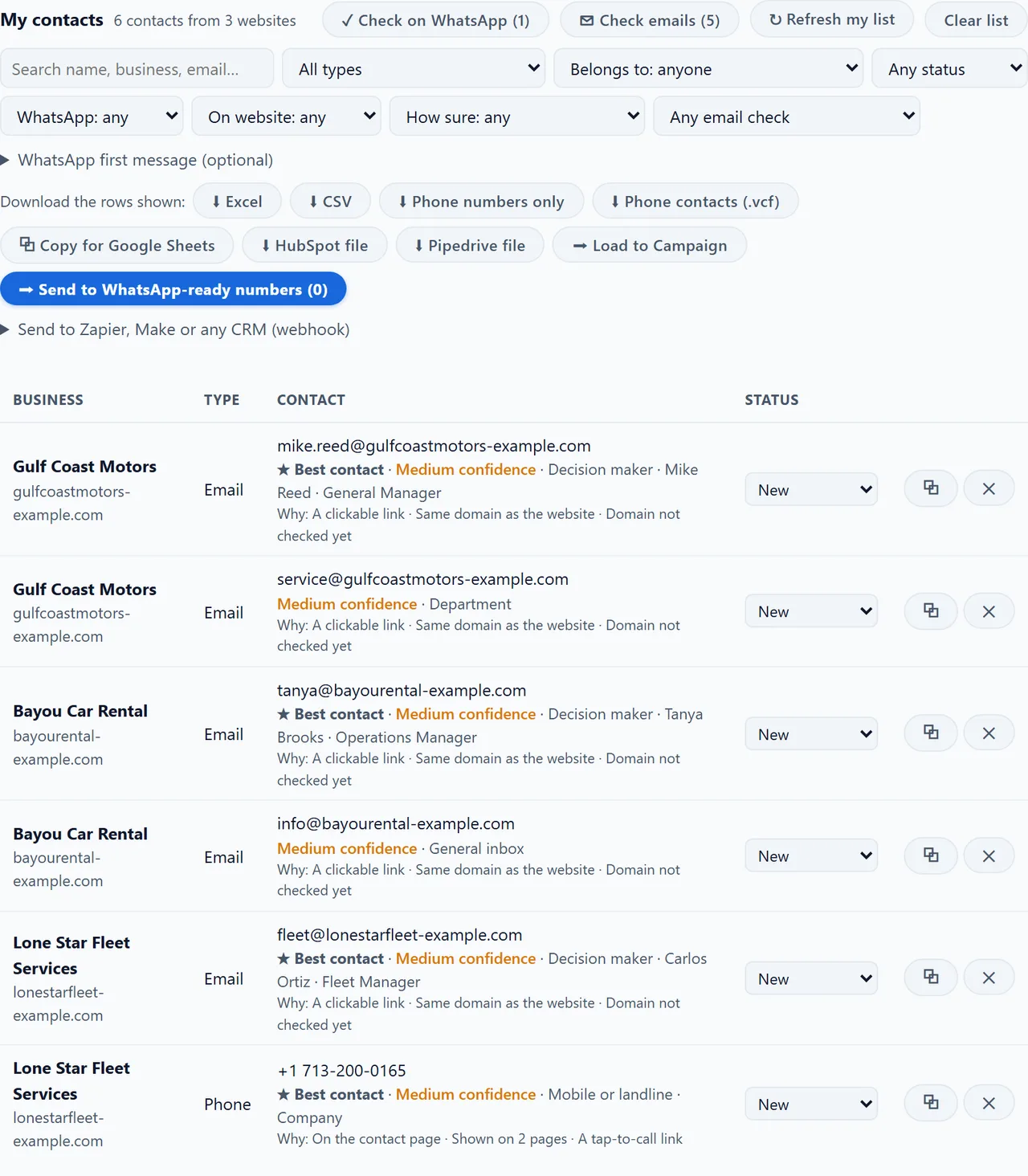
LeadTrapper’s Email Finder reads each business website, including contact, team and branch pages, and collects the emails, phone numbers and WhatsApp numbers the business publishes. It labels each email as a general inbox, a department, a named team member or a branch, and marks owners and directors as decision makers. Small trades and dealers often publish only a general inbox, so use the phone to ask who handles vehicles. Our guide to finding the decision makers in a company shows the method.
Build your prospect list free for 14 days
The Trial Vehicle Offer
Fleet managers do not pick a detailer from a flyer. They want to see their own vehicle clean and know you will turn up again. The detailing guides agree on a simple order:
- Call and ask one question. “Who looks after cleaning your vehicles?” Then offer one free detail on one vehicle at a time that suits them.
- Do the trial and photograph it. Take before-and-after pictures and send them straight to the decision maker, not only to the person you met.
- Send a one-page price within 24 hours. One guide recommends three tiers: a basic maintenance wash, an interior and exterior refresh, and a premium service (DetailPro, read on 24 November 2026).
- State the schedule. A fixed day and time each cycle, and a confirmation the week before.
- Offer a paid trial for a bigger fleet. One guide suggests a paid trial visit on two vehicles before a contract (Blue Ridge Mobile Detail, read on 24 November 2026).
A worked example. You are a mobile detailer in Tampa. You list 60 car rental offices, taxi firms and plumbing and HVAC companies from Google Maps. You call 20 and get through to 8 managers. Four accept a free exterior wash on one vehicle.
You do those four trials in a week, send photos, and a 12-van HVAC company says yes to fortnightly exterior washes at $90 a van. That is about $1,080 per visit round, or about $2,160 a month at two rounds. A taxi firm takes a monthly interior clean of 8 cars at $120 each, about $960 a month. These numbers are a worked illustration, not a forecast.
Pricing and Contract Terms
Fleet pricing is per vehicle, set by service level and frequency. The figures below are example prices from one detailing guide, written for the US market. Use them as a starting point and check your own costs (DetailPro, read on 24 November 2026):
| Service | Example price per vehicle |
|---|---|
| Basic exterior maintenance wash | $40 to $75 |
| Interior and exterior detail | $80 to $150 |
| Premium full detail with protection | $150 to $250 |
The same guide suggests aiming for contracts worth at least $400 a month, treating accounts under 4 vehicles as not worth the overhead unless they book premium service (its own FAQ says 5), and giving 10 to 15% off for 8 or more vehicles a month as your main concession.
Another guide suggests exterior maintenance every 2 to 4 weeks and a full detail every 2 to 3 months, though its FAQ gives a different range (Blue Ridge Mobile Detail, read on 24 November 2026). Ask each client how often they need it.
Put it on one page. A short agreement that covers the services included, price per vehicle, billing date, locations, visit days and a service window, how keys are handled, what triggers a re-quote (fleet size, vehicle condition, extra services), and a 30-day cancellation clause. Photograph each vehicle before and after so billing disputes are settled quickly. Ask for a referral about 60 days after the first invoice, once the service has been steady.
Wash Water, Insurance and Site Rules
Three things can end a fleet account early. Handle them before you start.
Wash water. The EPA’s best practice sheet on vehicle maintenance and washing says storm drains lead directly to local waterways, not to treatment facilities. It says most stormwater problems from car washing come from residents, fleet activities and charity car wash fundraisers that send polluted wash water into the storm drain system, and notes that commercial car washes often recycle or treat their water first (checked on 24 November 2026).
Many cities and states therefore expect mobile detailers to cover or avoid drains and capture or contain wash water, and some require a permit to discharge to a sewer. Check with your local stormwater or environmental office. Rules outside the US differ.
Insurance. One guide says fleet buyers expect proof of general liability and commercial auto insurance before you work on their vehicles (Blue Ridge Mobile Detail, read on 24 November 2026). Get the certificates ready and name the client as an additional insured if they ask. Ask your insurer what covers damage to a customer’s vehicle while in your care.
Access and safety. Check that the site has water and power or that you bring your own, where you may park, when vehicles are available, and who signs for keys. A dealer’s forecourt and an office car park have different rules, so ask the manager in writing.
Contact Them Within the Rules
Phone first, then a short email or WhatsApp message with your trial offer. Each country has its own rules.
- US email. The FTC’s CAN-SPAM guide says the law makes no exception for business-to-business email. It requires your physical postal address and an opt-out you honour within 10 business days, and lists penalties of up to $53,088 per email (checked on 24 November 2026).
- UK email. The ICO’s guidance on electronic mail marketing says you can email any corporate body, but sole traders and some partnerships count as individuals and need consent. A self-employed taxi driver or one-van tradesman may be on that side, so call instead (checked on 24 November 2026).
- WhatsApp. Many small fleets answer WhatsApp. LeadTrapper’s WhatsApp Number Filter shows which numbers are on WhatsApp, and our guide to WhatsApp B2B outreach covers how to message businesses without getting your number restricted.
- More countries. See whether email scraping is legal. This is not legal advice.
A first message might read:
Hi Dave, I run a mobile detailing service in Tampa and wash vans for HVAC firms nearby. I’d like to do one of your vans free this week, photograph it, and send you a one-page price for the whole fleet. Who handles vehicles at your firm? If you’d rather not hear from me, reply STOP.
Private Customers, Briefly
Private customers are easier to reach but pay once, and LeadTrapper is for business lists, not for scraping individuals. For private work, use your Google Business Profile, ask every customer for a review, post before-and-after photos on local social pages, and offer a simple monthly maintenance plan. A few repeat private customers fill the gaps between fleet visits, and neighbours of your fleet clients are the easiest to reach.
LeadTrapper builds the business list and finds the contact details a business publishes. It cannot count a firm’s vehicles, tell who is unhappy with their current detailer, or replace the trial wash. Those parts stay with you.
Where LeadTrapper Finds Leads
LeadTrapper collects leads from each of these sources in one Windows app, then checks the numbers and sends the WhatsApp messages from the same place.
- Google Maps Scraper: Business leads from any city.
- Facebook Scraper: Advertisers, pages and group members.
- Instagram Scraper: Leads from profiles and hashtags.
- TikTok Scraper: Creators, hashtags and commenters.
- LinkedIn Scraper: Profiles by role and city.
- Email Finder: Emails from business websites.
Frequently Asked Questions
Pick one commercial buyer type, such as car dealers or van fleets, list every one in your area from Google Maps, find the fleet or operations manager, and offer a free detail on one vehicle. Send before-and-after photos and a one-page monthly price within 24 hours. Add private customers through local groups and reviews.
Start with small local fleets of 5 to 25 vehicles, such as contractors, delivery firms, estate agents and rental offices, which are easier to win than large corporate or government fleets. Offer a trial on two vehicles, agree scope, schedule and price in a one-page contract, and show proof of liability insurance.
Dealerships preparing used cars for sale, rental offices cleaning cars between rentals, taxi and ride-hail operators whose interiors affect ratings, trades with branded vans, estate agents with company cars, driving schools, and offices that offer detailing to staff in the car park as a perk.
Quote per vehicle, by service level. Example prices only: $40 to $75 for an exterior maintenance wash, $80 to $150 for an interior and exterior detail, and $150 to $250 for a full detail with protection, according to one detailing guide. Many detailers give 10 to 15% off for 8 or more vehicles a month.
Fleet buyers usually ask for proof of general liability insurance, and often commercial auto cover, before you start. Wash water is regulated: in the US the EPA says storm drains lead to local waterways, and local rules often require capturing or containing wash water. Check with your city or state stormwater programme.
It builds the list. The Google Maps scraper lists businesses of a type in a city with phone, website, rating and review count, and the Email Finder reads each site for emails, phone numbers and the owner or manager names the business publishes. It cannot tell you how many vehicles a company runs, so ask when you call.
About LeadTrapper
LeadTrapper is a Windows app for finding business leads and contacting them on WhatsApp. It collects business contacts from Google Maps, Instagram, Facebook, TikTok, LinkedIn and business websites, checks which numbers are on WhatsApp with its Number Filter, and sends personalised campaigns with automatic delays from one or more WhatsApp accounts. It also has a chatbot, a shared inbox for every account, and Store Orders for online shops. It installs from the Microsoft Store, and the full app is free for 14 days, then $50 a year. Free web tools, browser extensions and a Wix app are listed on the Free Tools page.
Every Dealer, Rental Office and Fleet in Your Area, in One List
The Google Maps scraper, Email Finder, Number Filter and WhatsApp tools all come with LeadTrapper. $50/year, all features included.