In this article 8 sections
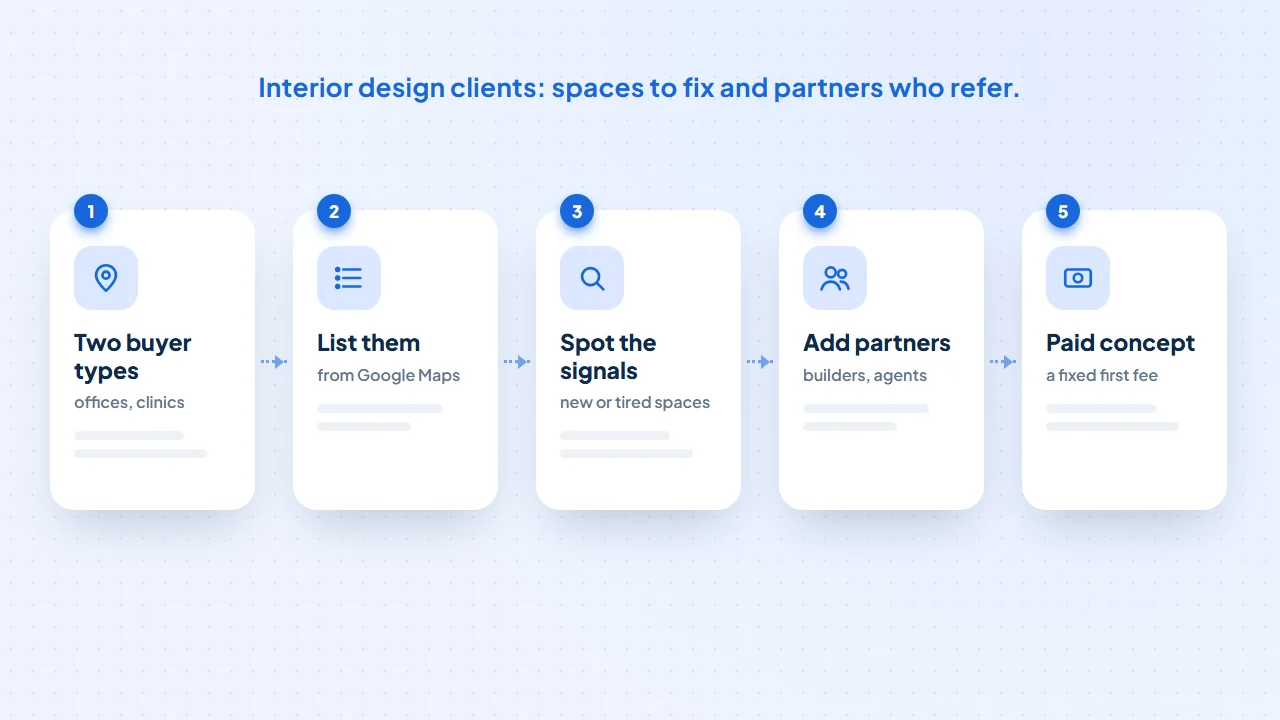
Go after commercial spaces that are being opened, refitted or sold: clinics, restaurants, offices, hotels and holiday lets. Build a Google Maps list of one type in your city, spot new or tired spaces, and offer a paid concept for a fixed fee, such as $1,500 for a reception redesign. Then add referral partners: builders, architects and estate agents.
- Homeowners come one at a time. Clinics, restaurants, hotels, holiday-let hosts and developers each have several spaces and refit them on a cycle, so one good project leads to the next.
- Buying triggers are visible: a new lease, a new opening with few reviews, a planning application, a refurbished competitor, or a season about to start.
- Builders, architects, estate agents and kitchen suppliers meet your future clients before you do. A written one-page referral offer works better than a coffee and a hope.
- Sell a paid first step: a concept, a layout plan or a survey for a fixed fee. It filters out people who only want free ideas and it shows how you work.
- Check your local rules. Some US states and other countries regulate who may use the title interior designer or sign off commercial plans.
Interior design is often sold house by house, through a friend’s recommendation. That is fine for a first year. Growth gets easier when you sell to businesses, because a business has several rooms, several sites and a reason to refit on a schedule. It also gets easier when you build a small network of people who meet your clients before you do. This guide covers both. We make LeadTrapper, which we use in some steps below, and we say so where it appears.
Who Buys Interior Design
Commercial and investor buyers choose a designer for the result, not only for taste, so the offer is different from a homeowner’s. Each type below has a different trigger:
| Buyer | What they need | Buying trigger | Who decides |
|---|---|---|---|
| Medical and dental clinics | Reception, waiting room, treatment rooms | New site, new owner, rebrand | Owner or practice manager |
| Restaurants, cafes, bars | Layout, lighting, seating, atmosphere | New opening, new concept, falling reviews | Owner |
| Offices and co-working spaces | Layout, meeting rooms, reception | New lease, team growth, return-to-office plans | Office or operations manager |
| Boutique hotels and guest houses | Rooms, lobby, public areas | Refurbishment cycle, new owner, peak season ahead | Owner or general manager |
| Holiday-let and short-stay hosts | Furnishing, styling, photo-ready rooms | New property, poor reviews, season start | Host or property manager |
| Developers and show-home builders | Show homes, marketing suites, finishes | Launch date, sales slowing | Sales director or project lead |
| Estate agents and sellers | Staging and light styling before sale | A listing that has not sold | Agent or seller |
One design guide lists short-term real estate investors, flippers, buy-renovate-rent investors and boutique hotel owners as B2B targets, and notes cold outreach is accepted in B2B (DesignFiles, read on 24 November 2026). Another says realtor relationships are often stronger in high-end new construction than in resale markets (Interior Design Community, read on 24 November 2026).
Pick two types that match your portfolio. “We design reception areas for private clinics” gets a clearer reply than “we design interiors”.
List Them From Google Maps
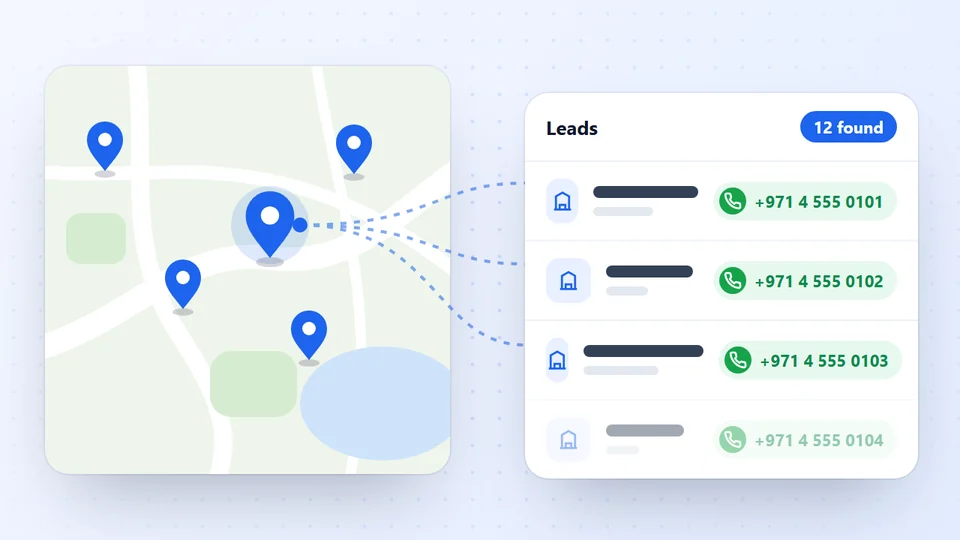
Search Google Maps for each type and your city, such as “dental clinic Leeds”, “boutique hotel Bath” or “vacation rental agency Denver”. Each listing shows phone, address, website, rating and review count. One search shows about 120 places, so a big area needs several searches by district.
LeadTrapper’s Google Maps scraper does this on Windows. You type the business type and the city, it searches area by area until no new businesses appear, and you export a CSV. The guide to getting more than 120 Google Maps results explains the method.
What a list looks like. In our own test on 24 September 2026, a full scan for dentists in Amman returned 160 practices in about 21 minutes. 99% had a phone number, 69% a website and 15% an email address on the listing or homepage (see the full Google Maps scan results). For a designer that means the phone gets you to the manager, and the website shows the space.
Search each category separately (hotel, guest house, restaurant, gym, coworking space) and keep a column for the type.
Spot a Space That Needs You
You can see the need from your desk. Use the listing photos, the website and the reviews:
- Tired rooms in photos. Dated furniture, harsh lighting and cluttered reception areas show up in the Maps photo tab.
- Reviews about the space. Search a business’s reviews for “dark”, “cramped”, “noisy”, “dated” or “uncomfortable”. Those words are your opening line.
- New or just opened. A listing with only a few reviews is often a new site, and a new site needs a finished interior or the next phase.
- Competitor refits. A competitor opening a stylish new site pushes the others to respond.
- Planning and building permits. In many places the council or city publishes planning applications and building permits online. A fit-out of a clinic, a change of use for a shop, or a new hotel extension means a client with a deadline. Check how your local authority publishes them.
- Season. Holiday-let hosts and hotels want refreshes before peak season. Restaurants refit in quiet months.
Write the weak point next to each business in your sheet and use it as the first line of your message. LeadTrapper gives you ratings and review counts to sort by, but it does not read images or review text, so this step is yours.
Referral Partners
Many designers say referrals from other professionals are their strongest source. They meet the client at the moment the client decides to spend money. Build a short list of partners, give each a one-page note about what you design and how to introduce you, and keep in touch.
| Partner | Why they meet your client first | What you offer |
|---|---|---|
| General contractors and builders | Clients ask them for design help during a build | A designer who writes clear specs and respects lead times |
| Architects | They design the shell, clients need the inside | Joint presentations, a handover from their plans to your finishes |
| Estate and letting agents | They see tired homes and holiday lets | Staging for listings, a fee or swap for referrals |
| Kitchen, bathroom and furniture showrooms | Customers ask who can help with the whole room | A trade account and a referral swap |
| Mortgage brokers and relocation firms | Clients are moving in | A move-in styling package |
| Other designers with a different niche | They turn away jobs that are not theirs | An exchange of leads |
One guide suggests choosing five to ten allied professionals, giving them a one-page brief on your niche and how to introduce a client, and offering joint presentations or co-hosted walkthroughs (Design Ink Co, read on 24 November 2026). Another suggests formal referral fees of 10 to 15%, or a referral swap, with home decor stores and estate agents (DesignFiles, read on 24 November 2026). Those are the authors’ suggestions. Check that fees are allowed where you work: some professional bodies and local laws limit referral fees.
Find partners on the same Google Maps list: search “general contractor”, “home builder”, “architect”, “kitchen showroom” and “real estate agency” in your city. Build trust before you ask for leads: send a short note after a project, refer clients back, and show up on site when promised.
Find the Decision Maker
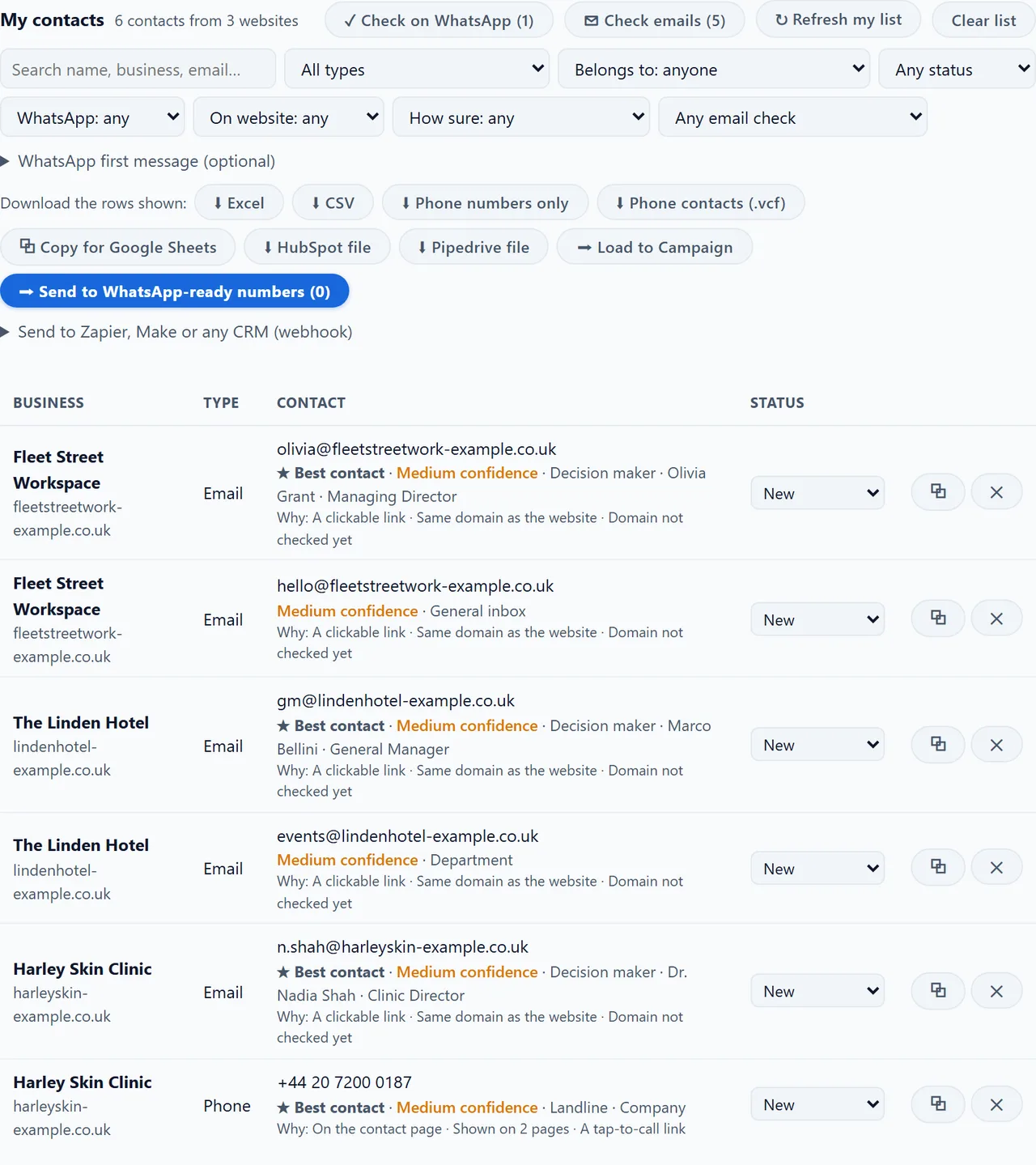
LeadTrapper’s Email Finder reads each business website, including contact, team and branch pages, and collects the emails, phone numbers and WhatsApp numbers the business publishes. It labels each email as a general inbox, a department, a named team member or a branch, and marks owners and directors as decision makers. If a business shows no email on its site, you can tick a box to check its Facebook and Instagram page. For hotels and chains, general managers and owners are usually named on an about or team page. Our guide to finding the decision makers in a company shows the method.
For developers and larger groups, the person who commissions design is often a project director or sales director. LeadTrapper’s LinkedIn scraper lists profiles by job title and city, with name, headline and location. It collects no contact details, and LinkedIn bans scraping, so the risk is yours; read whether LinkedIn allows scraping. For small owner-run places, call and ask for the owner.
Build your client list free for 14 days
A First Offer Worth Paying For
Free ideas attract people who will not hire you. A paid first step shows commitment, shows how you work and counts towards the full fee if the client goes ahead. Example prices only, set yours from your hours and local market:
| First step | What the client gets | Example price |
|---|---|---|
| Reception concept | Layout, mood board, materials and a budget range | $1,500 |
| Holiday-let styling day | Furniture plan, shopping list and styling on the day | $600 |
| Site survey and options | Measured plan, 2 layout options, rough cost bands | $900 |
| Show-home package | Furniture schedule, styling, delivery coordination | quoted by the unit |
A worked example. You design for private dental clinics in Bristol. You list 90 clinics from Google Maps, check their sites and reviews, and shortlist 15 with dated waiting rooms or reviews that mention the space. You also list 12 builders and 8 estate agents for partner outreach. You write to the 15 clinics:
Hi Dr Patel, your reviews are warm about the team, but three mention a cramped waiting room. I design reception areas for private clinics in Bristol. For $1,500 I’d give you a layout, materials and a budget range within two weeks, and I’d credit that fee against the build if you go ahead. If this isn’t useful, reply STOP and I won’t write again.
If two clinics say yes, that is $3,000 in concept fees, plus two reference spaces for the next 13. Those numbers illustrate the method, not a typical response rate.
Where Clients Are Listed
Different sources show different stages of a project. Use them together:
| Source | What it shows | How to use it |
|---|---|---|
| Google Maps | Every business of a type, with ratings and photos | The base list; rerun each quarter |
| Business websites | Owner, managers, team page, photos | Find the decision maker and judge the space |
| Council or city planning and permit portals | Fit-outs, new builds, change of use | Contact applicants at the right moment |
| Chamber of Commerce and trade association member lists | Active local businesses | Cross-check and meet at events |
| Industry directories such as NKBA | Buyers already searching for a pro | One guide notes these need a complete profile and sometimes fees (Interior Design Community, read on 24 November 2026) |
| Property portals | New listings and long-stay listings | Spot staging opportunities |
| Your past clients | Their friends and colleagues | Ask at the three-month check-in |
To compare with other trades that sell to the same buildings, our guide to finding clients for a commercial cleaning business shows how a trade that follows designers into the same spaces finds its clients, and our guide to finding clients for a photography business covers the photographers who will shoot your finished projects.
Rules to Know Before You Pitch
Interior design regulation. Rules vary widely. ASID’s government and public affairs FAQ describes the two main kinds of US state law: title acts, which control who can use a designation such as registered or certified interior designer, and voluntary practice acts, which can give authority to stamp and seal plans. Some states restrict the practice itself.
Many practice rules exempt residential work and include other exemptions. If you work on commercial fit-outs that need permits, check with your state board, or the equivalent body in your country, before you advertise. The UK has no licence. This is not legal advice. (ASID link taken from search results on 24 November 2026; check the page for the current text.)
Email rules. The FTC’s CAN-SPAM guide says there is no exception for business-to-business email, requires your postal address and an opt-out honoured within 10 business days, and lists penalties of up to $53,088 per email (checked on 24 November 2026). In the UK, the ICO’s guidance on electronic mail marketing says you can email any corporate body, but sole traders and some partnerships count as individuals and need consent (checked on 24 November 2026). A one-person cafe or single-dentist practice may fall on the individual side, so call them. See whether email scraping is legal for more countries.
WhatsApp. In many countries managers answer WhatsApp. LeadTrapper’s WhatsApp Number Filter shows which numbers are on WhatsApp, and our guide to WhatsApp B2B outreach covers how to message businesses without getting your number restricted.
LeadTrapper builds the list and finds contacts. It does not read permits or judge photos, and it cannot replace a relationship with a builder. Those parts stay with you.
Where LeadTrapper Finds Leads
LeadTrapper collects leads from each of these sources in one Windows app, then checks the numbers and sends the WhatsApp messages from the same place.
- Google Maps Scraper: Business leads from any city.
- Facebook Scraper: Advertisers, pages and group members.
- Instagram Scraper: Leads from profiles and hashtags.
- TikTok Scraper: Creators, hashtags and commenters.
- LinkedIn Scraper: Profiles by role and city.
- Email Finder: Emails from business websites.
Frequently Asked Questions
Pick one or two buyer types, such as dental clinics and holiday-let hosts, list every one in your area from Google Maps, and look for new or tired spaces. Contact the owner or manager with a fixed-fee first step. At the same time, build five to ten referral relationships with builders, architects and estate agents.
Businesses with customer-facing spaces and money to spend on them: medical and dental clinics, restaurants and cafes, offices, boutique hotels, holiday-let and short-stay hosts, gyms, and property developers who need show homes. Multi-site groups are worth more than single sites because they refit on a schedule.
Through referrals from builders, architects, estate agents and furniture suppliers, local search with a Google Business Profile, direct contact with businesses that have a space to improve, and local business or property events. Instagram helps clients check you out, but one design blog notes it often brings price shoppers.
Offer a fixed-fee first step instead of a full-project quote. Example prices only: a layout and mood-board concept for a reception for $1,500, a styling day for a holiday let for $600, or a site survey and options report for $900. A paid first step shows how serious the client is.
It depends on where you work. Some US states restrict the title 'interior designer' or require registration for commercial work, others do not regulate it, and the UK has no licence. Check your state board, CIDQ or ASID chapter, or your country's equivalent before you advertise commercial work.
It finds the businesses and their contacts. The Google Maps scraper lists businesses of a type in a city with phone, website, rating and review count, and the Email Finder reads each site for emails, phone numbers and the owner or manager names the business publishes. It cannot see planning applications or tell who is about to refit.
About LeadTrapper
LeadTrapper is a Windows app for finding business leads and contacting them on WhatsApp. It collects business contacts from Google Maps, Instagram, Facebook, TikTok, LinkedIn and business websites, checks which numbers are on WhatsApp with its Number Filter, and sends personalised campaigns with automatic delays from one or more WhatsApp accounts. It also has a chatbot, a shared inbox for every account, and Store Orders for online shops. It installs from the Microsoft Store, and the full app is free for 14 days, then $50 a year. Free web tools, browser extensions and a Wix app are listed on the Free Tools page.
Every Clinic, Hotel and Restaurant in Your City, in One List
The Google Maps scraper, Email Finder, Number Filter and WhatsApp tools all come with LeadTrapper. $50/year, all features included.